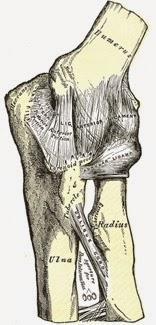
 The elbow joint is often referred to as a “hinge joint,” much like a door hinge that allows two movements, swinging open and closed, or, in the case of the elbow, flexing and extending. However, this is a bit simplistic, as just beyond the place where the upper arm bone, the humerus, and the lower arm bones, the ulna and the radius, meet to form the elbow joint is another important joint that adds a few more movements into the mix. This is the connection between the two forearm bones themselves. The top part of the radius and ulna abut one another in such a way that the forearm bones can roll over one another, which ultimately allow the palm of the hand to spin up and down, as in the action of giving and receiving some “skin.” To the untrained eye, this seems like “rotation” of the wrist joint, but in actuality, it starts at the elbow joint and has the fancy names of supination and pronation. And, like the knee joint, the elbow joint also has ligaments on the inner and outer aspect of the joint to keep the upper and lower arm bones from bowing in and out. Cartilage coats the bony ends of the elbow joint bones to keep them flowing smoothly over one another as we move the arm around.Like many of the other joints of the body, the elbow is subject to wear-and-tear arthritis, problems that arise from injury, repetitive stress on the ligaments and tendons near the joint, and unusual skeletal variations. The most common source of elbow soreness and pain in my students by far is of the repetitive stress variety, so I’d like to focus on those for the rest of this blog. And, of the many possible causes of such repetitive stress, working at the computer is way at the top of the list. As a family doc, when my patients came in with elbow soreness and pain at the outer edge of the elbow, I’d diagnose them with “tennis elbow” and if the pain was on the inner elbow, it would be tagged as “golfer’s elbow,” even if they did not play tennis or golf! The underlying problem was really the repetitive action, whatever its source, leading to a chronic inflammation of the tendons in those areas that is called “tendonitis.” And this is probably what I was kicking up in my own elbows when playing my fiddle. The areas involved are often tender to touch and also painful when you flex or extend your elbow, or even when you flex and extend your wrist (which could be confusing, eh?).Addressing Elbow Pain with YogaAn initial approach to addressing this kind of elbow pain would be to avoid the repetitive movement that precipitates it, even if certain yoga poses might normally require such a movement. This means you have to be willing to improvise and change the appearance of poses as needed to keep the joint relatively quiet. Non-weight bearing poses for the arms are a good idea initially, so as to reduce the additional pressure and demands on the elbow joint that poses such as Downward-Facing Dog pose (Adho Mukha Svanasana) and Upward-Facing Down Dog (Urdva Mukha Svanasana) bring into the elbow. Choosing to focus on poses where your elbows are fully straight and extended, such as Warrior 1 and 2 (Virbradrasana 1 and 2), Triangle pose (Trikonasana) and Extended Side Angle pose (Uttitha Parsvokanasa), is a great starting place, and also has the added benefit of moving your shoulder joints through a pretty full range of motion, which could have positive effects on your elbows. Eventually exploring poses that bring your elbow joints into play with weight bearing on the joints should be done mindfully. You want to try and maintain the full movement of the elbow joint without worsening the pain. Start with Eagle pose arms (Garudasana), and if that feels OK, advance to Cow-Faced pose (Gomukasana) arms, which adds more deep bend to the joint. See Standing Shoulder Stretches.
Eagle Pose Arms

Cow-Face Pose Arms
I also find that Wrist Flossing can be beneficial for the elbows as well as the wrists, so take that for a test spin, too!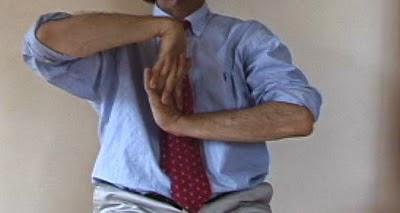

Subscribe to YOGA FOR HEALTHY AGING by Email ° Follow Yoga for Healthy Aging on Facebook