


~ contributed by Jodi Kearns & Abigail Williamson; Abby is a University of Akron history major who worked with the Wispé collection for her Museums & Archives Studies certificate Capstone Experience.
In the early 1950s, Lauren G. Wispé set out to study social and psychological factors associated with eminence in the field of psychology by analyzing selected psychologists’ responses to a 12-page questionnaire asking about family, early education, and socioeconomic backgrounds. If you want to read Wispé’s results, have a look at Traits of Eminent American Psychologists published in Science in 1963.
The Cummings Center has a small collection of the returned questionnaires, which have some coding marks from the data analysis, and no additional research materials.
Some of the questions ask about parents’ ages at the psychologist’s birth, parents’ professions, and family members’ achieved levels of education. Questions cover work experience, mentors and influences, promising students, and prominent research and publications. The collection is a trove of eminent psychologist autobiography and self-awareness.
Even one seemingly simple question opens a rabbit hole one can fall into for hours, such as the question, Have there been any handicaps or factors which have interferred [sic] with your career?
Some wrote that there were financial factors interfering with their careers:
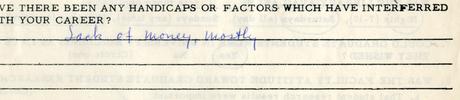 Henry Edward Garrett
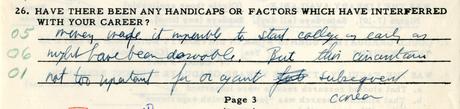 Chauncey McKinley Louttit
 Floyd L Ruch
Some interfering factors were physical health:
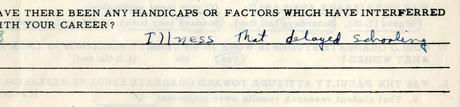 Roger Garlock Barker
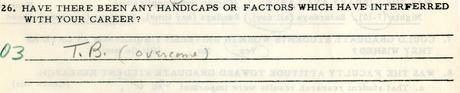 Arnold L Gesell
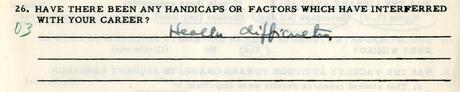 Gardner Murphy
Some factors were matters of personality and mental health:
 Floyd Allport
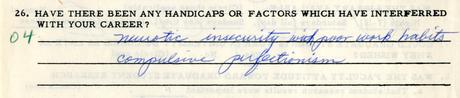 Donald George Marquis
Writer’s block:
 Dale Benner Harris
Mediocre conversationalist:
 Stanley Smith Stevens
Unattractiveness:
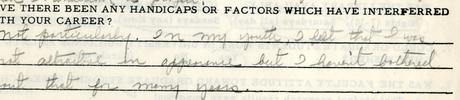 Mitchell Dreese
Insufficient education was quite a common factor:
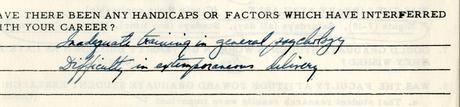 Charles William Bray
 Donald Wallace MacKinnon
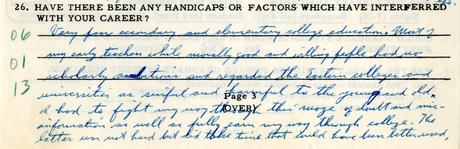 Walter Richard Miles
Cultural handicaps? Absolutely.
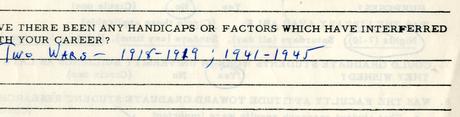 Samuel Weiller Fernberger
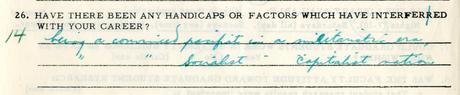 George Wilfred Hartman
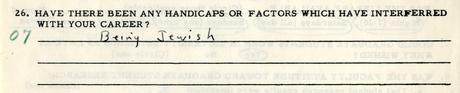 David Krech
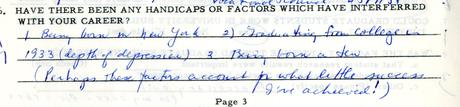 Lawrence S Rogers
 Max Wertheimer
Too many assigned administrative responsibilities? Of course.
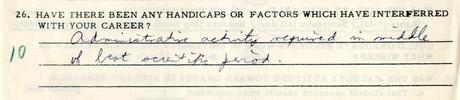 Carl I Hovland
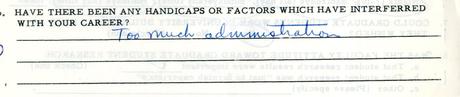 Clifford Thomas Morgan
Some psychologists listed many factors:
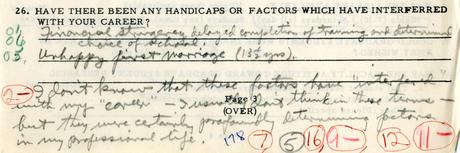 Harold Mowbray Hildreth
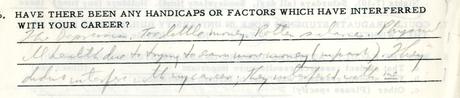 Abraham Harold Maslow
 Lewis Madison Terman
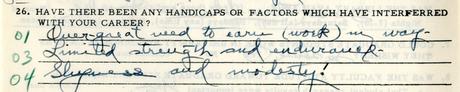 Robert Mearns Yerkes
 And many fortunate fellows had none:
 Gordon W Allport
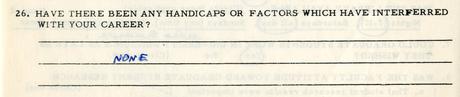 Harry Frederick Harlow
 Laurance Frederic Shaffer
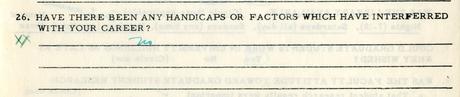 Burrhus Frederic Skinner
 Donald Edwin Super
And then there are these mid-20th Century vaguebookers:
 Louis Leon Thurstone
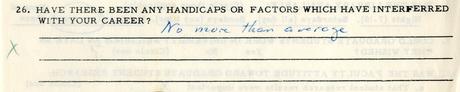 William Clark Trow
 George Richard Wendt
The Wispé questionnaires are both a chronical of self and a database of whimsy, which hold innumerable research projects and social media posts. We’re investigating the best way to make these digitized surveys and transcriptions fully available to you, while we await the time-consuming completion of the project.
Want to read what E.G. Boring wrote about E.B. Tichener being “adequate” and that Harry Harlow found his professors “moderately competent?” Want to read how E. C. Tolman named David Krech as an outstanding student and Krech listed Tolman as an academic mentor?
This collection has the tea, in psychologists’ own handwriting, and we’re excited to spill.







