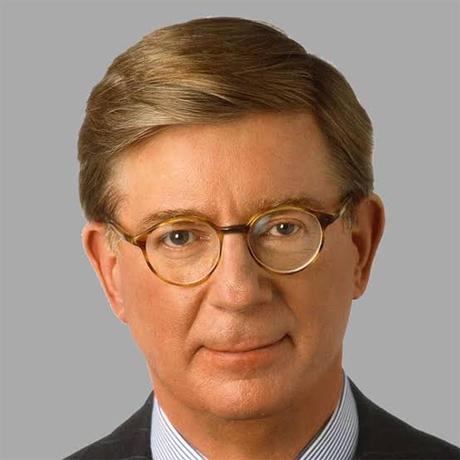
George Will is a writer with interesting things to say, who says them interestingly. At a book sale, his Suddenly looked brightly new; I overlooked the subtitle’s “1986-90.”
Ancient history. But I started reading anyway and found much fascinating. This essay collection exults in what Will considered the global triumph of American ideals. But in our own political culture he saw rot creeping in.
Ain’t seen nothin’ yet. Sometimes I spot a bit of mold in a bag of bread, and pretty soon the whole bag goes in the trash.
Will is conservative to his marrow. But, seeing clearly, he’s one of the few not sucked into the moral swamp U.S. “conservatism” has become.

I was particularly moved by his 1989 writings. One piece about Tiananmen was dated in late May, when it looked like things could go either way. The next was June 8.
Then there was his November 20 essay.
At 17, living near the 1964 World’s Fair, I liked exploring there. Wandering into West Germany’s pavilion, I viewed a film about the Berlin Wall. It was my geopolitical awakening.
A quarter century later, I’d been griping about a barrier installed at my office blocking my window view. On November 9, my wife returned from work and I said, “The wall came down today!”

“The one in your office?”
“No — the one in Berlin.” On the TV news I’d just seen people dancing atop it. People whooping ecstatically as they flooded through open gates.
Signaling the end of something begun in 1917. But Will traces things back exactly 400 years earlier, to a manifesto nailed to a church door 60 miles from Berlin.

Soon after, Luther “spoke seven words that define the modern frame of mind: ‘Hier stehe ich. Ich kann nicht anders.’ (‘Here I stand. I can do no other.’) The primary idea of the Reformation was the primacy of individual conscience. It has been the high octane fuel of all subsequent history.”

Will later quotes Gorbachev speaking of two great history-shaping revolutions, the French and the Russian. Overlooking the American one! Which Will deems most salient, seeing “an intellectual line connecting Wittenberg and Worms with Philadelphia, 1776, and Gettysburg, 1863.” Jefferson having put forth a few words about inalienable rights and human equality, with Lincoln elevating them as the dedicatory proposition of a nation.
“In 1989,” Will wrote, “history’s fast-forward button has been punched hard” — at the wall that was “Communism’s starkest confession of moral bankruptcy.” But he saw “the spark that lit the short fuse” in an electrician working at Poland’s Gdansk shipyard, named Lech Walesa. And, just days after that other confession of Communist moral bankruptcy at Tiananmen, Poland’s rulers somehow allowed a free election, whose results utterly shattered their ideological pretensions. The wall’s fall was the other shoe dropping.
Will’s November 1989 piece ends saying “Only the Reformation is remotely comparable to today’s gale-force intellectual winds and loud cracking of institutional foundations.” This “has been the most startling, interesting, promising and consequential year ever.” (His emphasis.)
Soon after, watching New Year’s fireworks with my wife, I myself shouted, “Goodbye blessed golden 1989!”

In 1993 I visited a free Russia. Walking in St. Petersburg (no longer “Leningrad”), up the famed Nevsky Prospekt, the grim gray Soviet facades were interspersed with a few flashes of color — new stores that had sprung up. When I returned in 1995, it was all color.
Will quotes Wordsworth: “Bliss was it in that dawn to be alive.”
Now night falls. Will we see another dawn?