


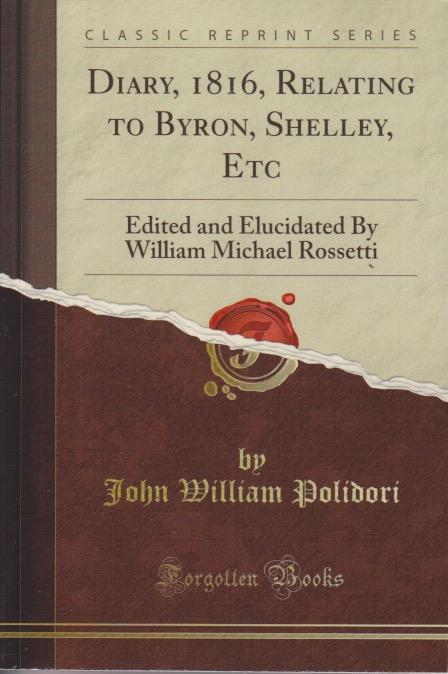
Before reading Lord Byron’s Doctor by Paul West, I started reading John William Polidori’s diary. This is freely available online, but I need a book in my hands to truly read. A little backstory: before his trip to Switzerland in 1816 with Lord Byron, the poet’s publisher paid Polidori to write this diary. After Polidori died by suicide, his sister edited out what she thought reflected badly on the family, and destroyed the original. The diary was published in 1911, edited by Polidori’s nephew William Michael Rossetti. The edition I read was a reprint by Forgotten Books, containing the University of Toronto’s Library’s edition for scanning. While not the most exciting reading, it is revealing. Polidori appreciated the finer things in life (he qualified as a medical doctor), but he sometimes missed the point. For example, being paid to write about Byron’s travels, his mentions of Bryon are relatively few.
You get the real sense that Polidori was jealous of the Lord with whom he traveled. Then, when Percy Bysshe Shelley and his party arrived in the neighborhood, it becomes clear that Polidori was jealous of Byron’s attention to Shelley. I sympathize with the author; both Byron and Shelley were already famous and infamous for their writing and lifestyles. Both were from aristocratic families and had no profession other than writing and traveling. For Polidori this was a working trip. His mood seems to be reflected in that, just after the famous ghost story contest, entries begin to focus mostly outside the gathered writers until they stop altogether. Much of the summer is left blank. In September Byron sent Polidori packing, and the remainder of the diary is about his, often penurious, travels through his ancestral Italy.
Polidori is now known as the author of “The Vampyre,” which he wrote during the period covered in the diary. He doesn’t talk about it much. For me, Polidori is a sympathetic figure. A lonely man, he was intimate with the most famous English poet of his day. He often, however, in his own accounts, wasn’t in control of his emotions, particularly when he felt he’d been slighted. Jealousy can be a very difficult monster with which to wrestle. But reading this diary does lead to the uncanny sense that the most interesting parts were the things he didn’t discuss. The diary has been used as the basis of more than one fictional treatment of the events of the summer of 1816. And since some of the juicy bits are left out, free rein is given to the imagination.







