


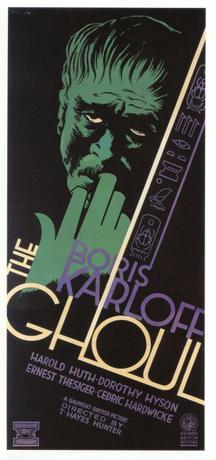
Frankenstein made Boris Karloff a wanted man. In horror, that is. In need of a fix without spending anything, I took Amazon Prime’s offer of The Ghoul. (You had to pay for Sleepaway Camp III.) A 1933 black-and-white horror film, it followed two years after Karloff’s signature role. I hadn’t heard of The Ghoul before, and, it turns out, there’s nothing supernatural about it. Still, it’s creepy and it has the right atmosphere. And instead of the mommy Karloff played the year before, he’s now a dying Egyptologist. Just before he dies, he purchases, with nearly his entire fortune, “the eternal light,” a jewel that will bring him into an Egyptian afterlife. An Egyptian Sheikh, however, wants the jewel back because he believes in Egyptian religion, just as Karloff’s Professor Morlant does. An unscrupulous servant steals the jewel once Morlant dies, although the professor warned him that if he tried anything, he (the professor) would rise from his grave and kill him. The heirs find out that their uncle has died and his shifty lawyer, who wants the jewel for himself, races to the house before they can arrive. Add in a vicar who believes paganism in Britain is disgraceful, and you have a full house on the night Morlant rises from the dead.
The servant, now believing that his master has indeed arisen, confesses to where he put the jewel, which leads to Morlant stalking the party in the house until he finds it. The heirs dismiss the vicar, who keeps saying the clash of religions is important. The Sheikh tries to find Morlant, aware that he has recaptured the jewel. The heirs go to the tomb to sort out what is going on, and Morlant, cutting an ankh into his chest with a knife, offers the jewel to a statue of Anubis, who takes it. It turns out “Anubis” is really the “vicar” who was really a thief who’d planned the heist some time before. The police, whom the heirs called, arrive before the Sheikh, who took the jewel and locked the rest of them in the tomb, can get away. A bit complicated, I know.
The movie makes heavy use of religion and dialog about religion for an early horror film. It ends sadly for Morlant, who dies believing he is entering the eternal light, but, as a scene of the doctor makes clear, Morlant was buried alive because of catalepsy; he never arose from the dead in the first place. The Sheikh, subdued, England is Christian again, and all is well. Except for Morlant, the duped professor who believed what he’d studied was true. The ghoul (the term before zombie caught on) wasn’t real after all.
I’m glad to have happened upon this one. If I ever get around to writing my book on how horror and religion interact, The Ghoul will surely be among the early films that must be discussed.







