


Rabbit holes are my favorite part of the internet. They can be used for heavy-duty research, but in my case they’re mostly just fun. I’ve written about Dark Shadows many, many times on this blog. Although I did watch many episodes of the original run with my brothers, my memories of the story line tend to come from the concurrent series of pulp fiction books by Marilyn Ross. These books, which I have only ever seen used, were distinguished by their olive green covers and an oval cutout on the front where an image from the television series, sometimes apparently selected at random, was shown. There were a total of 32 of them and, as an adult I collected them all. Some months ago I wrote about my delight at finding several of them, in very good condition, at an antique and curio shop not far from us. Recently in that shop again, I looked over the titles and discovered one that wasn’t in the series but was in the larger series, Paperback Library Gothic.
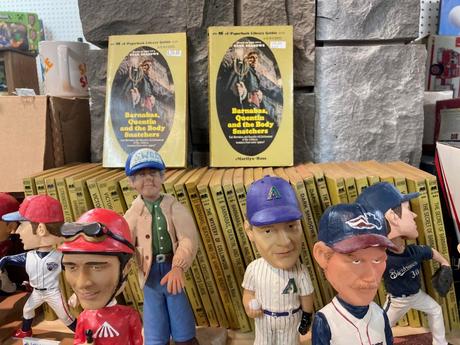
I’d never really given much thought to it, but the book was in great shape and was riffing off the Dark Shadows series. It was reasonably priced, so how could I not? Excited as a schoolboy coming home in time to catch the series on TV, I looked up the series online and fell down a rabbit hole. There was an entire series in the mass market paperback format that I adore, from the sixties and seventies. Shy of writing a bestseller myself, I’d never be able to afford them all. The series included some classic titles out of copyright by such authors as Ann Radcliffe, Jane Austin, Bram Stoker, and Wilkie Collins (no relationship to Barnabas). To these they added contemporary gothic titles including several by W. E. D. Ross, writing under the pseudonym Marilyn. These were pre-Dark Shadows books. There were well over a hundred of them.
Paperback Library was an independent New York City publisher founded either in 1960 or 1961, capitalizing on the pulp fiction and mass market paperback models. They were bought out by Warner in 1970. Warner eventually became Grand Central Publishing—still in New York. In the large conglomerations that brought us down to only five major publishing houses in English, Grand Central was acquired by Hachette, one of said big five. Recently the main distributor of mass market paperbacks decided it would no longer handle that format, essentially dooming it. And with it a piece of my childhood. Thankfully there are still some rabbit holes to fall down.







