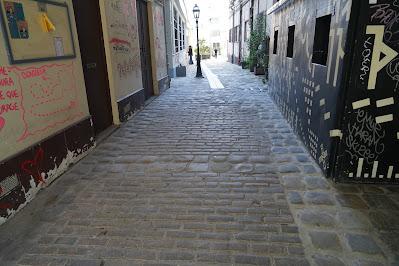
The paving in this small and charming Paris passageway is unremarkable at first glance. On closer inspection, it is actually a rare survival of a nearly forgotten feature of Paris and London: wood as a road surface.
That might seem a strange choice, but it did make a certain sense. As the cities had moved to paved roads, one negative effect was hard to miss: the noise. The ceaseless sound of iron hooves and iron carriage wheels on stone was unsurprisingly unpopular with residents. Today, we have quieter surfaces such as tarmac or asphalt, but the nineteenth-century version, macadam, was made only of crushed stone. It relied on the weight of vehicles to help compact it and bind the stone dust into a crust. The result had advantages over stone paving (not least that it was cheaper), but did not prove durable under the weight of heavy traffic.

Wooden blocks offered a quieter, low-cost alternative to other methods. They were laid in Paris, as well as in various London parishes, during the nineteenth century. Thus wooden roads were found in Old Bailey in 1839 and Piccadilly in 1840, albeit briefly, before making a triumphant return to London in the 1870s. IanVisits has found that wood-paved roads were common throughout the city in the early twentieth century and continued to be used into the 1950s. He has even tracked down a few surviving patches.
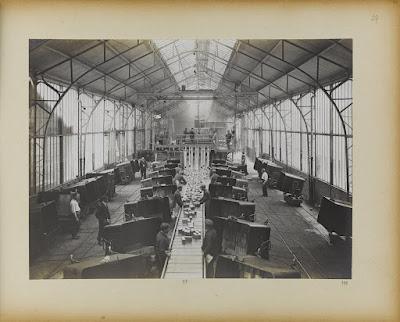
Buoyed by their London success, the Improved Wood Pavement Company took their wares to Paris. The city was persuaded - and set up its own factory. Wooden paving blocks were first used in the area around the Champs Elysées and soon spread more widely.
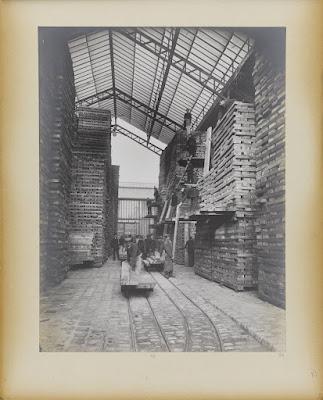
Selection of blocks in the Paris warehouse
However, these wooden roads had their disadvantages. They became very slippery in the rain; they soaked up other liquids and became smelly and unhygienic, even causing infections in horses' hooves; they could swell and shift when wet, creating trip hazards; and in the major Paris flood of 1910, many thousands of blocks floated loose. From that point on, new road surfaces would be asphalt rather than wood.
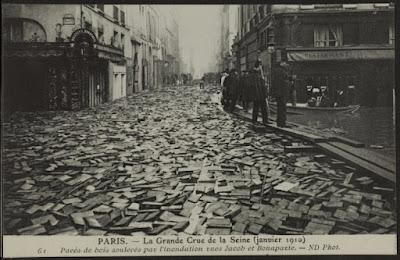
Loose blocks in the street after flood, 1910
The patch of wood paving here is a unique Parisian survival in the Passage Saint Maur. It is protected by a covered entrance, and is an appealing curiosity: there was another visitor at the same time as me, enjoying their encounter with this quirky piece of the past.
1910 photos: anonymous album, Bibliothèque de l'Hôtel de Ville, Paris