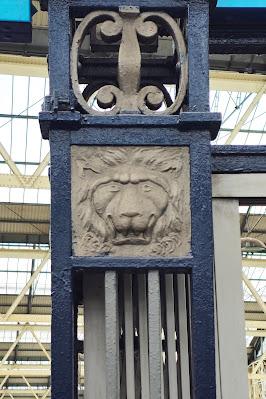
Among and around all the shiny retail at Waterloo Station are endless interesting details. Most recently, I noticed this lion head decoration on platform 15.
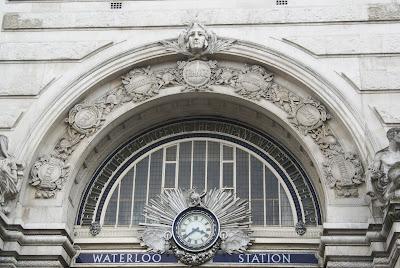
One reason for the richness of detail in the station is its rather piecemeal development over time. That's despite it having been rebuilt in the early twentieth century after the original station had become so confusing and complicated that the best option was to replace it altogether. The current station fully opened in 1922, having been delayed by the First World War. (For that reason, its main entrance is formed of a victory arch commemorating the war.)
However, that was not the end of the matter. Further changes have extended the station, changed visitors' perspectives on its architecture, and yes - made it a little more complicated again. Although it still can't compare to its predecessor, which had not been built as a terminus - the plan was to extend lines into the City - so had to have facilities added on in piecemeal buildings. It also housed a changing assortment of lines and services including the Necropolis Railway (to Brookwood Cemetery) which had its own private facilities, and the later arrival of tube lines. Things grew so chaotic that platform 1 was in the middle of the station and other platform numbers were used more than once, so finding your train was a real challenge!

The Battle of Waterloo Station: Puzzle - to find the train you want, or anyone able to give you any information (Punch, 30 June 1883)
By contrast, the replacment was planned and built as a terminus and the platform numbering has remained pretty sensible. But there have been subsequent alterations and additions. In 1994, Eurostar came to Waterloo. New platforms were built - and then closed again thirteen years later when the cross-channel train moved to St Pancras Station. They languished for a while, sometimes used for non-travel purposes such as dramatic performances of The Railway Children. Most recently, they reopened in 2018-19 as shiny new national railway platforms - along with the inevitable new retail spaces.
The concourse balcony opened in 2012; its main purpose may have been to create new retail and refreshment spaces but it also allows visitors to get much closer to some of the historical details.