


We can complain because rose bushes have thorns, or rejoice because thorn bushes have roses.
– Abraham Lincoln
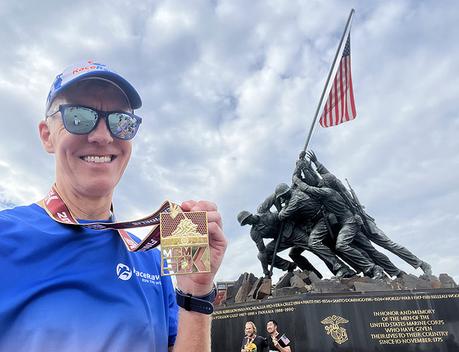
Riddle me this: How do you follow up a race day in one of the world’s most excellent cities? With a race day in one of the nation’s most excellent cities, of course! And with little more than that tenuous logic to guide my decision making, I renewed my 50 States tour six weeks after Sydney with a trip to Washington D.C. and the Commonwealth of Virginia for the Marine Corps 50K.
While most of the 21,000+ runners in Virginia would be lining up for the 48th annual Marine Corps Marathon, I opted to embrace a “more is better” mindset and commit to the 50 km (31-mile) distance. In only its third year—after launching in 2019, the event was canceled in 2020 and 2021 due to the pandemic—the Marine Corps 50K already wore the crown as the nation’s largest ultramarathon.
Surprisingly, choosing a marathon (or ultramarathon) in Virginia was tougher than I’d expected. Yes, the Marine Corps Marathon (MCM) is the obvious first choice as one of the largest and most iconic marathons in the country, with a race day that hosts upwards of 20,000+ runners annually. But with other top-rated marathons in Richmond, Roanoke, and even Virginia Beach, the decision to run MCM was no foregone conclusion…
Until I realized that unlike Richmond, Roanoke, and Virginia Beach, I could convince my brother Chuck and my sister Sandy to join me for a family trip to Washington D.C. Despite her activist mindset, this would be Sandy’s first visit to our nation’s capital, and I was keen for her to immerse herself in 247 years of American history. To my thinking, D.C. is the one city every American should visit in their lifetime. Chuck had visited the city on several occasions, while Katie and I would be returning for the first time since I’d run the JFK 50 Mile five years earlier.
Trip planning went smoothly but for one hitch: Sandy would need to be back at work in Dallas by Tuesday morning after the Sunday marathon. This minor inconvenience meant we’d need to front-load our visit so that most of our sightseeing happened before race day.
As any traveling runner will tell you, for the sake of your race-day performance it’s best to defer the bulk of the sightseeing and extracurricular activities until after the race—and particularly in a walker-friendly city like D.C. where you’re likely to do most of your exploring on foot. In our case, that wouldn’t be possible. At the same time, full immersion was the true raison d’être of this trip, with the Marine Corps 50K providing a convenient justification. (Admittedly, this is the case with many of our travels on this 50 States quest—race day is often a healthy afterthought.)
And so before I could notch another state, I notched down my expectations for race day and set my mind to simply enjoying the opportunity by invoking a mantra that’s served me well in my travels through the years: physical baggage good, mental baggage bad.
With that settled, the five of us—me, Katie, Sandy, Chuck, and his girlfriend Christine—touched down at Reagan International Airport on Wednesday ready to hit the ground walking for our whirlwind tour of D.C. in advance of Sunday’s main event.

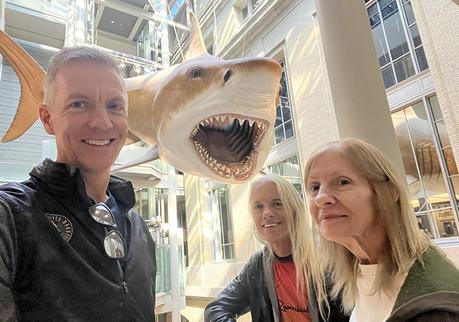
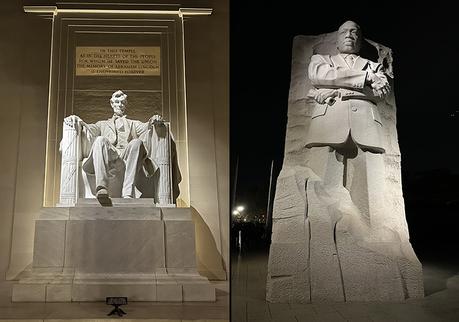
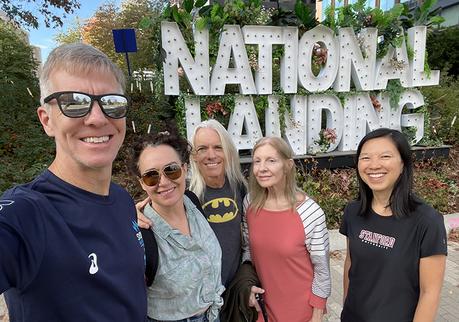
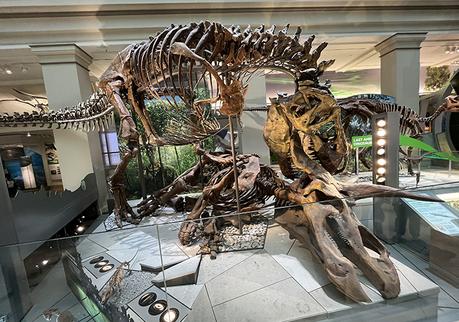
And walk we did, our tireless peregrinations covering the city like the dotted line in a Bil Keane Family Circus cartoon. And it was awesome. After enjoying dinner outdoors Wednesday night in National Landing, we spent Thursday touring the Smithsonian National Museum of Natural History followed by the National Archives, where my long-time friend Jill (who works as Deputy Chief of Staff for an Illinois congressman) introduced us to one of the friendly archivists who generously took the time to share his insights on the Rotunda that houses the Declaration of Independence, the Bill of Rights, and the U.S Constitution. We then strolled to dinner at nearby Oyamel (a local Mexican mainstay from celebrity chef José Andrés) before joining a guided “monuments at night” tour that showcased the city’s iconic monuments, memorials, and landmarks including the Washington Memorial, the Lincoln Memorial, and the White House.
On Friday we picked up where we’d left off with several hours in the sprawling Smithsonian National Zoo. Predictably, despite stiff competition from the zoo’s other residents the giant pandas stole the show, and with it many onlookers’ hearts. The youngest panda, 3-year-old Xiao Qi Ji, entertained the audience by playfully somersaulting down the hill in his enclosure. We easily could have filled an entire day at the zoo; reluctantly, though, we pulled ourselves away and headed back to the National Mall for a quick tour of the National Air and Space Museum.
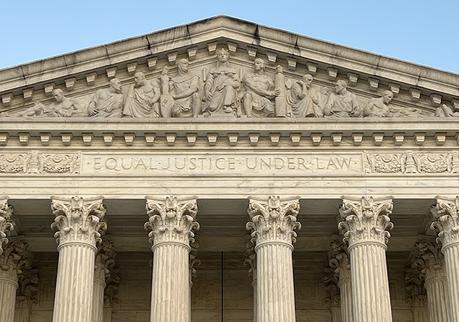
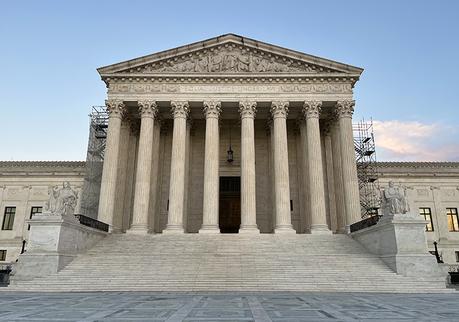
From there we circled the perimeter of the U.S. Capitol before arriving at the Supreme Court. As we stood regarding its white marble exterior in the fading light, the words “EQUAL JUSTICE BEFORE LAW” inscribed on the portico above its grand staircase, I tried to assure myself that the timing of our visit—with the sun setting on the highest court in the land—was strictly literal and not metaphorical as well. Luckily my thoughts were interrupted as we set off for another excellent meal with another long-time friend, this time in the Mount Vernon Square neighborhood at Ottoman Taverna with Acting Secretary of Labor Julie Su.
All in all, we’d enjoyed 2+ days of unrivaled sightseeing. Not only that, but I’d get to see much of it all over again on race day. And though the nagging voice of experience in my head insisted the bill for so much time on my feet would come due Sunday morning, the voice wasn’t loud enough to prevent me from falling quickly into a deep and peaceful slumber that night.
On Saturday, under an intense autumn sun, Katie and I hailed an Uber for the 30-minute drive (even longer by Metro) to the pre-race expo held across the Potomac River in “OMG where are we going,” otherwise known as National Harbor, Maryland. Yes, the expo was held in the next state over. There, as temperatures peaked in the low 80s on the warmest day of an unseasonably warm October week, we followed the ant-like procession of runners with their clear plastic bags to the spacious Gaylord National Resort & Convention Center.
By the time we arrived in the early afternoon after a leisurely morning, the crowds at the expo had thinned considerably. With most of the vendor booths touting the Armed Forces and not of particular relevance to us (though we did visit with the fine folks at the Richmond Marathon and Air Force Marathon booths), we were able to get in and out with almost military efficiency.
I was disappointed to discover that the merch tent lacked an appealing option for 50K runners; I refused to wear anything labeled simply “Marine Corps Marathon” because, well, I wouldn’t be running the marathon. And dammit, those extra five miles deserved their own merch. Fortunately, and by now I shouldn’t be surprised, Katie (in cahoots with Santa) later found an attractive, steel blue MCM 50K sweatshirt that showed up under the Christmas tree.
Owing to a lack of available Ubers around National Harbor, we left the expo and hopped aboard a shuttle transporting runners between the expo and the closest Metro station. And from that Metro station we eventually made it back to home sweet home at the Crystal Gateway Marriott in Arlington. Conveniently located adjacent to the Crystal City Metro station (mile 23 of the marathon) and one mile from Reagan International Airport, I can heartily recommend the Crystal Gateway Marriott as your headquarters for Marine Corps Marathon weekend.
After the obligatory carbo-load dinner at nearby La Bettola Italiano, we turned in early for our customary predawn wake-up call. Because as the military mantra goes, “If you’re early, you’re on time; if you’re on time, you’re late.” And I didn’t want to be late.
Turns out I’m not cut out for the military.
Getting There Is Half the Fun
I awoke Sunday morning feeling relaxed after a decadent seven hours of decent sleep—not bad for race day. The world outside remained shrouded in darkness. I ate and dressed quietly, then headed downstairs with Katie to where Chuck waited in the lobby.
After a short walk from our hotel to the Crystal City Metro station, the three of us rode the yellow line two stops to Pentagon City. There’d been some confusion as to how exactly we should get to the start line—uncertainty re: the schedule of the official race shuttles had compelled us to take the Metro; unfortunately, it turned out the Metro station located steps from the start line at Arlington National Cemetery was closed on race morning, leaving as our only option the Pentagon City station which, in turn, meant a significantly longer walk to the start line.
Ironically, the stunningly beautiful morning that greeted us in Pentagon City foreshadowed a tough day ahead—perfect weather for spectators, not so much for runners as temperatures hovered already in the low 60s before the sun had made an appearance.
Exiting the Metro station at 6:45am with hordes of our fellow runners, I assumed I’d have plenty of time—assuming no emergency pit stops—to make it to the start line. I was all kinds of wrong. (This seems like the right place for a public service announcement to MCM hopefuls: Save yourself some stress on race morning, and DO NOT UNDERESTIMATE the amount of time needed to reach the start line. This should be common sense to someone who’s run as many races as I have, and yet somehow…).
All told, I tallied at least 1½ miles on the walk/jog from Metro station to start line. The three of us walked and walked—past the Pentagon (very cool), through a brief security checkpoint, and toward the Runner’s Village set up in the North Pentagon Parking Lot. Cutting through the Runner’s Village, I craned my neck in search of the start line before we were finally pointed in the general direction of muffled noise.
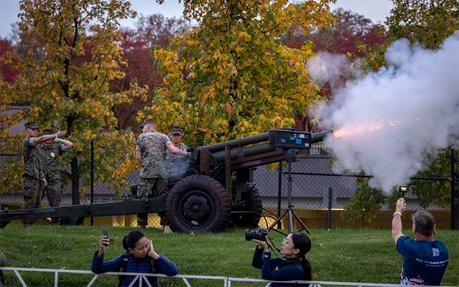
As the clock ticked down to my 7:15am start time and the first glow of dawn lit the horizon, I bid Chuck and Katie a hurried farewell before hustling ahead. Following the flow of foot traffic up the on-ramp and onto SR 100, I could hear the PA announcer in the distance but still couldn’t see the start line. As his disembodied voice counted down the seconds to the start, I broke into a slow jog. Approaching the back of the very long—and very empty, with the marathoners waiting in the wings—start corral, to my chagrin I found myself still unable to see a start arch. That’s when the {BOOM} of the howitzer split the morning air, sending the 50K runners on their way.
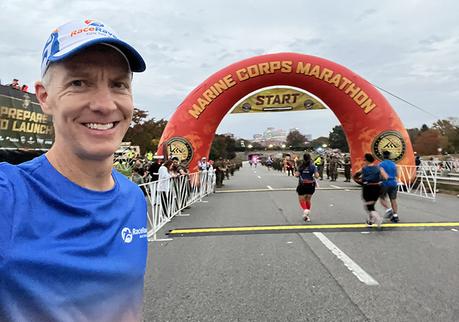
Several other 50K runners jogged alongside me, time slowing to a crawl as we took seemingly forever to cover the length of the never-ending marathon start corral, which I now noticed was taking up both sides of SR 110. Finally the highway dipped downward, and I was relieved to see at last two familiar orange start-line arches directly ahead, with the 50K start arch on the opposite side of the highway (of course it is, I thought). Crossing the median as the full-throated voice of the PA announcer warned all 50K runners to get to the start line asap before it closed, I paused for a quick selfie (I’d earned that much!) before crossing the start line. Returning my iPhone to my Spibelt I realized I’d already lost one of my GU packets, my nutrition for the day.
C’est la vie. It was go time at the 3rd annual Marine Corps 50K, the warmup act for the 48th annual Marine Corps Marathon which would start 40 minutes later. All that was left was the running. And yes, my word count just to reach the start line exceeded most people’s entire race report.
TL;DR: Don’t. Be. Late.
Calm Before the Storm
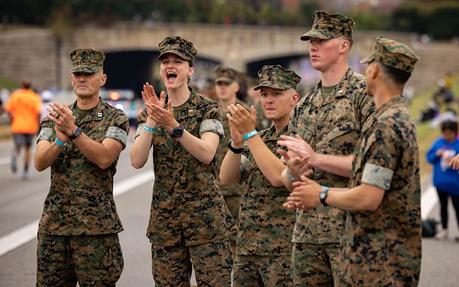
Our first few steps were greeted with enthusiastic cheers from a small group of Marines before we passed Arlington National Cemetery, a somber and respectful moment in the first light of day. With more than 2,200 active and retired Marines supporting the day’s festivities, men and women in uniform would be a frequent sight on this day. (Sound familiar, D.C.?)
Having started four minutes after the gun, I ran by myself for the first half mile or so before I started to catch up with the 50K back-of-the-packers. With little more than the rhythmic patter of our footfalls for company, we set our sights on the glass-and-steel cityscape in the distance. Moments later we reached the urban village of Rosslyn, its towering office buildings and luxury condominiums flanking the course like silent sentinels standing watch over empty streets and darkened storefronts.
Into the heart of Arlington we ran, transitioning from the business district into more residential neighborhoods where the first civilian spectators of the day greeted us with exuberant cheers. For a visitor coming from the West Coast, the stately red-brick buildings were an appealing sight, and I almost expected to see the crowds here dressed in powdered wigs, petticoats and tricorne hats.
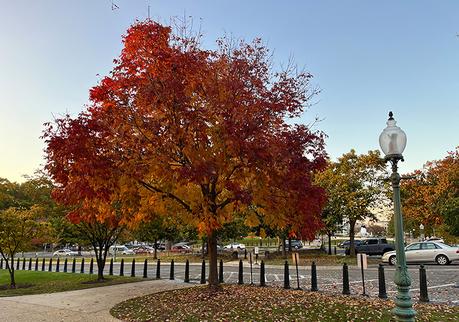
I was loving the wide, well-maintained streets, and soon we found ourselves in more rural surroundings reminiscent of the “in between” stretches of vast green countryside that separate points A and B on long road trips. Autumn had not yet run its course here—no surprise, with high temperatures hovering around 80°F during our visit—and many of the trees still flaunted their flamboyant fall wardrobes.
The course rolled quite a bit in the first five miles, and already I could feel the humidity coming on strong. In mile 3, I noticed that the fellow running ahead of me was already soaked in sweat. Likewise, I could tell I was glowing more than usual; this reminded me of summer training runs in Los Angeles, a city that’s gotten increasingly humid in recent years. Only this wasn’t Los Angeles, and late October definitely wasn’t summer.
I was convinced all our walking and sightseeing around DC—coupled with the day’s heat and humidity—would eventually catch up to me; the only question was how long it would take. So I decided to maintain a comfortable sub-5-hour pace for as long as possible before fatigue inevitably set in and forced me to adjust on the fly.
Screenshot
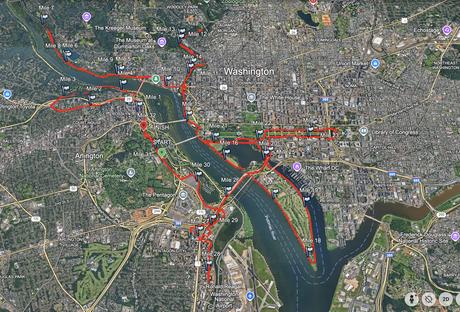
" data-image-title="Screenshot" data-orig-file="https://blisterscrampsheaves.com/wp-content/uploads/2025/09/mcm-50k-course-map_google-earth_bch.jpg" style="width:750px" data-image-meta="{"aperture":"0","credit":"","camera":"","caption":"Screenshot","created_timestamp":"0","copyright":"","focal_length":"0","iso":"0","shutter_speed":"0","title":"Screenshot","orientation":"1"}" width="2592" data-medium-file="https://blisterscrampsheaves.com/wp-content/uploads/2025/09/mcm-50k-course-map_google-earth_bch.jpg?w=300" loading="lazy" data-permalink="https://blisterscrampsheaves.com/2025/09/17/marine-corps-50k-race-report/screenshot-8/" alt="Google Earth course map for the Marine Corps 50K" height="1762" class="wp-image-9185" data-large-file="https://blisterscrampsheaves.com/wp-content/uploads/2025/09/mcm-50k-course-map_google-earth_bch.jpg?w=614" />Google Earth course map for the Marine Corps 50K (click for higher-res image)Not only would this be my second straight warm-weather race after Sydney, but it would be my fifth marathon in six months with two of those international. My body was tired to be sure, but after this I could cruise into the holidays and start looking forward to 2024. I just needed to get this done, and I was determined to enjoy the doing.
Turning onto the George Washington Memorial Parkway we ran along the Potomac River, the natural dividing line between Virginia and Washington DC. Having pulled ahead of the 5-hour pace group, I pumped the brakes to ensure I didn’t get too far ahead since I suspected—to misquote Ben Franklin—that a penny’s worth of energy saved now would be a penny earned later.
Leaving the George Washington Memorial Pkwy in mile 5, a brief but nasty uphill jag led us onto the Francis Scott Key Memorial Bridge, named for the author of the poem “Defence of Fort Mchenry” (1814) which eventually (in 1931) would become “The Star-Spangled Banner,” aka our national anthem. Putting Virginia in our rearview mirror, this short stretch across the Potomac afforded us a nice view of Georgetown as we prepared to start the out-and-back portion that was unique to the 50K course.
Rather than running on the C&O Canal Towpath alongside the calmly flowing waters of the Potomac River, however, we ran this 5-mile out-and-back stretch on the parallel road, which afforded us a questionable view of the glorified drainage ditch known as the Chesapeake and Ohio Canal. No matter, these miles would be the most peaceful of the day as the humidity here was countered by a cool breeze that made me feel (incorrectly) like I could run all day.
I ran largely by myself until our speedier counterparts began to pass us in the opposite direction. Eventual winner Calum Neff (2:55:57), who would outpace the competition to a new course record, took the time to pump a fist and encourage the rest of us slow-footed types. Trailing in fourth place, eventual runner-up Michael Wardian flew by looking dialed in and zoned out. For my part I cruised along, knocking out easy miles at a four-hour marathon (and 4:45 50K) pace, not a pace I intended to sustain but one that felt very comfortable at that moment. If only the entire race could be this serene and uncrowded…
The only disturbance in the force along this stretch was two handcycle athletes who came up on us fast from behind, each yelling “ON YOUR LEFT!” loudly and repeatedly as my fellow bipeds and I swerved quickly to get out of their way. Why these athletes were behind us and not leading the way, I had no idea. Whatever the reason, this was a terrible idea for both us AND them—the handcycle athletes should start ahead so they can stay ahead of the runners, and it’s not fair to anyone that they should have to navigate their way through crowds of runners. I couldn’t imagine what they’d do once we merged with the tightly packed crowds of marathoners.
Approaching the end of this out-and-back section, we passed the first (and only 50K-specific) food station. I don’t recall what they were serving, but subsequent food stations (five in all) would offer Honey Stinger waffles, applesauce, and UnTapped gels made with maple syrup, none of which my stomach found remotely appealing.
Movie buffs (which I am not) running the Marine Corps 50K should keep an eye out for an Easter egg here. As you return to the start of the out-and-back section, off to your left just before the merge with the marathoners coming across the Key Bridge, you’ll pass a former gas station-turned-public parking lot. Unremarkable to be sure, but hidden in the back corner of this parking lot—between the stone wall covered in creeper vines and the neighboring building—is a stone staircase where the priest apparently falls to his death in the movie The Exorcist.
Coincidentally or not, the Exorcist Steps (as they’re now known) marked another melancholy ending of sorts on this day—the end of my personal peace & quiet.
Into the Storm
Suddenly, like a dam breaking we found ourselves swept up in the flood of marathoners as we entered Georgetown proper on beautifully surfaced streets lined with trendy, upscale shops and gold-lettered storefronts. And it was here the realization hit me that I was running the Marine Corps Freaking Marathon, 20,000+ participants and all. Turns out “The People’s Marathon,” as the race is known due to its lack of prize money, hosts a LOT of people.
Unfortunately, with no pace groups in my field of view, I had no way of knowing how fast the marathoners hemming me in on all sides now were running, which made me feel like a fish out of water.
Turning right at the golden dome of the Farmers and Mechanics Bank building we reached the riverfront, where a band—apparently the Marine Corps Base Quantico Band, whom we’d see again later—was playing “I Melt With You” by Modern English. “Dude, it’s U2!” a fellow next to me exclaimed to his friend as we banked left beneath the freeway. There we slowed for road construction before a 270° turn pointed us north along Rock Creek and Potomac Pkwy for another out-and-back.
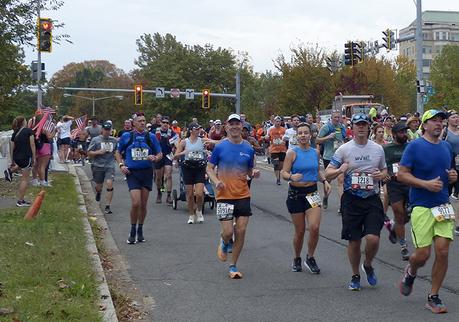
Certainly the going had slowed at the 50K/marathon merge, but now it became even more challenging to maintain pace as our progress slowed to almost a shuffle. I felt like a sweaty sardine, and my focus shifted from pacing to footing as I tried to avoid stepping on people and making a bad situation even worse. Crowds like those at MCM are a big reason I’m not a diehard fanboy of the World Marathon Majors (and especially London) while so many others are. Today, though, I was determined to keep my cool and just enjoy the day.
Lack of elbow room notwithstanding, the out-and-back along Rock Creek and Potomac Pkwy was a lovely, tree-lined stretch of parks replete with beautiful fall colors, plus a beautiful spectator in Katie near mile 11 in Francis Park. Along this stretch I focused on the kaleidoscope of colors as well as the incredible energy of the crowds, and I continued to hit every aid station in my bid to stay hydrated. Luckily the cloud cover remained, and I debated if and when the sun might burn away our sole salvation on this increasingly humid day.
One disappointing aspect of race day was the aid stations, which didn’t operate as efficiently as I’d expected from the U.S. Marine Corps. The best aid stations reliably use two different cups throughout the race, one for water and one for sports drink to allow a quick visual ID. Here, though, cup usage was inconsistent, and I was never sure in the hustle and bustle whether I was grabbing one or the other. Normally this wouldn’t matter much, but today in the humidity my stomach wanted nothing to do with an overly sweet sports drink.
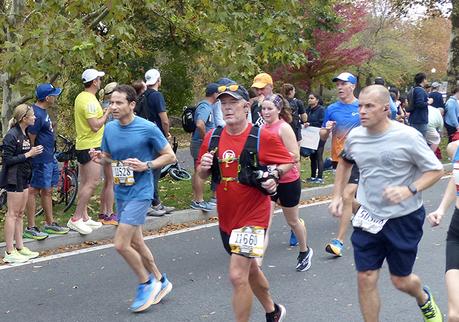
The farther we ran, the more I appreciated that the “bonus mileage” for the 50K had been tacked on early in the race. That way, for the rest of the day I could simply add five to each mile marker without the nagging realization that we’d have to run an extra five miles closer to the end of the race. From now on we’d be in sync with the marathoners, and so when they were done, we were done. Given that the 50K distance always feels to me like an annoyingly long marathon, and especially on a warm day like this, that awareness was key to maintaining a positive mindset.
Leaving Georgetown we entered Foggy Bottom, with the Potomac to our right and the unmistakable curved façade of the infamous Watergate complex to our left. This was followed by a building I hadn’t entered in nearly 40 years, but which I still remember vividly for its posh elegance, ornate décor and signature red carpeting—the Kennedy Center for the Performing Arts. Having failed to scrutinize the course map ahead of time (hey, I was sightseeing!), seeing Watergate and the Kennedy Center in close succession was an unexpected treat.
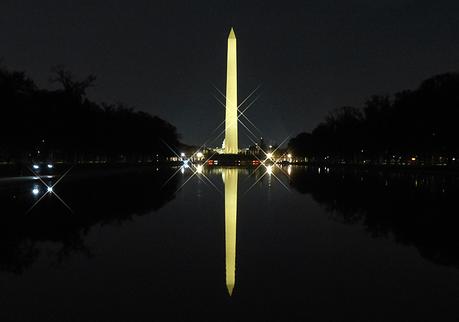
Continuing south along the river we entered West Potomac Park and the National Mall, aka what every American thinks of when they think of Washington D.C. The National Mall is home to more than 100 unique monuments and memorials. Most of what we could see along this stretch was community baseball & softball fields, but again the crowd support was so intense here that it hardly lacked for energy. And crossing the Ohio Drive Bridge did regale us with an amazing view of the Washington Monument and the Jefferson Memorial. That momentary glimpse of American history across the water left me with a feeling of sudden-onset patriotism and pride.
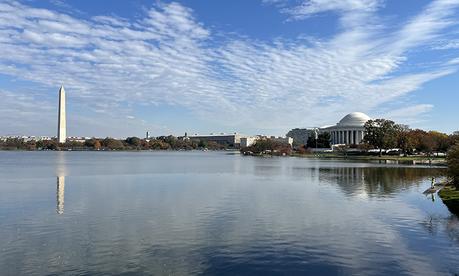
Here I downed my first Maurten gel of the day to try to boost my flagging energy levels, to no effect. It was going to take a lot more than a shot of maltodextrin to offset three days of being on my feet 😬
One of the few course highlights I’d noted beforehand was mile 17/12 of the 50K/marathon course. This was the emotional wear blue Mile, a mile dedicated to honoring American servicemembers killed in the line of duty. Blue posters lining both sides of the road depicted “Faces of the Fallen,” individual men and women who made the ultimate sacrifice for our country. This mile is intended as a respite from the raucous madness of the marathon and an opportunity for quiet reflection, and most runners treated it respectfully as such.
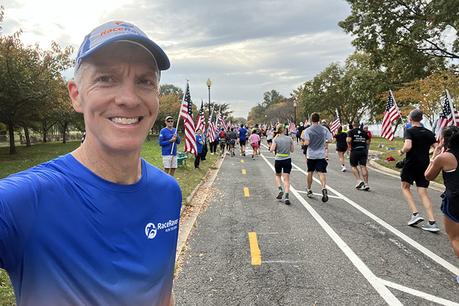
Except, that is, for the oblivious jabberwocky to my left whose mouth didn’t miss a beat as we entered the somber stretch. Rather, dude kept up a steady stream of blather directed at his buddy while everyone around us fell silent. I’m sure I wasn’t the only one offended by his clueless banter, and I tried to focus instead on the faces on each poster while accelerating just enough to get out of earshot. Then the moment passed, and as we exited the wear blue Mile volunteers on each side of the route held oversized American flags and cheered loudly as we passed.
Running on Fumes
Reaching the southern tip of East Potomac Park (aka Hains Point) at mile 18, we followed the road around Hains Point and back the way we’d come. Pausing at the aid station, I imagined how beautiful this stretch must be during cherry blossom season. I’ve experienced cherry blossoms to some extent in Tokyo and Sydney, and they have a glamour all their own.
Along this stretch, small motivational signs appeared regularly with inspirational messages like “FUTURE SELF WILL THANK YOU FOR WHAT YOU’RE DOING TODAY” and, for the moms among us, “YOU GAVE BIRTH TO A HUMAN, YOU CAN DO THIS.” My pace had started to slip and I dug deep, determined to give as much as I could for as long as I could.
Then we were back in the heart of the National Mall, skirting the Tidal Basin with the Washington Monument towering overhead. Katie had mentioned seeing me at mile 20, and I was hoping she’d be here to snap a photo with the monument in the background. No such luck. And so with my second wind receding and with fatigue treating my willpower like the Kool-Aid Man treats walls, I resolved to keep running until my next Katie sighting.
That resolve lasted less than a mile, when a slight feeling of nausea hit me as we approached the mile 21 marker and turnaround on Independence Ave SW. I slowed to a hike for a couple of minutes to reorient myself before forging ahead.
This would be the pattern for the next ten miles as I was forced to battle through fatigue on a run/walk basis. When I did run, I actually ran pretty well, but the inconvenient truth was that I just ran out of gas. This wasn’t a nutritional bonk, this was pure exhaustion caused by a perfect storm of challenges: too much sightseeing, too much humidity, and maybe even too many marathons in the previous six months. More than anything, though, this was karma caused by my failure to respect the 50K distance. And karma really is a bitch.
On the other hand, having wisely set no time goals for myself, I was determined to enjoy the moment—the crowds, the energy, the fact I was running in one of the world’s most remarkable cities surrounded by 247 years of American history. The Marine Corps Marathon in many ways amounts to sensory overload. So many of the city’s iconic monuments and memorials go unnoticed and unappreciated on race day when your brain is fighting for glucose and the streets are packed with rowdy spectators. And yet D.C.’s sensory overload didn’t vex me in the same way that London’s relentless wall of sound had, in part because I wasn’t sick or injured during the race.
The scene and surroundings reminded me of the line from The Rime of the Ancient Mariner where the titular sailor finds himself surrounded by salty ocean water: “Water, water, everywhere, nor any drop to drink.”
At the same time, I’m constantly amazed that cities like Washington D.C. and New York and Los Angeles shut down busy roads for hours at a time to allow weekend warriors like me to see & appreciate their city in a way that even the non-running locals never could. And it’s one of the reasons why, despite their often unwieldy size, I still ❤️ most urban marathons.
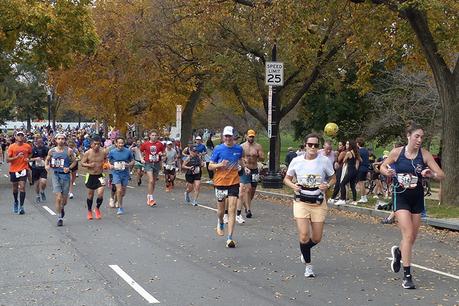
Speaking of spectators, if you like boisterous crowds then the Marine Corps Marathon is the race for you. On race day D.C. stands for Delightful Crowds, and the spectators consistently brought their “A” game with signs like:
1) “We’ve been trying to contact you about your extended warranty”
2) A drawing of a dog’s face asking, “Why did you throw your ball so far?”
3) Race day fell in the same week that the GOP caucus in the House of Representatives took 3+ weeks to elect a new Speaker, and the historic chaos of that election inspired several wonderfully nerdy signs, e.g. “You’re running better than Tom Emmer (Speaker-Elect for 4 hours)”
4) In the final two miles of the race: “You have 1 more MCM finish than Kipchoge!” (Eliud Kipchoge of Kenya is considered by many to be the greatest marathoner of all time, but he’s never run MCM! 🙌)
5) Plus the obligatory Ken and Barbie signs that were everywhere at that time
On the other hand, as long as I run marathons I’ll never appreciate the “You are NOT almost there” signs early in the race. Not funny, not clever, not now, not never.
A Monument-al Effort
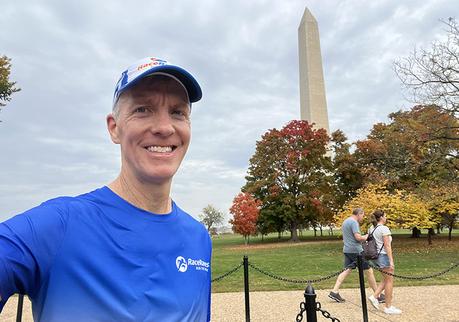
As we cleared the Tidal Basin and circled the Washington Monument, I once again slowed to catch my breath, using the opportunity to snap a selfie with the city’s most recognizable landmark. Soon after this I did see Katie in mile 23, and I took the opportunity to pause and try another energy gel with plenty of water. Again, my disgruntled stomach’s response was a mild mutiny that warned me to quit while I was ahead (was I ahead?).
Bidding Katie a weak farewell, we passed the distinctive bronze-latticed exterior of the National Museum of African American History & Culture. This was followed in short order by several other notable buildings including the National Museum of American History, the National Museum of Natural History, and the National Gallery of Art. Certainly my interest in these attractions didn’t help my performance, but at this point enjoying myself too much was the least of my worries.
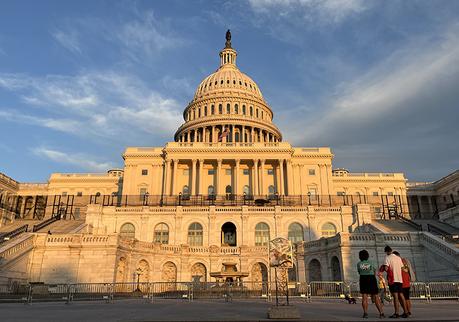
Reaching the eastern end of the National Mall, we turned onto Pennsylvania Ave and entered Union Square. Here we circled the Capitol Reflecting Pool on the grounds of the U.S. Capitol, arguably the most impressive architectural feat in D.C. Admiring this breathtaking symbol of democracy with The Statue of Freedom mounted atop its dramatic white dome, I struggled to reconcile its 230-year legacy with the harsh reality of all the modern-day cranks and sycophants who now walked its hallowed halls. At that moment, however, my brain was in no shape to grapple with this cognitive dissonance.
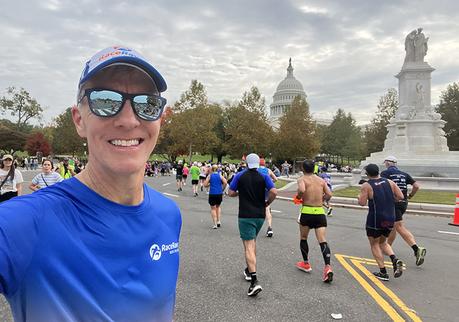
After a quick pause for a photo op during which the 5-hour 50K pace group passed me, we continued past the easily overlooked Ulysses S. Grant Memorial (depicting Grant astride his horse facing the reflecting pool) and around the James A. Garfield Memorial in honor of our 20th president. Then we completed our symmetrical loop of Union Square and headed back the way we’d come, the trees along Jefferson Dr SW modeling a variety of vivid autumnal hues.
Onward we labored, past the Dwight D. Eisenhower Memorial and the National Air & Space Museum. A sign announced the latter as undergoing “major renovations,” a favorite phrase around DC since at any given time, several parts of the city are undergoing a facelift. In this respect the timing for MCM Sunday was advantageous since—according to the guide for our Thursday night tour of the monuments—the final bit of construction scaffolding had come off the Capitol that morning.
Continuing west along the National Mall, we passed a building that stood out among its more muted and monochromatic brethren—the gothic-inspired, red sandstone façade of the Smithsonian Institution Building aka the Castle, which houses the Smithsonian’s administrative offices. The Castle has to be one of the nation’s most attractive administrative buildings, though here I’d like to insert a plug for Lovett Hall on the Rice University campus. And in true D.C. fashion, it’s now closed for the foreseeable future as it undergoes its first major renovation in 50+ years.
Here I was surprised to see Katie again, and instinctively I pulled over before realizing I had no real reason to do so. At the same time I noticed a spectator sporting the midnight-green football jersey worn by the Pro Bowl (and now Super Bowl-champion) quarterback of the Philadelphia Eagles, who were in town to play D.C.’s own Washington Commanders. That says it all, I mused wryly as its owner turned to reveal the name on the back of the jersey: HURTS. Well played karma, well played.
Charging the Hill
Just as it seemed we were destined once again for the Washington Monument directly ahead of us, we banked left past the U.S. Holocaust Memorial Museum where the other members of our group, who had spent the morning at the museum, just missed seeing me. This was followed steps later by the visually unremarkable but administratively vital Department of the Treasury housing the Bureau of Engraving and Printing, where the nation’s paper money is printed.
Ahead of us, near the 50K mile 25 mark (mile 20 for the marathon), taiko drummers pounded out their motivational rhythm at the “Beat the Bridge” gauntlet, one of four time-limited checkpoints along the course. I’m always a fan of taiko drummers, in part because they remind me of the Big Sur International Marathon and my hometown Los Angeles Marathon.
Pausing briefly at the mile 25 marker to take a few deep breaths and steady myself, I harnessed the percussive energy of the drummers to propel myself forward. Our trajectory afforded us one last stunning view of the brilliant white Jefferson Memorial before we departed D.C. via the 14th Street Bridge over the Potomac. The humidity was taking its toll, and here on the bridge many runners paused to refill their bottles from the self-serve water monster dispensers that lined the route.

After half a mile that I wished I could have enjoyed more, we re-entered Virginia where we said goodbye to most of the day’s scenery and hello to the final 10K, a grueling gauntlet that’s bad enough during a marathon but even worse in a 50K where it starts at mile 25.
In the distance to our right the sprawling, low-slung form of the Pentagon beckoned us homeward. With that welcome back to Arlington, I slowed to a walk to catch my breath and channel motivation from the mile marker confirming that yes, we 50K runners had reached the marathon distance at last. Now keep running, I thought. Much to my chagrin the midday sun peeked out from behind the clouds for the first time, and I quickly wished it back into hiding.
Minutes later I relaxed a bit as I recognized the familiar skyline and surface streets of National Landing where we were staying at the Crystal Gateway Marriott. Here we embarked on our fourth and final (and least scenic) out-and-back stretch of the day through the Crystal City business district. One last Katie sighting early in this stretch provided some short-lived momentum, as did passing a walker in a Marathon Maniacs “PACER” singlet who looked suspiciously like the 5-hour 50K pacer.
By the time we reached mile 28 on the out-and-back, the muscles in the lower back on my right side had tightened up significantly, and I needed another brief walk break to gather myself and quiet the discomfort in my back.
Then we left Crystal City behind and, several quick turns later, set our sights on Pentagon City and the finish line. In the final three miles I kept reminding myself to breathe deeply as my core muscles and lower back tightened unexpectedly, which kept me from running comfortably. Lower back pain during a race was new to me, and I ascribed it to the awkward camber of many of the roads. My core and lower back tightness coupled with the oppressive humidity prevented me from running for more than a few minutes at a stretch.
Mentally and physically, I was DONE. One thing I’d learned, though, in my running career and as I’d worked my way back from a 16-month injury hiatus, was to always keep going—to keep moving forward no matter what. Because you never know what might happen when you refuse to give up and when you give yourself a chance to succeed. As Winston Churchill put it, “If you’re going through hell, keep going.” So that’s what I did, running when I could and walking when I couldn’t, while using each aid station to stay hydrated.
With parts of the road here under construction, this was the least scenic stretch of the day. Not that I cared. One last frontage road led us back to where it all began, as we passed the Pentagon and the marathon mile 25 marker (mile 30 for us 50Kers) before re-emerging on SR 110 where we’d crossed the start line roughly five hours earlier.
The frenzied crowds here were much appreciated and I pushed forward with everything I had, which at this point wasn’t a hell of a lot. My clothes were soaked through in the relentless humidity, my core muscles felt like armored plates, and my lower back still barked loudly as if imploring me to call it a day and curl up in the soft green grass alongside the highway.
Instead I forged ahead in fits and starts, past Arlington National Cemetery to the final left turn leading up to the finish line at the Marine Corps War Memorial, aka the Iwo Jima Memorial. And when I say “up,” I mean UP—this final climb is among the steepest of the day, and in true Semper Fi spirit, runners are urged to “charge the hill” to the finish line. And how I wish I could have. Walking into the final turn to let my core muscles relax and to summon one last surge of energy, I charged the mercifully short hill with all I had left.
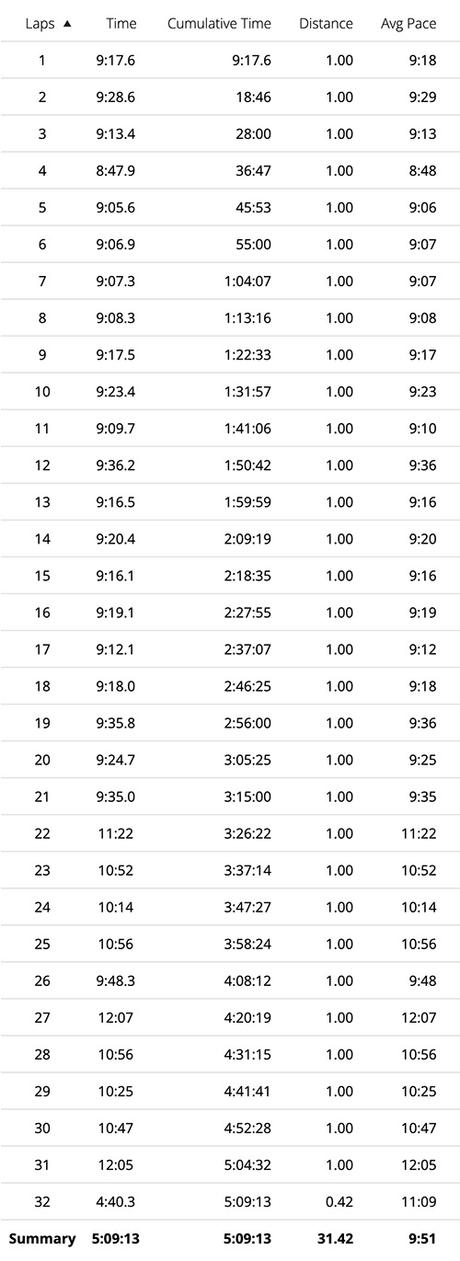
Screaming spectators (though no Katie that I could see) willed us forward to the final right turn that brought the glorious orange finish arch into view. Even in my patently depleted state, I was surprised to discover I had literally nothing left—no residual adrenaline, no higher gear to shift into. And so I simply stayed the course. Basking in those final few yards, I crossed the line with a weak “Oorah!”—the battle cry of the U.S. Marine Corps—and stopped the clock in a time of 5:09:08, an average pace of 9:51/mile.
The Few, The Proud
Unsteadily I stood basking in a moment of exhausted euphoria. I was totally spent as I shuffled forward through the finish chute to where servicemembers in uniform stood waiting to congratulate finishers. I felt an incredible sense of pride as one hung the hard-earned 50K medal around my neck. Weakly I fist-bumped a number of Marines, thanking them for their service as they in turn thanked me for my support. Had I been more coherent and comfortable, I would’ve thought to take a picture with them 🤦🏻♂️
Grabbing two bottles of water and two bananas, I continued toward the Marine Corps War Memorial, where somehow I was able to stand just long enough to take a few selfies. Then I collapsed on the concrete steps in front of the memorial for a couple of minutes, trying to regain some sense of composure before heading for the exit to find Katie.
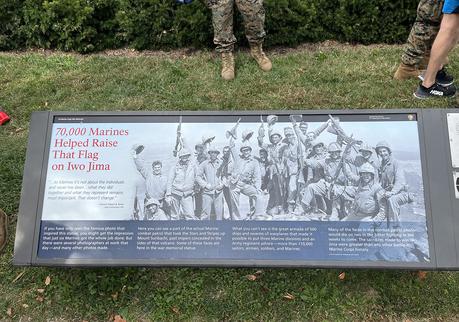
There I sat admiring one of the more remarkable monuments in a city filled with remarkable monuments. Dedicated in 1954 as a tribute to all U.S. Marines who died in service, the memorial is based on the Pulitzer Prize-winning photograph that shows six Marines raising the U.S. flag atop Mount Suribachi during the Battle of Iwo Jima on February 23, 1945. The iconic moment took place during the final stages of the American campaign in the Pacific during WWII.
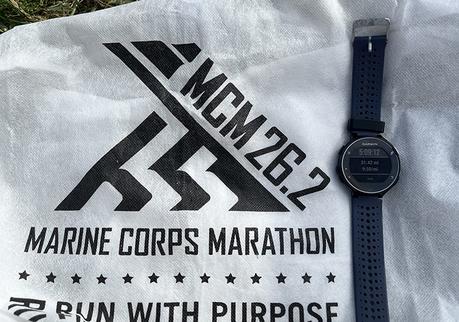
Glancing at my Garmin, I was surprised to note my finish time was much better than expected given all that had transpired. As I’d later discover, I’d finished just outside the upper quartile of 50K finishers, suggesting that aside from the Calum Neffs and Michael Wardians, many of my fellow ultrarunners had suffered right alongside me. Under normal circumstances and with my focus squarely on race day, I’d have set a goal of sub-5 hours. But this was not that day.
In fact, owing to the high humidity, organizers made the difficult decision to close two of the checkpoints on the course earlier than scheduled and then divert those runners to the finish line (where they still received their medals) via a shorter route. Not ideal, and certainly there were arguments to be made on both sides of the decision, but just another indication of how runners and organizers alike grappled with the challenges posed by the unseasonal warmth.
Slowly I stood and headed toward the crowded line leading to the exit. After a few more uncomfortable minutes on my feet I collected my MCM-branded, lightweight mesh poncho—this was late autumn, after all—and finisher’s “hospitality box” containing sweet & salty snacks that I’d save until later, once my stomach and I were on speaking terms again.
I’d run 31.1 miles, and not a single NFL game had kicked off yet.
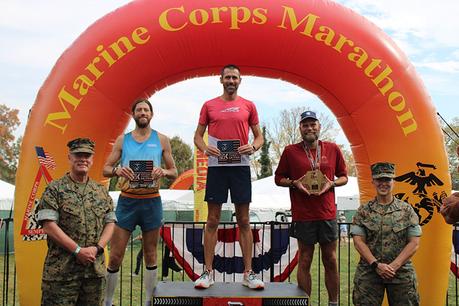
Clearing the exit, I met Katie and collapsed once again on a crowded grassy incline outside the memorial. Apparently, Katie had just missed my finish as she flew out of her last Metro stop at Arlington National Cemetery and made a mad dash down the hill. Despite her disappointment at missing my dramatic home-stretch shuffle, the truth was that we’d already seen each other five times along the course. Whose spouse does that?
Security reasons notwithstanding, still it was unfortunate that with so much open green space on the grounds of the memorial, we weren’t allowed to occupy or enjoy much of it. Aside from the seemingly interminable walk from the Pentagon City Metro station to the start line, the post-race setup was the biggest downside to race day. On the bright side, the National Watermelon Promotion Board had set up a table on the street below us and was handing out generous servings of watermelon to finishers. Except that neither Katie nor I like watermelon. So instead I lay on the grass, using my MCM poncho as a pillow while dumbly sucking down my Tailwind recovery drink—always a post-race winner with even the most defiant stomach.
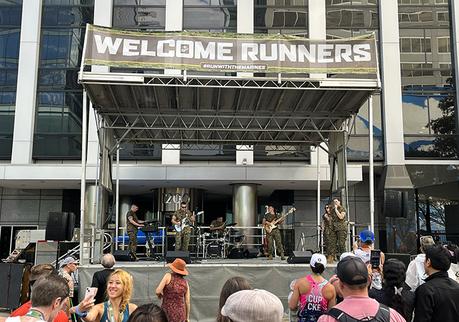
Finally, after gathering my wits on the grassy slope, we rose and headed toward the nearby Rosslyn Metro station. On the way we passed a stage where a live band comprising six talented musicians in uniform—as it turns out, the Marine Corps Base Quantico Band I’d seen earlier in Georgetown—were energetically belting out hits from rock gods like Van Halen (“Jump” and “Panama”), Blondie (“One Way or Another”), Bon Jovi (“Livin’ on a Prayer”) and Green Day (“Basket Case”). For me, the sextet was the hands-down highlight of the finish festival.
On the Metro ride back to the hotel, several runners saw my 50K medal and we exchanged congratulations. “Great day for a marathon,” I responded. Because the truth was, I had no business trying to run 31.1 miles on this particular day, and my best bet would have been to play it “safe” and stick with the marathon distance. But that never entered my mind, and I had as much chance of forgoing the nation’s largest 50K as I did of overtaking Calum Neff on that final climb to win the damn thing. It simply wasn’t going to happen.
Obviously I would have preferred to dial down the suffering in those last 10 miles, but I’d run 21 good miles on an all-around tough day. And I can honestly say I have zero regrets. I’d love to return to D.C. one day to run the Marine Corps Marathon itself. At the same time, I’d be ok if this turns out to be the last 50K of my running career, since the distance feels more like an annoyingly long marathon than a true ultra. But again, I’ll never say never.
On a side note, I’m grateful to have run the 50K when I did, because as of this writing—with the Marine Corps Marathon celebrating its 50th anniversary and an expected field of 40,000 runners this October—the 50K distance has been removed from the schedule. If the organizers ultimately decide to move the 50K to its own date as has been rumored, the event won’t be the same without the sheer joy and excitement of marathon race day that transforms D.C. into a living, breathing, sobbing, cheering, screaming, wildly celebrating organism.
And on a personal note, a belated shout-out of support to USMC Commandant Gen. Eric Smith, who had been congratulating runners at the finish line earlier in the day and who, ironically enough, suffered cardiac arrest while out jogging later that day. Fortunately, Gen. Smith made a full recovery and returned to full duty several months later. Best wishes to the commandant on his continued good health—not only do we share a love of running, but we both hail from the same city in Texas.
Eventually we made our way back to the Crystal Gateway Marriott. There we compared notes with Sandy, Chuck and Christine, who’d had a memorable day of their own at the U.S. Holocaust Memorial Museum, before enjoying a satisfying post-race meal at Padaek, a local Thai eatery.
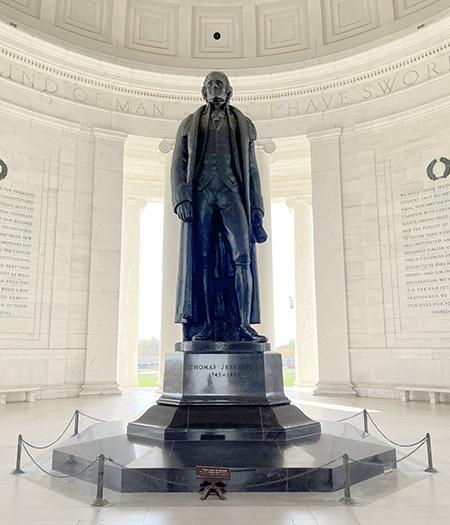
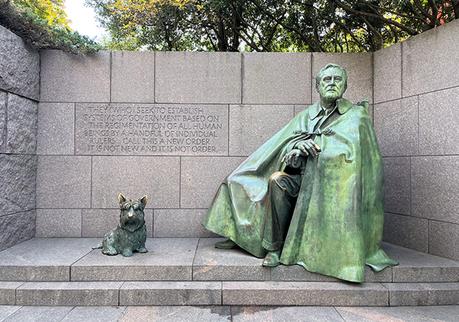
On Monday we all rode the Metro into D.C. one last time to pay a visit to the FDR Memorial and the Jefferson Memorial, before saying goodbye and going our separate ways for the return trip home. With our afternoon free, Katie and I reunited with my friend Jill who met us for an excellent lunch at Rasika—an upscale Indian restaurant from James Beard Award-winning chef Vikram Sunderam—and then kindly chauffeured us to Reagan National Airport for our own flight back to Los Angeles.
As our plane rose from the tarmac and headed west into a glorious sunset, I reflected on the wild racing year I’d had. It had come on the heels of a lengthy injury hiatus that left me second-guessing for a time whether 50 States (or seven continents, or six World Marathon Majors) would ever really happen. And now here I sat, with all six Majors completed and with the delayed-onset muscle soreness of state 37 creeping into my legs. To call the past 6+ months a success would be an understatement, and I was thrilled to call a grand finale like the Marine Corps 50K my last hurrah in an epic year of running.
Or should I say, my last “OORAH!”
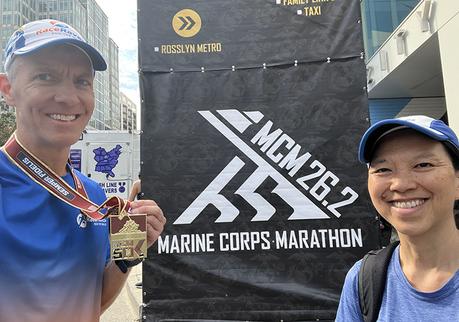
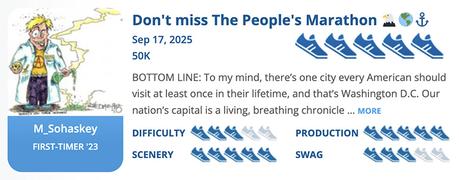
BOTTOM LINE: To my mind, there’s one city every American should visit at least once in their lifetime, and that’s Washington D.C. Our nation’s capital is a living, breathing chronicle of 249 years of American history—the good, the bad, and the ugly. And with more than 100 unique monuments & memorials plus another 750+ historic landmarks, it’s an insanely cool place to run a marathon. So much so I figured HEY, why not extend the revelry another five miles and run the Marine Corps 50K instead? So while I did run the 50K distance (the largest 50K in the country), my narrative applies to the marathon as well.
(As I write this, it’s unclear whether the 50K will continue, since it was canceled for 2025 as the organizers focus on the marathon’s 50th anniversary celebration. And no official 50K date has yet been announced for 2026. Stay tuned.)
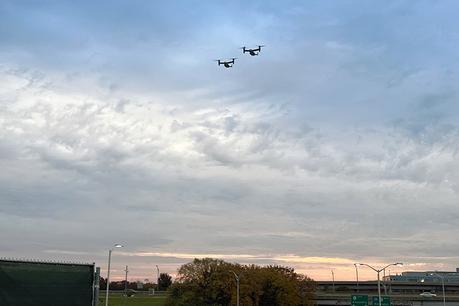
The Marine Corps Marathon, aka “The People’s Marathon” for its lack of prize money, is an energetic and patriotic powerhouse. And few race days rival the raucous joy and excitement of D.C. on marathon Sunday. The pomp and circumstance of race day is worth experiencing first-hand, from the MV-22 Osprey flyover and USMC Color Guard at the start line, to the emotional wear blue Mile, to the 2,200+ active-duty and retired Marines who support the event.
And did I mention the monuments? MCM is quite literally a run through history from start to finish. The race starts near the Pentagon and alongside Arlington National Cemetery, then enjoys a few quieter miles before crossing the Potomac River into D.C. where the real sightseeing begins. In mile 15 of the 50K (= marathon mile 10), you’ll pass the Watergate complex and the Kennedy Center for the Performing Arts. For the next 10 miles or so through the National Mall, the course is a “who’s who” of iconic monuments and memorials—including (but not limited to) the Jefferson Memorial, the Washington Monument, the United States Capitol, and several Smithsonian Buildings—before finishing strong back in Arlington at the Marine Corps War Memorial aka the Iwo Jima Memorial. There’s even an Easter egg for movie buffs: the fateful steps from the 1973 horror film The Exorcist are located along the 50K course, one block before it merges with the marathon course in Georgetown.
Plus, owing to the delayed onset of autumn in 2023, D.C. was still awash in fabulous fall colors into late October. So MCM really does have it all.
A note on being a tourist in D.C.: If you’re an experienced traveler or 50 Stater, this next nugget may seem obvious. But for the Marine Corps Marathon in particular, I’d recommend saving the bulk of the sightseeing until after the race. As a tourist you’re likely to do a lot of walking around D.C., and being on your feet that much before the race is a recipe for—if not disaster, then at least distress. Trust me, I knew better but still found out the hard way because our schedule left us no choice.
And a note on being a runner at MCM: Again this may sound obvious, but do be sure to leave yourself plenty of time on race morning to get from your hotel/Airbnb/VRBO to the start line. MCM is no laid-back, small-town marathon, and it’s easy to underestimate the amount of time required. The closest Metro station to the start line (Arlington National Cemetery) is CLOSED on race morning, and the walk from the Pentagon City station to the start is roughly 1½ miles with a brief stop for security screening. So don’t be that guy, i.e. ME, who misjudges the timing and shows up minutes after the starting howitzer goes off 🤦🏻♂️
That said, all the logistics of race weekend are worth the hassle (yes, even venturing out to Maryland for the expo, see below). Because once you charge the hill up to the Iwo Jima Memorial, let out a triumphant “OORAH!” and receive your finisher medal from a uniformed U.S. Marine who thanks YOU for running, that’s one shining moment you’ll never forget.
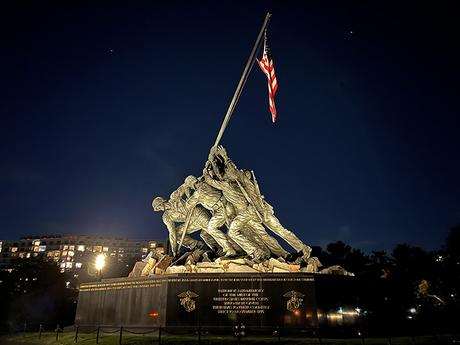
PRODUCTION: As you might expect for the Marine Corps Marathon/50K, race weekend for the most part went off with military efficiency. Race day itself was a well-oiled machine, though the organizers’ logistical prowess will clearly be tested this year when the race doubles its capacity to 40,000 runners for the sold-out 50th anniversary celebration. My only complaint—a minor objection made more consequential by the unseasonal warmth and humidity—was the aid stations, which could have avoided considerable confusion by using color-coded cups to distinguish water and sports drink. Instead, more often than not I was left guessing each time I accepted a cup of liquid from a volunteer. (Shout-out to all the incredible volunteers, who without exception were friendly and helpful.) And though I do wish we’d been allowed to stick around and enjoy the copious green space around the Marine Corps War Memorial after finishing our race, it was all worth it to be able to finish a stone’s throw from the memorial itself. Oorah!
My biggest complaint with race weekend was the expo—or rather, the location of the expo which was (and still is) in another state. I know Maryland is a hop skip & jump from D.C., and I’m sure there’s a reason the expo is held at the Gaylord National Resort & Convention Center in National Harbor rather than at one of D.C.’s (or Arlington’s) many meeting spaces. But simply getting to the expo required a 30-min Uber ride or an even longer and more convoluted Metro trip. And with everything else about race weekend (sightseeing included) centered on the nation’s capital, having to go so far out of our way to pick up my bib number and some safety pins felt overly inconvenient. (Luckily, once inside the Gaylord the expo itself was easily negotiated if not particularly compelling, and by arriving slightly later on Saturday we avoided the morning onslaught.) Getting back from the expo was even worse, since the law of supply and demand made it nearly impossible to hail an Uber around bustling National Harbor.
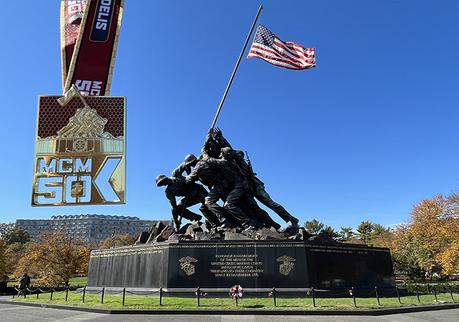
SWAG: The Marine Corps 50K medal is perfectly fine, if less elaborate than the marathon medal. It’s simpler in design and more two-dimensional than the rounded, locket-style marathon medal adorned with the Eagle, Globe and Anchor icon. At the same time the rectangular, burgundy-and-gold 50K medal boldly depicts the Marine Corps War Memorial as its centerpiece, which sets it apart. And the color-matched ribbon is distance-specific as well. But it’s the “MCM 50K” label that will always be my true source of pride.
As for the MCM 50K shirt, that’s another story. Granted, it’s high fashion compared to the notorious 2018 design; still, two years later I’ve yet to find an occasion (or the gumption) to wear it. The shirt is a shiny, long-sleeve mock turtleneck (?) with an inner fleece lining that feels like it wouldn’t breathe well. It’s easily the heaviest non-sweatshirt I own. The color scheme of the shirt matches the finisher medal: the torso is made from shiny burgundy polyester while the arms are an equally shiny gold polyester covered in a busy honeycomb design. #RUNWITH THE MARINES is printed down the right arm while MISSION ACCOMPLISHED runs down the left arm (and honestly, 22 years later that slogan’s still got too much Dubya to it). The front of the shirt is emblazoned with the Eagle, Globe and Anchor icon. From the front, the shirt gives the impression that I have some personal affiliation with the U.S. Marine Corps. Only on the back do the words MCM 50K appear (who sees the back?) above two lines that I can only imagine were the winning entry in the local fourth-grade poetry contest: “WHEN IT COMES TO RUNNING ULTRAS AS A FEAT, THE MARINE CORPS HAS GOT ‘EM ALL BEAT!” Not exactly Shakespeare’s “Now bid me run, and I will strive with things impossible.”
Fortunately, Katie went online after the race and was able to find an attractive, steel blue MCM 50K hoodie that I’ve happily worn and will continue to wear on our travels to cooler-weather destinations. ‘Cuz when it comes to finding race merch as a feat, my wife Katie has got ‘em all beat 🖐️🎤
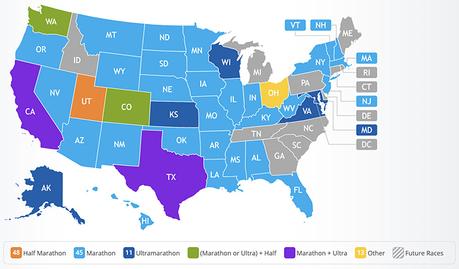
Updated 50 States Map:
Screenshot
" data-image-title="Screenshot" data-orig-file="https://blisterscrampsheaves.com/wp-content/uploads/2025/09/raceraves-50-states-map_va_bch.jpg" data-image-meta="{"aperture":"0","credit":"","camera":"","caption":"Screenshot","created_timestamp":"0","copyright":"","focal_length":"0","iso":"0","shutter_speed":"0","title":"Screenshot","orientation":"1"}" width="750" data-medium-file="https://blisterscrampsheaves.com/wp-content/uploads/2025/09/raceraves-50-states-map_va_bch.jpg?w=300" loading="lazy" data-permalink="https://blisterscrampsheaves.com/2025/09/17/marine-corps-50k-race-report/screenshot-7/" alt="Mike Sohaskey's 50 States map after 2023 Marine Corps 50K" height="440" class="wp-image-9152" data-large-file="https://blisterscrampsheaves.com/wp-content/uploads/2025/09/raceraves-50-states-map_va_bch.jpg?w=614" />RaceRaves rating:
Screenshot
" data-image-title="Screenshot" data-orig-file="https://blisterscrampsheaves.com/wp-content/uploads/2025/09/mcm-raceraves-review_bch.jpg" data-image-meta="{"aperture":"0","credit":"","camera":"","caption":"Screenshot","created_timestamp":"0","copyright":"","focal_length":"0","iso":"0","shutter_speed":"0","title":"Screenshot","orientation":"1"}" width="750" data-medium-file="https://blisterscrampsheaves.com/wp-content/uploads/2025/09/mcm-raceraves-review_bch.jpg?w=300" loading="lazy" data-permalink="https://blisterscrampsheaves.com/2025/09/17/marine-corps-50k-race-report/screenshot-11/" alt="" height="295" class="wp-image-9258" data-large-file="https://blisterscrampsheaves.com/wp-content/uploads/2025/09/mcm-raceraves-review_bch.jpg?w=614" />FINAL STATS:
Oct 29, 2023 (start time 7:15 am)
31.42 miles in Arlington, VA and Washington DC (state 37 of 50)
Finish time & pace: 5:09:08 (first time running the Marine Corps 50K), 9:51/mile
Finish place: 360 overall, 36/171 in M(50-59) age group
Number of finishers: 1,295 (925 men, 370 women)
Race weather: warm (66°F) & cloudy at the start, warm (72°F) & partly sunny at the finish w/high humidity
Elevation change (Garmin Connect): 658 ft gain, 627 ft loss
Elevation min, max: 3.3 ft, 237.8 ft
The appearance of U.S. Department of Defense (DoD) visual information does not imply or constitute DoD endorsement.
Screenshot
" data-image-title="Screenshot" data-orig-file="https://blisterscrampsheaves.com/wp-content/uploads/2025/09/mcm-splits_bch.jpg" data-image-meta="{"aperture":"0","credit":"","camera":"","caption":"Screenshot","created_timestamp":"0","copyright":"","focal_length":"0","iso":"0","shutter_speed":"0","title":"Screenshot","orientation":"1"}" width="500" data-medium-file="https://blisterscrampsheaves.com/wp-content/uploads/2025/09/mcm-splits_bch.jpg?w=109" loading="lazy" data-permalink="https://blisterscrampsheaves.com/2025/09/17/marine-corps-50k-race-report/screenshot-10/" alt="" height="1371" class="wp-image-9191" data-large-file="https://blisterscrampsheaves.com/wp-content/uploads/2025/09/mcm-splits_bch.jpg?w=373" />





