We lived side by side with the Neanderthals for tens of thousands of years; before the ultimately went extinct. For years palaeoanthropologists have been asking: why were we the species to survive? After all, contrary to popular opinion, the Neanderthals had a lot going for them. They were strong, smart and even had bigger brains than us. How could us weak, small-headed humans from down south have succeeded where our brawny cousins failed. The only advantage we seemed to have was a forehead.
One of the most popular explanations for their demise is that they were simply inefficient. Their strong muscular body and large brains required a lot of energy to sustain. Estimates suggest that Neanderthals would’ve needed 4,000 calories a day; double our measly 2,000. Some of the more extreme proponents of this hypothesis have even argued that this is why Neanderthals didn’t make cave art like humans, or innovate quite as much as us. Gathering all the calories they needed to survive took too much time and so they couldn’t afford to sit around wasting energy doodling with tools or playing with rocks. However, I suspect this claim could be categorised as something that rhymes with “full wrap”.
Anyhoo, the Neanderthals were quite short (an adaptation to the cold climate they lived in. Being shorter reduced surface area exposed to the elements, minimising heat loss). As such their steps would be shorter, making walking less efficient. Some estimates indicate that it would’ve cost Neanderthals 30% more energy to travel from point A to point B than humans. So not only did they need more energy to survive it cost more gathering that food in the first place.
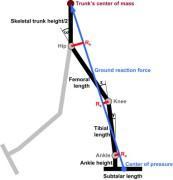
The new, more complex model the researchers used for Neanderthal locomotion
However, a new study has challenged these conclusions. The 30% more energy claim was based on a very simple model of Neanderthal locomotion. Two researchers from the Czech Republic created a more complex model that more accurately modelled Neanderthal locomotion. Their results effectively slashed the amount of extra energy Neanderthals in half; indicating they only needed 14% more energy than us for walking. What’s more, most of this additional cost was the result of the fact Neanderthals – with their larger brains – had higher metabolic demands. If you look at just the energy each species spent on walking the Neanderthals were actually more efficient than humans! It’s just their basic metabolism that pushes them over the top.
So this research doesn’t disprove the “expensive Neanderthals” hypothesis; effectively showing that they did need more energy to function than us. But it does show that they didn’t need more energy to travel, which raises the question: would they still have been inefficient enough to go extinct? Would their higher metabolism alone been enough to hamper their ability to compete with modern humans as we encroached on their territory?
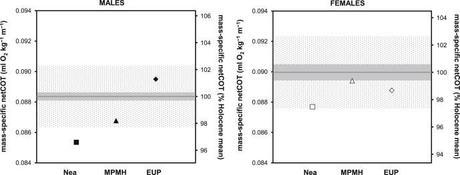
The cost of walking for male and female Neanderthals (Nea) and humans (the other two dots), excluding the cost of basic metabolism
There’s been a long tradition of scientists underestimating Neanderthals. First we thought they died out because they were dumb, which turned out to be false. Because they didn’t cook their foot, making digestion more expensive. Also false. They relied solely on meat, so couldn’t as effectively exploit their natural habitat. That turned out to be wrong too! And we thought they were rubbish at walking.
Don’t underestimate the Neanderthals.
References
Hora, M., & Sladek, V. (2014). Influence of lower limb configuration on walking cost in Late Pleistocene humans. Journal of Human Evolution.