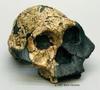
Spears are a key part of the modern hunter-gatherer toolkit. But what about the ancient toolkit? Like, the really ancient toolkit.
Could early hominins - with chimp-sized brains - have made these "modern" tools?
Researchers examining modern hunter-gatherers have found that spears can actually be made with very simple tools. So simple that early hominins, like Lucy, could have made them.
This could help resolve a key debate over whether these species were hunters or just scavengers. Being capable of making offensive weapons like this would be a strong piece of evidence in favour of hunting.
Easy peasy spears
The "new" evidence that Lucy and other early hominins could have made spears is actually something some people have known about for ages. It turns out the Australian aborigines had the secret all along
Anthropologists studying them found out that they sometimes often make break stone flakes off larger stones. These flakes are very sharp, and they use them to whittle down wood into a fine point. This makes a pretty decent spear. Lightweight, easy to replace and very quick and cheap to make. For a population on the move it ticks all the right boxes, saving them lugging heavy stone-tipped spears (or heavy fancy tools to make spears) around.
Crucially, this trick of breaking sharp stone flakes off a core is something our ancestors had mastered by ~2.6 million years ago. These tools - called the Oldowan - were created by hominins with chimp-sized brains. Like Lucy. And if they had these tools, could they have been using them like the aboriginies? Could they have been making wooden spears?
Too dumb to stab?
Perhaps the biggest objection to this idea is the fact that spears are a pretty tough tool to make. Not necessarily physically tough (as the aforementioned discovery shows) but cognitively demanding.
Crucially, the manufacturer needs to have a "template" in their mind of what the finished product is going to look like. And there isn't any evidence makers of the Oldowan had that ability. You can make a flake just by hitting a rock a specific way, you don't need to plan out what the flake would look like beforehand. Yet with a spear you do need to make those sorts of plans.
The ability to think all these steps ahead is thought to have emerged much later. Almost a million years after the Oldowan first appeared people began making bifaces. These teardrop shaped tools have a consistent shape, so must have been planned beforehand. These bifaces are also associated with an increase in brain size, suggesting that you need to be a bit smarter than a chimp to be able to make these complex, planned tools.
However, not everyone agrees with this statement. Some researchers suggest that the planned shape of bifaces might not actually be planned and simply a bi-product of repairing the tool. One side breaks so you repair it. Then the other, so you repair that and suddenly it's more symetrical than you anticipated! Others have also pointed out there is a lot more variation in biface shape than you would expect if they were all being explicitly planned.
Perhaps the biggest critics of the idea that chimps are too dumb to make spears are the chimps themselves. It turns out they can actually make them! There are cases in the wild of chimps sharpening wood with their teeth to create spears. They then use these to stab into trees, killing primates taking shelter in them. So yeah, you might not want to disagree with them too much; lest they turn their spears on you.
Early hominins might not have had the teeth to sharpen spears, but it seems that they may well have had the brains (and now we know they also had the tools).
But is there any evidence?
Of course, just because someone could do something doesn't mean they actually did. Is there any evidence for these early hominins making spears? Well, there is some circumstantial evidence in favour of it (so you might want to grab a few grains of salt for the road).
Experimental studies have found that using these Oldowan flakes damages them. Different uses produce different sorts of damage. As such, archaeologists can out these ancient tools under the microscope and identify exactly what they were used to do. The most common use of these tools appears to have been to process meat. Cutting through skin, slicing off meat and other fun butchery stuff. But almost as often these tools were used on wood.
What's more, they can even identify the sort of activity these tools were used for. And when you look at the tools which were used on wood, scraping appears to have been the most common activity. That's the exact same action that would be used to turn this wood into spears.
As I said, this is highly circumstantial, but tantalising evidence nonetheless.
tl;dr
Modern people use ancient-style stone tools to make spears. This raises the possibility that the original creators of those ancient tools could also have made spears. There is some circusmtantial evidence of this, but it does need a healthy dose of salt wood shavings
References
Boyd, R., & Silk, J. B. (2015). How Humans Evolved. WW Norton & Company, New York.
Hayden, B. (2015). Insights into early lithic technologies from ethnography. Phil. Trans. R. Soc. B, 370(1682), 20140356.
Lemorini, C., Plummer, T. W., Braun, D. R., Crittenden, A. N., Ditchfield, P. W., Bishop, L. C., ... & Potts, R. (2014). Old stones' song: Use-wear experiments and analysis of the Oldowan quartz and quartzite assemblage from Kanjera South (Kenya). Journal of human evolution, 72, 10-25.
Li, H., Kuman, K., & Li, C. (2015). The symmetry of handaxes from the Danjiangkou Reservoir Region (central China): A methodological consideration. Quaternary International.