Culture Magazine

Chester's Newest Statue: Thomas Brassey

By Carolineld @carolineld

Happening to be in Chester on 28 May, I was able to watch the unveiling of a new statue right in front of the railway station. It was an appropriate site, because the statue commemorates Thomas Brassey (1805-1870), railway builder. 
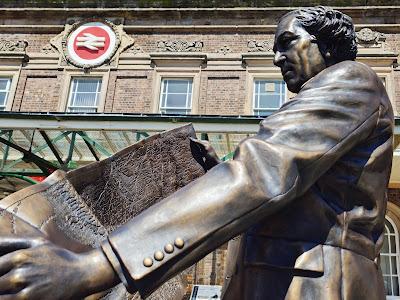
Photo showing a side view of the bronze Thomas Brassey statue. In the foreground is his left hand holding a map.

Brassey was born just outside Chester, the son of a farmer, and educated in the city. He began as a land surveyor, quickly becoming a partner of the firm in which he apprenticed and expanding it into building materials. He established a factory and major brickworks in Birkenhead. On George Stephenson's advice, he expanded his activities into railway building, starting with the Penkridge Viaduct in Staffordshire in 1835. The advice proved more than sound: other tenders followed and in 1841, Brassey won contracts in France as well. (Not entirely successfully: the Barentin Viaduct collapsed in 1846, although its replacement - which he built at his own expense - is still standing!) 
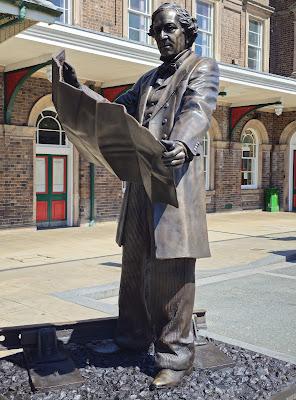
Full-length view of Brassey's statue: he is consulting a map, and placed in front of the station building.
 The 1840s were the height of Britain's 'railway mania' and Brassey was able to pick and choose his contracts. There were a lot of them - by the time of his death, Brassey's company had built a third of the UK's railway, as well as significant amounts of rail network across the world. That meant constructing much more than track: he also built stations, viaducts, bridges and tunnels - including Chester Station itself, manufactured building materials, and employed tens of thousands of workers. And his interests extended beyond the railways: he also built part of London's sewer system. His Grand Crimean Central Railway, built at cost price, was a contribution to the war effort for the Crimean War against Russia.  

Unsurprisingly, Brassey died a very wealthy man. However, he was also a modest one and had a reputation as a good employer, including to the navvies (labourers) who built the railways and whom he paid fairly as well as providing food and clothing. His work was of high quality and is still central to Britain's railway infrastructure.  
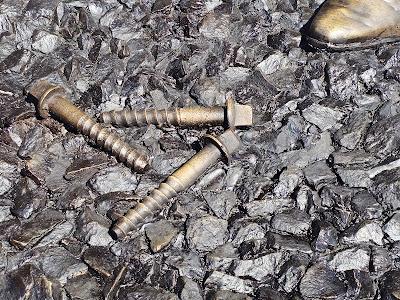
Detail of the statue base, including several bolts.
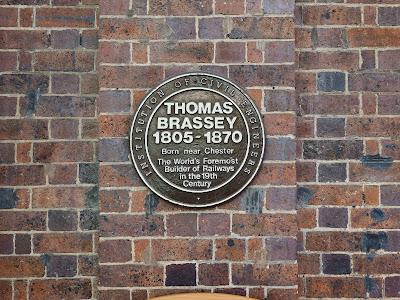
The statue is not the only memorial to Brassey at the station - there is also a plaque inside, erected by the Institute of Civil Engineers. 
Photo of a circular plaque to Thomas Brassey, The World's Foremost Builder of Railways in the 19th Century, placed by the Institute of Civil Engineers.

The Thomas Brassey Society campaigned and raised funds for the statue, which was sculpted by Andy Edwards.  


Back to Featured Articles on Logo Paperblog