Before reading on, take a moment to think where this fine building entrance might be found, and its likely age.
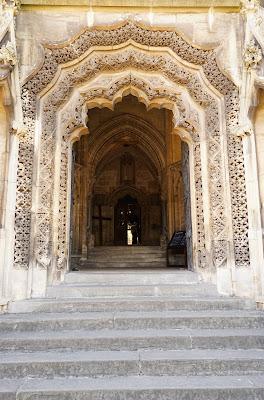
If you don't already know St Mary Redcliffe, you might not have guessed that this is the entrance to a parish church in Bristol - or that it dates to 1325. It leads into the hexagonal outer north porch, which leads in turn to an even older inner porch built at the turn of the thirteenth century.
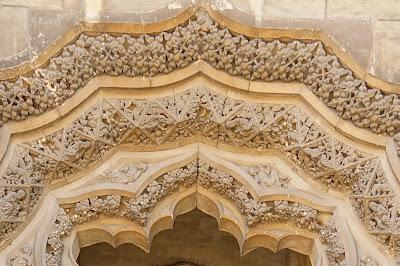
Michael Quinton Smith's architectural history of the church suggests that the outer porch's decoration and the hexagonal porch shape were inspired by the Eleanor Crosses. Other sources of inspiration may have included nearby Wells Cathedral as well as the south transept of Gloucester Cathedral and the Lady Chapel at Ely Cathedral. However, the overall form of the entrance point to more distant influences - Smith identifies Indian and Chinese. This is unsurprising, as Bristol was already an important port when the church was built above its harbour; Moorish Spain was among its most frequent trading partners.
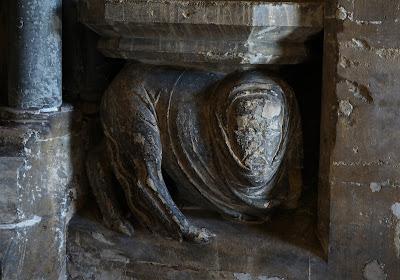
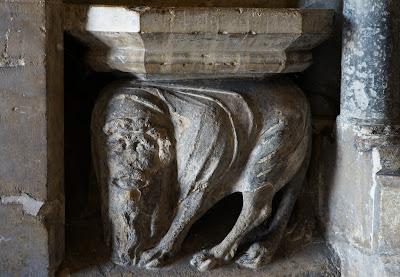
Less is said about the extraordinary carvings at the base of the arch between the two porches. English Heritage's listing text simply describes them as 'fine human-faced beasts'. That hardly does these intriguing characters justice!