Culture Magazine

Albert Bridge in Colour

By Carolineld @carolineld

The Albert Bridge is perhaps London's prettiest Thames bridge, and certainly its most fragile. Right from the start, there were issues: in the 1880s, Joseph Bazalgette had to add suspension bridge elements to Roland Mason Ordish's original 1873 construction. Concrete piers were added in 1973. Despite all the changes, it is not structurally strong and traffic has to be carefully restricted. 
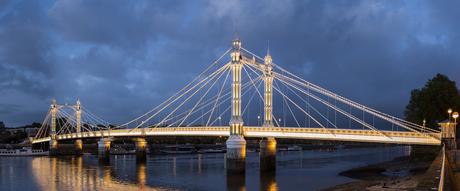
Photograph of Albert Bridge at night. The suspension bridge appears finely detailed, its supporting pillars made up of multiple slender pillars and its cables lit by lines of white light.

Image by Diliff, Wikipedia

White and dainty with its fine pillars, columns and cables, it is reminiscent of a finely detailed wedding cake. However, the Albert Bridge in fact has more color than a first glance suggests.  
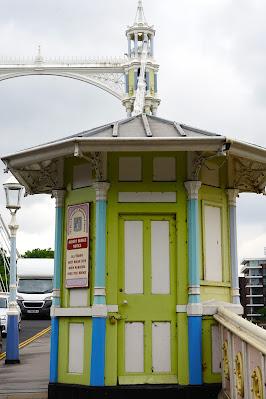
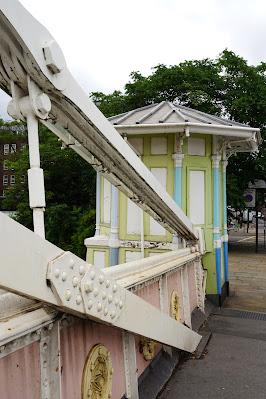
Photo of a small, octagonal tollbooth painted white with bright green and blue details.
  The green and blue accents are most obvious on the little huts at each corner of the bridge. These are tollbooths: the bridge was originally a commercial venture. It was not a successful one, though. (Unsuprisingly, as a condition for allowing it to be built was that the company had to compensate and maintain nearby Battersea Bridge.) The tolls only lasted for six years before the bridge was taken into public ownership. The booths remain, cheerful little reminders of the bridge's earliest days. And you can see signs on them warning troops to break step as they cross the bridge - a warning to the residents of nearby Chelsea Barracks. The barracks closed in 2008 but the signs remain.  
Photo of the colourful tollbooth with white bridge cables in the foreground.

The same colours are also used more subtly elsewere on the bridge's structure. They were added in 1992, to help make the bridge more visible to shipping - especially when light is poor.  
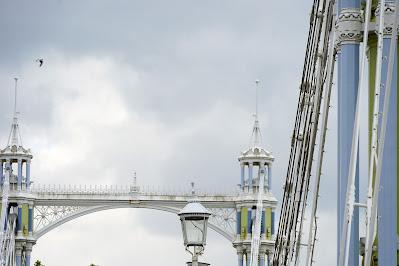
Photo showing detail of the bridge, with white cables and blue and green details on their supporting pillars.

The most recent works to the bridge meant it was closed for almost two years in 2010-11. It remains delicate, but Londoners' affection for it - and Grade II listing - mean that it has survived beyond many pessimistic predictions. Its delicate white lines are famous, but the less obvious coloured touches help to keep it safe as well. 
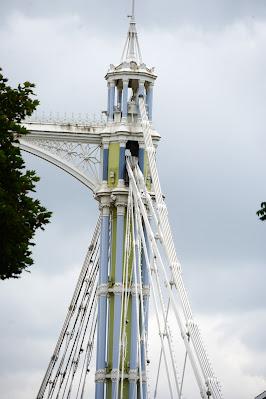
Photo showing one of the supporting pillars, painted in blue and green.
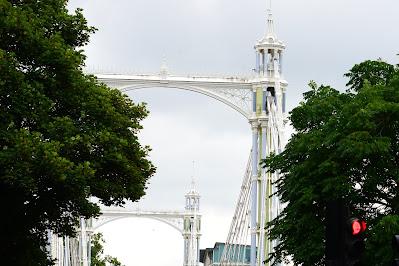
Photograph showing another view of the upper part of the bridge from the approach. There are trees in the foreground, with pillars and cables beyond.


Image credit: nighttime photo of Albert Bridge by Diliff - CC BY-SA 3.0 


Back to Featured Articles on Logo Paperblog