


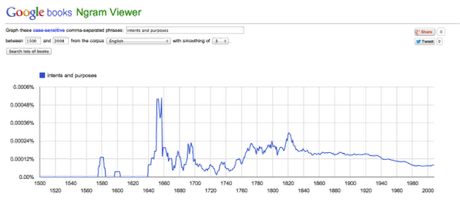
Click here for the dynamic version.
For all intents and purposes, here is a short history of one of the most commonly misquoted expressions to ever grace the English language.
The phrase “for all intents and purposes” means “in every practical sense,” and was first coined in England in 1546, when Henry VIII wrote in an Act of Parliament:
"to all intents, constructions, and purposes"
According to Google’s Ngram Viewer, the phrase didn’t show up in the English corpus until 1576. The next milestone in AIP’s history occurred in 1709, when Joseph Addison abbreviated it in The Tatler:
"Whoever resides in the World without having any Business in it … is to me a Dead Man to all Intents and Purposes.”
However, people have been saying the phrase wrong for centuries. In 1870, The Fort Wayne Daily Gazette wrote the following:
"He has never had a representative in Congress nor in the State Legislature nor in any municipal office, and to all intensive purposes, politically speaking, he might have well have been dead.”
This malapropism has pervaded our speech because it sounds so similar to the original phrase. It’s a funny habit, considering the “intense” in “all intensive purposes” means the opposite of “practically speaking.”
For all intents and purposes, “intensive purposes” is only the phrase you’re looking for if your purposes are indeed intense.
(via NYT, Wordnik, & The Phrase Finder)







