


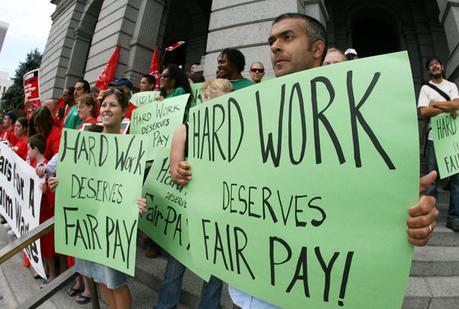
In the recent past, there's been some written about the high costs of low wages and I think it's important to cover some of those now. Wages in the US for the last 3 or 4 decades have stagnated so Americans, coast to coast, have, in fact, been making less money for doing the same or, in plenty of cases, even more work.
Corporations have given their people along with technology grinding out ever more work for us, yet even with inflation making things cost more, we're getting less and less in our paychecks. Some proof:
For most workers, real wages
have barely budged for decades
Wage Stagnation in Nine Charts
| Economic Policy Institute
The Economist explains:
Why American wage growth is so lousy
And it's hitting younger Americans hardest, it seems. Millenials make far less than their parents, the Boomers, at the same time in their lives.
The Incredible Shrinking Incomes
of Young Americans - The Atlantic
Millennials earn 20% less t
han Boomers did at same stage of life
Meanwhile, here in America, wages have been falling while corporate profits have been simultaneously, disgustingly, immorally rising.
Corporate Profits Grow and Wages Slide
Why are US corporate profits so high?
Because wages are so low
US Wages Up, US Profits Down:
The American Economic Problem
Corporate Profits vs. Wages:
The Great Divide
Corporate Profits Rise to New Heights
as Wages Decline
Corporate Profits Just Hit An All-Time High
Not only have corporate profits been increasing greatly, but CEO pay has been soaring, as well.
CEO Pay Has Grown 90 Times Faster
than Typical Worker
Top CEOs Make 300 Times More
than Typical Workers
CEO Pay Continues to Rise
as Typical Workers Are Paid Less
The Only Thing Up on Wall Street
Is CEO Pay | Fortune.com
So with this in mind, I'd like to point out some of the costs of low wages, but for corporations.
First, one of the costs of low wages to corporations is that they get lesser skilled workers for the jobs. If the job pays less, the people with more skills and who are, naturally, more desirable, go elsewhere for work and jobs and pay. It only stands to reason. So the company paying less get people with fewer skills, less knowledge, less experience and honestly, even less social skills. It's a ruder, cruder possible employee/associate. That's tougher to train and get to where they need to be for good customer service.
Second, once the jobs are maybe filled, there is the turnover in these jobs because they do, in fact, pay so little, too little. The employees find they can't stay at their job because it doesn't, in fact, pay enough to, say, keep the car running and rent paid, etc. The employee is pushed to do what they must and some do, in fact, find better-paying jobs elsewhere. And they leave. And as they do, there goes all that experience and training the company did to get and keep them. Definitely a cost.
Third, even if the employee stays, if they aren't paid enough, it's well known they may have to get at least a 2nd job, if not even a third. The original hiring company can pretend this doesn't matter or effect them or the employee or the service level or the job but they're virtually always mistaken on that. The more that employee is distracted by having to run to a second job and/or to fight, really to get enough money to keep their car running and the rent paid, the more it detracts from the work that needs to be done. It's a worn-down employee that is predictably drained and who naturally does not as good a job. They're at their figurative "ropes' end." They're worn out. And tomorrow, they have to do it all again.
So sure, companies can pay less and lots and lots are, in all kinds of sectors. And yes, they can think they're keeping their costs down because, on paper, maybe they are. But those lower costs of low-paying jobs have other costs, too, and at least one of them is the employees they get. After that, there's the additional cost of the type work they're getting from these individuals. And it's not the individual's, the employee's fault, not exclusively.
It's important, then, to note, that LOW WAGES HAVE A COST, COSTS, TO CORPORATIONS THEMSELVES.
Higher wages reduce employee turnover.
There Are Significant Business Costs to Replacing Employees
That lowers the cost of both replacing the employee but also of hiring the new employees.
Higher wages also, besides reducing costs, can and provenly do, in fact, raise productivity.
Want Innovation? Try Raising Minimum Wages
Additionally, it's been shown that a higher minimum wage increases all kinds of other business because, hello? people actually have money to spend. They have more money so they can and do spend.
CEO says minimum wage increase
boosts business
This is absolutely one area where the old saying of "You get what you pay for" rings very, very true.
Extremely so.
It also seems, to me and to a lot of us, that Senator Bernie Sanders is and was correct when he said:
Nobody who works 40 hours a week should live in poverty
Links:







