


Book Review by George Simmers: The Clockwork Man is science fiction 1923-style. It begins at a cricket match in the quintessentially English village of Great Wymering Dr Allingham is batting when a strange figure puts him off his stroke by walking in front of the sheet that is acting as a sight screen. I was reminded of Wodehouse’s Psmith in the city, where uou know from the start that the bank manager is an rank outsider when he walks carelessly behind the bowler’s arm just as Mike Jackson is about to make his century.
The offending person this time is even more alien than the bank manager. It strikes the doctor as ‘certainly abnormal. Its movements were violently ataxic. Its arms revolved like the sails of a windmill. Its legs shot out in all directions, enveloped in dust.’
The figure wears a red wig and a bowler hat, and his ears flap ‘violently backwards and forwards, with an almost inconceivable rapidity.’ He explains to a sympathetic listener that he is a Clockwork man, but there is something wrong with his clock. He is surprised to find himself in 1923.
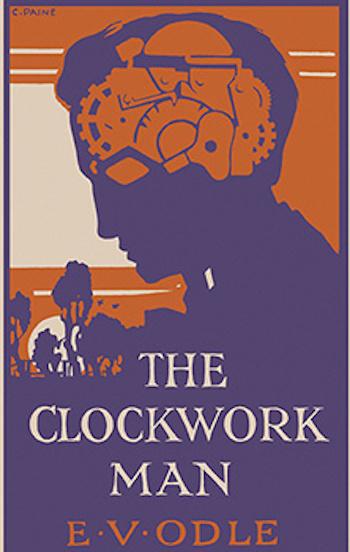 Cover of the first American edition
This strange man is interested in the game and asks the captain (who is a man short, so welcomes the suggestion) if he can play. He begins by hitting the ball way out of the ground, but when told he should run, keeps running until he hits the sight-screen sheet, and gets wrapped up in it. The match ends in confusion and violence.
Piece by piece we learn more about him. He comes from the future, when men like him are all regulated by a clockwork mechanism, but his has gone wrong. He is rather scornful of 1923, which is a primitive age when humanity was only just beginning to understand Einstein’s discoveries about Space and Time. The question is discussed in along conversation between Dr Allingham, whose ideas are very conventional, and Gregg, who has an inkling of the new science, imagines the clockwork as a way of harnessing the new Einsteinian reality:
The clock, perhaps, was the index of a new and enlarged order of things. Man had altered the very shape of the universe in order to be able to pursue his aims without frustration…. Time and Space were the obstacles to man’s aspirations, and therefore he had invented this cunning device, which would adjust his faculties to some mightier rhythm of universal forces. It was a logical step forward in the path of material progress.
That was Gregg’s dimly conceived theory about the mystery, although, of course, he read into the interpretation a good deal of his own speculations. His imagination seized upon the clock as the possible symbol of a new counterpoint in human affairs.
The novel shifts between social comedy of an alien mechanical stranger in 1923 and rather windy explorations of Einsteinian possibilities. I take it that Gregg’s wild theories and extrapolations from Einstein are Odle’s own thoughts on the subject. A final chapter gives us the back story that Odle had not managed to integrate into the novel. integrate into the bulk of the novel.
He tells about a catastrophic war:
There was a great deal of fighting and killing and blowing up and poisoning, and then the makers came and they didn’t fight. It was they who invented the clock for us, and after that every man had to have a clock fitted into him, and then he didn’t have to fight any more, because he could move about in a multiform world where there was plenty of room for everybody.
The clock gives the wearer the ability to move through time as as well as space. It seems that women (who are less aggressive, apparently) are not adapted in this way. They stay ‘real’ like the mysterious ‘makers’.
E.V. Odle was a man of letters – a short story writer and editor, on the fringe of the Bloomsbury set, He was Dorothy Richardson’s brother-in-law. During the war he had been manager of a munitions factory – which must have given him food for thought about mechanisation, and about human destructiveness.
The Bloomsbury connection makes me wonder about his ending.
We are told that ‘the makers were very clever, and very mild and gentle’ and that they don’t wear clothes. Are these mysterious ‘makers’ gods or aliens, or what?
Or, given the Bloomsbury connection, are they people of superior civilisation, of the Bloomsbury type, who lobotomise and castrate males of the lower orders who don’t live up to their high ideals? If so, that’s rather a terrifying future.
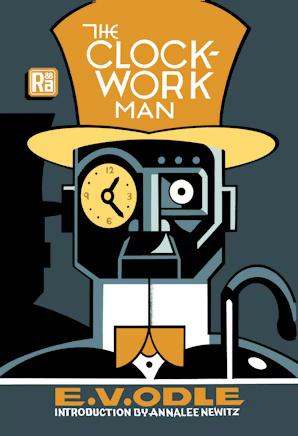 I rrsd the book as one of a paperback series of SF classics, publishe by MIT Press.







