Book(s) review by George Simmers: A few years ago I read (and reviewed here) Edgar Wallace’s Sanders of the River (1911), a book of stories set in colonial West Africa, written by someone who had never been there. The stories are a pure expression of the British imperialist fantasy – Sanders, the decent, honest and self-sacrificing colonial administrator brings peace and justice to his territory, settling arguments between the childishly squabbling tribes and working tirelessly for the good of all.
The other crucial character in this is Bosambo, an African, a man with a shady past, on the run from Liberia. Who comes to the territory and becomes chief of one of the tribes. Charismatic, imaginative and not entirely honest, in many ways he is the opposite of the calm, reasonable, law-giving Sanders, but they become allies, and the book conveys the point that to govern the territory, both men are necessary.
When I read Bones in London (1921), a much later book in Wallace’s African series, I was surprised, because it seemed to belong to a different genre altogether from the colonial adventures of Sanders of the River. I looked at some of the earlier books, to try to understand what had happened.
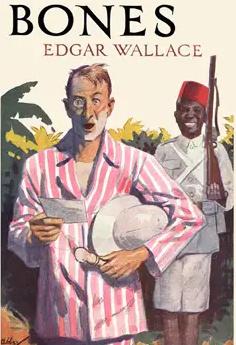
Bones (1915) is number four in the Sanders series (after The People of the River (1912) and The River of Stars (1913). In the first story Sanders goes on leave to England (and to collect a C.M.G.) Responsibility is left with his trusty second-in-command Hamilton, and a newcomer comes from England in support. He is Lieutenant Francis Augustus Tibbetts,
raw to the land, but as cheerful as the devil—a straight stick of a youth, with hair brushed back from his forehead, a sun-peeled nose, a wonderful collection of baggage, and all the gossip of London.
Because he is so tall, thin and bony, Hamilton immediately nicknames him ‘Bones’. He has huge ambition:
If you smile at Bones, you smile at the glorious spirit of enterprise which has created Empire. Out of such dreams as ran criss-cross through the mind of Lieutenant Tibbetts there have arisen nationalities undreamt of and Empires Cæsar never knew.”I
Bones’s inexperience is the main theme of the stories in this volume. He is either too soft on the natives, or too hard on them. He is easily fooled by the devious tribesmen; he accidentally kills a sacred green crocodile and has to replace it. He is clumsy, and there is much physical comedy:
He saluted with the hand that held the lather brush, turned about like an automaton, tripped over the mat, recovered himself with an effort, and preserving what dignity a man can preserve in pink-striped pajamas and a sun helmet, stalked majestically back to his quarters. Half-way across he remembered something and came doubling back, clattering into Hamilton’s room unceremoniously.
Bosambo is still around, and he is often there to get Bones out of a difficult situation. Gradually Bones learns the arts of Empite, and proves himself in one of the later stories by killing a tribal chief who has broken the law.
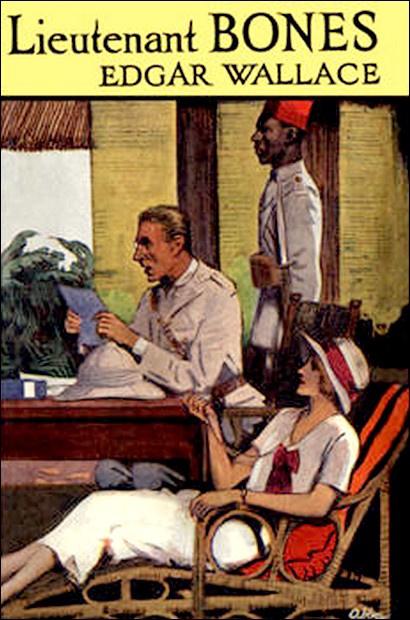
There was another series of short stories (The Keepers of the King’s Peace (1917) }between those in Bones and those in Lieutenant Bones (1915). By now Wallace’s African stories had moved upmarket from the penny paper, the Weekly Tale-Teller to the more upmarket glossy, the Windsor Magazine (price 6d). The stories in this collection are different from those in Bones. Sanders is back, and the teritory is more or less settled, Tibbetts is now almost entirely a comic character.
Whereas in earlier book he was working hard learning the complexities of Africa, in thies book he is not presented as a learning character, but as a settled one, and rather an idiot. He has a talent for doing stupid things, but they somehow turn out all right in the end. In the first story, he thinks he is hunting a German ship, but it turns out to be a craft of native rum-smugglers. He opens fire on it, the rum catches fire, and the craft crashes into a lurking German submarine, which is done for. Bones is the accidental hero.
There are reminders that even though all Britons are not as perfect as Sanders, they are better than the other imperial power, and that the worst elements of other countries come to Africa in the hope of profit:
All the bad characters, not only the French of the Belgian Congo, but of the badly-governed German lands—all the tax resisters, the murderers, and the criminals of every kind, but the lawless contingents of every nation, formed a floating nomadic population in the tree-covered hills which lay beyond the country governed by Bosambo.
Even hapless Englishmen like Bones are preferable to such foreigners – and he has the advantage of being lucky. (Edgar EWallace was a great devotee of horse-racing, and luck was a quality he valued.)
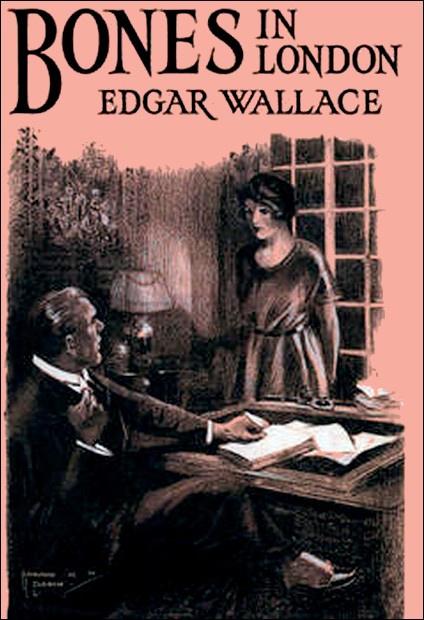
In Bones in London (1921, so six years later) the character has changed again. (Once again this comes from a series of stories in the Windsor Magazine.) Bones has won a lottery prize (his hopes for a sweepstake prize had been a running joke in earlier volumes) and is now a millionaire, and in London. He is looking for ways to invest his money, and becomes the prey of every swindler in London. He always triumphs. Hamilton, home on a pension, comes and joins him (rather unrealistically, since in Africa he had always been scornful of Bones – but Edgar Wallace wants Bones to have a straight man, and never seems worried about plausibility.) Bones is now even more of a comic character. His language had always been affected, but now it is ridiculously more so. There is a comic relationship with his secretary, whom he worships.There is comedy about his inability to spell or to write a coherent letter, which had never been mentioned in the earlier books. He is very much an upper-class twit, and there may be an attempt to emulate P.G. Wodehouse in the presentation of him.
The other characters are stereotypes. Africans have complained abut the racial stereotyping in the African stories; the English criminal classes have even more reason to complain abou their presentation in this book. They are consistently inept and stupid; the failure of their schemes is always due to their own stupidity, rather than to Bones’s intelligence – but he is more than ever blessed with amazing luck. Only in the last story does Bones triumph through anything but luck. In this story, some swindlers have persuaded Sanders, now retired, to invest his money in a worthless scheme. Bones actually uses brains and ingenuity to save his ex-boss’s fortune.
These three books show how Wallace used and manipulated a character for his immediate purposes, without worrying too much about consistency. These are stories for the magazine market, to be read on the train, and then vaguely remembered – not for a book where you might check back, reading them as in a novel. Reading these three books togetehr is a frustrating experience -so much repetition of tropes and character types, and somany inconsistencies of continuity. In Bones, Sanders returns from England in one story, only to be still away in England in the next. In one story, Bones has the job of looking after an adopted child – whse presence is unexplained. A few stories later, there is an explanation of how the child came to be in Bones’s care. Wallace obviously wasn’t concerned enough to straighten out any psuch problems when the stories were reprinted in book form. A reminder that the principal income of most popular writers of the time came from magazine publication. Book publication was a less profitable extra. And since Edgar Wallace was publishing anything between ten and eighteen books a year at this time, he would have had small time for scrupulous revision, anyway.
Wallace was the most celebrated thriller writer of his time, and the most professional, a dependable provider of thrills. He typically provided stories and serials that gave immediate reading satisfaction – excitement, surprises, violent action. These stories are a reminder that he could work in other genres – colonial stories and comedy, providing satisfying well-constructed stories. They also remind us that he typically wrote for the immediate market, and didn’t mind changing and manipulating his characters to suit the needs of whatever market or genre he was writing at the time.