


There was a time in my life (mid to late teens), when I was very into World War 2 stories. These typically belonged to two major categories:
- Thriller spy novels such as those written by Alistair MacLean such as Where Eagles Dare, or
- Sad novels about Nazi suppression and terror such as Night by Elie Weasel
However, it’s been ages since I revisited Nazi Germany. I felt I overdosed on those books and thought I’d read everything there was to read about that topic. Instead, I shifted my focus to books during World War 1 (Stay Where You Are and Then Leave), or World War 2 books based in Asia (The Garden of Evening Mists, The Narrow Road to the Deep North).
I really didn’t want to read The Book Thief, I had heard that this book was narrated by Death and that it was incredibly sad, and frankly at this point in time I really don’t want to read sad books, and so I resolutely stayed away from this one.
It was only this review from a blogger buddy who raved about the book and insisted it was worth reading despite the sadness, that made me change my mind.
Book Synopsis

Set during World War II in Germany, Markus Zusak’s groundbreaking new novel is the story of Liesel Meminger, a foster girl living outside of Munich.Liesel scratches out a meager existence for herself by stealing when she encounters something she can’t resist–books. With the help of her accordion-playing foster father, she learns to read and shares her stolen books with her neighbors during bombing raids as well as with the Jewish man hidden in her basement before he is marched to Dachau.
~ Synopsis from goodreads
What can I say that countless others haven’t said already? This is a beautiful book. Yes, it is sad, and yes, I cried buckets throughout the novel. But in spite of the sadness, there is a beauty to it.
I found myself taking the book with me everywhere, and reading bits and pieces of the book in the most inappropriate places (waiting at a shop for some tailoring to get done, waiting at a restaurant for a friend to come).
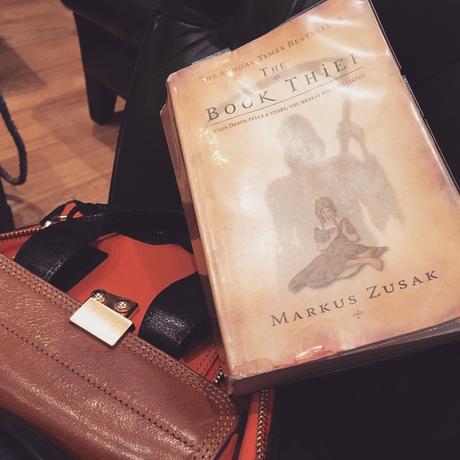
I shudder to think what my expressions must have been like in that restaurant as I read this book
Yes, it was that kind of compulsive reading, and even though this book is not a thriller as such, it’s very easy to read, and I found myself finishing this chunkster in a two-three days itself.
That said, this book isn’t perfect.
Like I said earlier, this book is narrated by Death, and while this works in some ways, in some ways it didn’t, at least not for me. Here’s an example:
Somewhere during the middle of the book, Death lets out a big spoiler about the fate of one of the characters in the book. Now, considering this is Nazi Germany, you can guess that this person’s fate was not good. However, by knowing in advance about this, I felt so very, very sad. I couldn’t actually focus on the light-hearted stuff that happens in the book, because I knew all along that this character is not going to have a happy ending.
Does that make sense to you? I think a lot of people liked this poignant aspect of the book. But it just annoyed me. I didn’t need to be constantly reminded that so and so person was going to die in a month’s time, or week’s time, or stuff like that. I found this approach a little gimmicky, calculated to make the reader cry.
Another impact of this spoiler was that I was focusing so much on the boy who died, that Liesel (the main character of the book) just passed me by. Either I missed any character development of Liesel or maybe there just wasn’t any. Probably Zusak and Death were too busy doling out spoilers to actually develop the core character in the book.
Death justifies this spoiler though:
Of course, I’m being rude. I’m spoiling the ending, not only of the entire book, but of this particular piece of it. I have given you two events in advance, because I don’t have much interest in building mystery. Mystery bores me. It chores me. I know what happens and so do you.
I guess if you see it from the point of view of Death, there is no such thing as spoiler, right? As death is something inevitable.
Leaving you on that very lively note, let’s go to other aspects of the book. After all who am I to comment on how an author chooses to tell his story?
The characters
Oh man! How can a writer make Nazis feel so human? This story is about a bunch of ordinary people living in Nazi Germany. Some people support Hitler, some do not, but all of them are equally helpless in this war that overtakes their lives. Each character living on Himmel Street (ironically means Heaven in English) is outlined so well. Right from Liesel’s foster parents, to the neighbors next door, to Max – the Jewish man who hides in Liesel’s basement, to the Nazi shopkeeper, and the boys in the Hitler Youth group – they are all beautifully written.
Plot and Writing
The writing is first-class, a little on the simple side as YA novels usually are, but still very well-written. Alas! The plot as such is pretty thread-bare. To be fair to the book, I don’t think this is a particularly plot-driven story, but still I would not be complete in my review if I don’t mention that the plot is no great shakes.
You read this book for the wonderful characters, the sad setting, and the author’s quirky writing style.
On a last note
I was googling around for a particular quote that I wanted to use in my review. Well, I couldn’t find the quote online, but take my word for it, it was a really beautiful one. However, while googling, I came across this image of the author reading out from his book during some book signing.
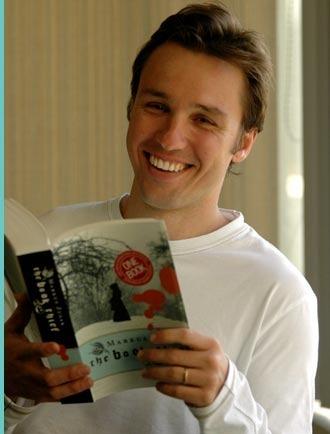
Why does he look so happy?
And I don’t get it. Why does he look so happy? At no point ever in my reading the book was I this happy. It’s just not fair that a writer wrings the hearts of his readers, and then smiles over it 

You can also purchase a copy of this book from Amazon







