


Book Review by Jane V: I came to Sirius for the first time many years ago, when a late teenager but my memory had wrongly attributed the novel to John Wyndham. The storyline must have made a great impression at the time because as soon as I found a list of Stapledon’s novels I realised that I had read Sirius before and had retained a sketchy idea of the story.
I feel that Stapledon uses the idea of a dog with the brain and mind of a man to examine the estate of mankind. He looks at the practical, rural life of an artisan; at the ivory tower of academia; at the spiritual world of religion; at the bestial nature in all humans. The conceit of using a dog as a part outsider to do this is interesting, seeing that dog is man’s closest non-human companion, ideally place to observe. What is lacking in all these areas of man’s life? Is it this lack which mankind is ever in search of, the ‘quickened mind’ which Stapledon often refers to in the novel?
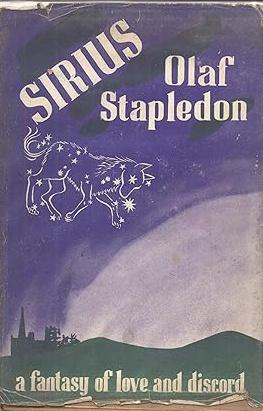 Cover of the 1944 edition
Olaf Stapledon was a philosopher who wrote futuristic novels posing ‘what if’ questions. One question I would expect a philosopher to ask is, ‘is it morally or ethically right to create a chimera whose life cannot ever be a happy or comfortable one?’ But nowhere in the novel does Stapledon do this.
The novel is narrated by the lover and future husband of Plaxy, daughter of Thomas Trelone, the Cambridge scientist who created Sirius, a male dog with a male human brain. Robert, the narrator, claims to have had access to Sirius’ diaries and to have filled in where the diaries were lacking. Trelone has been experimenting for some time seeking to create a dog with the intelligence of a human. Along the way he has created ‘super-sheep-dogs’, collies of superior ability (which he sells to local Welsh sheep farmers). He succeeds in creating only one super-brain dog – Sirius, named for the brightest star in the northern hemisphere. Stapledon explains this process rather vaguely as ‘introducing a certain hormone into the blood stream of the bitch. This increased the bulk of the cerebral cortices and made the nerve fibres much finer. This resulted in a much larger head than normal.’ (Stapledon equates the size of the brain with the extent of the intelligence, which is now known to be a false assumption.)
The puppy is raised as far as is possible as a human child, alongside Plaxy, Thomas and Elizabth’s youngest child. Consequently child and puppy form a close relationship which Plaxy later describes as the Plaxy/Sirius ‘spirit’. The humans in the family learn to understand Sirius’ version of human speech and the dog learns to read and to appreciate and sing music. His ear for sound is far superior to that of a human although his eyesight lacks color and clear definition. (We now know that collies have very good vision.) His sense of smell is for him his most important sense, bringing to him information about the emotions and moods of his humans, a sensibility which eludes human beings.
Sirius matures much slower than a normal dog but as time goes by he enters his teenage years. He and Thomas have many long discussions as they roam the moors of north Wales. Thomas promises Sirius that he will one day be taken to Cambridge to meet Thomas’s scientific team and to participate in the life of academia. But first Thomas’ plan for Sirius is that he shall go for a year to a kind local sheep farmer and learn to work the sheep and to experience the tough life of an ordinary sheep dog. Meanwhile Plaxy is sent away to boarding school, at the age of sixteen. Teenage Plaxy and teenage Sirius grow somewhat apart, chiefly because Plaxy is preoccupied with boarding school friendships. Sirius meanwhile begins to explore the doggie side of his nature, developing an interest in bitches on heat and standing up to his rather aggressive co-worker. But he feels his intellect is atrophying in this environment and is impatient to move on to explore all human life and experience.
At last, when Plaxy gains a scholarship to Cambridge, Thomas takes Sirius up to the university, taking great pains to introduce his creation to only those who will not divulge to the general public the existence of this phenomenon. Sirius opinion of the ‘ivory tower’ life is not altogether favourable. He notices the jostling for fame and a tendency for ‘back stabbing’ among the academics who ‘are itching for personal success, for limelight, or to make someone else in it (the university) look foolish or ugly.’ Sirius attends departmental meetings and participates in the research, allowing himself to be studied. But he grows dissatisfied with the academic life; he feels that Pugh the sheep farmer is more real than these brainy people who work with their minds only and underate their dextrous hands. It is Sirius’ lifelong regret that he is unable to undertake any activity which requires fine manipulation because his paws are no match for human or ape hands. At Cambridge Sirius suffers what he feels to be moral decay and his sexuality grows rampant. He feels loyalty and sincerity in humans is inferior to that shown by dogs. ‘Loyalty with dogs could be absolute and pure. With men it was always queered by their inveterate self-love. They must be insensitive really, drunk with self, and insensitive to all else. There was something reptilian about them, snakish. . . . What enraged him most of all about human beings . . . was their self-deception’, they were ‘quite different really from the mask they presented to the world’.
Thus disillusioned and bored with the academic life, Sirius asks to be allowed to study religion as practised by the Church of England. Accordingly he goes to stay with a cousin of Thomas Trelone who ministers to a flock in London’s east end. The reverend Geoffrey Adams has chosen to remain in this poor parish where he ministers to the deprived citizens in truly Christian fashion. Sirius accepts this as sincere good work but his intellect does not permit him to accept the unquestioning faith or the adherence to ritual which Rev Geoffrey advocates. Geoffrey learns to understand Sirius speech and cleric and dog have many good discussions on these points. But looking around him at the undernourished, poorly housed and uneducated people Sirius is ‘amazed by the contrast of homo sapiens in affluence and homo sapiens in penury’. He experiences social inequality. He observes a dock strike. Physically Sirius becomes constipated from lack of proper exercise and he feels his mind is constipated too. ‘It was his nature to give himself absolutely to some work; but to what work? To mere sheep-tending? To science? Why, of course, to the spirit. But how?’ (It would be helpful if Stapledon had defined what he means by ‘spirit’ but nowhere does he do that. I take the meaning to be something like the essence of being, certainly not the soul as understood by Christians.)
One compensation for Sirius in the east end is the music of the church, in which he takes great delight. He persuades Geoffrey to allow him into the vestry where he can sing along with the humans. He even composes music of his own to perform. His superior grasp of sound produces music which the human ear is unable to fully appreciate. Sirius is anxious to find his calling in life, his raison d’etre. He has a vision of ‘the superhuman master with his claim for absolute loyalty and service.’ Is this God, or a god? Inevitably Sirius becomes disillusioned with the religious life too. He feels he is a misfit and a mistake and asks to return to a ‘proper job’ – looking after Pugh’s flock in north Wales.
He returns to the farm as the manager, having learnt from Pugh about markets and profits; sheep husbandry and all areas of farm management. He feels he has found his purpose in life. He has sheep dogs of the extra intelligent type under him to help with gathering and lambing. It is during this time in his life that Thomas suggests taking him to the Lake District to study how sheep farming is carried out there. It is while here that Sirius experiences Man as cruel tyrant. This farmer is cruel and violent. He beats his dogs and, in defence of one of his co-workers, Sirius kills him. Meanwhile in Europe the Nazis are invading weaker countries and showing just how far ‘man’s inhumanity to man’ can go. Thomas comes to rescue Sirius but on their way home to Wales they pass through Liverpool just as an air raid strikes, and Thomas is killed. Sirus is at last his own master emotionally and physically. Thomas’ wife Eliabeth is anxious to help on the farm but wears herself out with her not all together welcome interference and dies of shock when she believes her son, service on a ship, has been kiiled in a torpedo attack.
Plaxy gives up her career in London and she and Sirus now move into a farm cottage in the wilds of north Wales. Sirius continues to run Pugh’s farm and life seems idyllic. Yet Sirius has forebodings – “This is not real. It is a lovely dream. Presently I shall wake up.” And Plaxy replies, “Perhaps it will not last long, but it is real while it lats. And there is a rightness in it. It had to be, to make us one spirit for ever, whatever else may come. We shall be happy, never fear.” He kissed her cheek.’ Here the narrator (Plaxy’s one time lover) buts in. He asks why a girl admired by many with a promising career as a teacher should give it all up to live with a man/dog. He offers, ‘Does it not seem probable that the underlying motive of this decision was the identification of Sirius with her father?’ (Her father with whom she had not had a particularly easy relationship.) Plaxy dismisses this idea, ‘holding that it (did) not do justice to the power of Ssrius’ own personality over her.’
The couple, man/dog and young woman live together live together in a close relationship which the reader is given to understand includesa physical element. Plaxy works hard on the farm and for a while the idyll continues. But inevitably tongues in the village begin to wag. Superstition and rumor grow among the village folk. The minister becomes involved and pronounces Sirius a visitation of the devil. The simple folk canot accept a close relationship between and dog and a young woman. Then Plaxy is called by the War Office to return to London and take up a war job. Sirius visits to the previously friendly village become dangerous as the folk thrown stones at him. Good farmer Pugh, who knows the secret of Sirius creation, is drawn into the persecution and Sirius decides that he must leave to protect him. Sirius turns dog and vanishes into the wild, living on rabbits and occasional sheep but keeping out of sight of humankind, no longer able to communicate with Plaxy. She, however, returns to look for him, even as mobs of men and boys with sticks and guns are hunting Sirius down. She finally finds him, fatally wounded by gunshot, holed up in a cave. As she cradles him in her arms he dies.
Plaxy stands facing the coming dawn and sings his requiem, music Sirius himself had composed. ‘The wordless phrases symbolised for her the canine and the human that had vied in him all his life long. The hounds’ (of those hunting down Sirius) baying blended with the human voices. There was a warm and brilliant theme which he said was Plaxy, and a perplexed one which was himself. Looking down on him she realised that his tragedy was inevitable. And under the power of his music she saw that Sirius, in spite of his uniqueness, epitomised in his whole life and in his death something universal, something that is common to all awakening spirits on earth, and in the farthest galaxies. For the music’s darkness was light up by a brilliance which Sirius had called ‘colour’, the glory that he himself, he said, had never seen. But this, surely, was the glory that no spirits, canine or human, had ever clearly seen, the light that never was on land or sea, and yet is glimpsed by the quickened mind everywhere.
As she sang, red dawn filled the eastern sky, and soon the sun’s bright finger set fire to Sirius.’
If an author can write as affectingly as this, why did he write all that convoluted, ridiculous stuff he had written before this novel? I think in Sirius he finally found his way.







