



Insert size 12 universal needle, skipped stitches. Insert size 14 universal needle, skipped stitches. Insert size 12 ballpoint needle, skipped stitches. Insert size 14 ballpoint needle, can you guess? Skipped stitches.
I sat in front of my two sewing machines, my Juki DDL 5500 and my Singer Brilliance, and no needle, thread, tension setting, or presser foot was preventing skipped zig zag stitches on an orange stretch lace fabric I was sewing. The stitch formed on the right side of the stitch but when the needle shifted to the left and pierced through the fabric, the top thread wasn’t catching the bobbin thread and the entire stitch line ended up looking like a straight stitch.
“What would Jesus do?” I questioned. “Jesus would ask Google.”
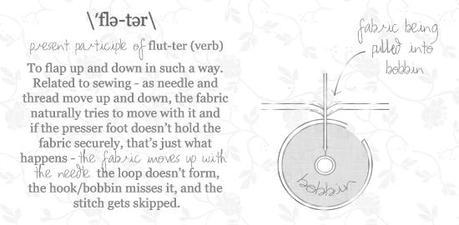
Google did not answer my question as easily as Jesus would, not as prophetic either, and I had to probe the sewing forums to find a solution. Nestled in one of them (too cliche?), a seamstress fretted about how her new Bernina was skipping stitches while attaching elastic. Just like me, no thread, tension setting, needle, or presser foot was solving the problem. She was extra steamy because this was a new machine and her old machine, a Viking, never skipped stitches. Another seamstress commented that the cause of her problem might be the placement of the needle. She bet that on her old machine, the needle was closer to edge of the opening on the throat plate, which was preventing the fabric from “fluttering” and the stitches from skipping. In other words, the placement of her needle when sewing a zigzag stitch on her new machine was more in the middle of the throat plate opening, which made it easier for the fabric, especially a flimsy one, to “flap” up and down with the motion of the needle.
What is fluttering? Related to sewing, I had no idea, which made me dig deeper into the confines of Google and learn a lesson in stitch formation (okay, that was definitely cliche). My answer came from the book Beyond the Pattern: Great Sewing Techniques for Clothing: From Threads, to which Google gave me a snapshot of a couple of its pages.
A stitch is formed when the needle is lowered into the shuttle race, “the mechanism that surrounds the bobbin and holds it in place,” and the top thread forms a loop around the bobbin. The loop catches the bobbin thread and brings it up to the fabric, where it locks with the top thread and forms a stitch. If for any reason the loop does not form or the loop misses catching the bobbin thread, the stitch gets skipped (a diagram of how a stitch is formed is provided in the link above).
As the needle and thread move up and down, the fabric naturally tries to move with it and if the fabric moves with the needle enough, the loop doesn’t form and the stitch gets skipped. This is why it’s hard to stitch close to an edge – because the fabric gets sucked into the bobbin.

I could be completely wrong in my thinking but it makes sense to say that fluttering caused my skipped stitches. It explains why the right stitch of my zig zag, the one closer to the edge of my throat plate, forms while the left zigzag, the one more in the middle of my throat plate, skips. It also explains why when I put an index card/tissue paper underneath the fabric while sewing, no stitches skip, and why when I reduce the speed of my sewing, skipped stitches do not form (the faster the machine moves, the more fabric flutters). So, can I conclude that in addition to type of needle, thread, presser foot, and tension setting, the position of the needle must be considered too (I still had to use a ballpoint/stretch needle when sewing the stretch orange lace)? Is the solution to skipped stitches the right combination of needle position, needle type, thread, presser foot, and tension setting? Boy, there’s a lot that goes into that equation but I think that’s the only way to get the right answer.







