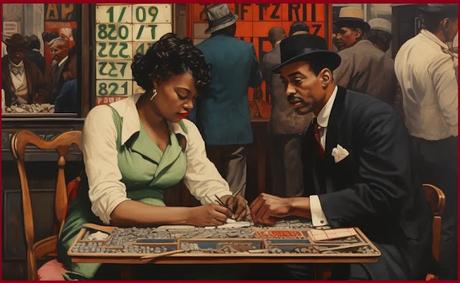
picking a winner
For many years, the 'number' was the last three digits of the 'handle', the amount race track bettors placed on race day at a major racetrack, published in racing journals and major newspapers (much like attendance figures at a football games). Other numbers, like the last digits of a stock price, or the exact balance of the US Treasury, were sometimes used. Punters would place bets with a bookie at a tavern, bar, barber shop, social club, or any other semi-private place acting as an illegal betting parlour. Runners would carry the money and betting slips between the betting parlours and the local syndicate headquarters, called a 'numbers bank'.I planned and co-hosted a poetry writing workshop recently based on numbers and objects. One of the numbers I chose was pi. Others included the fibonacci sequence and the golden ratio.There is a growing body of poems whose form references the mathematical constant known as π (or pi), the ratio of a circle's circumference to its diameter. As a number, it is written as 3.1415926535897932384626433 (etc to as many decimal places as you care). As a poem - or rather a piem - regardless of content, its form is based in some fashion on the sequence of digits in the constant.This could be for instance letters or syllables per word (or line), words per line, lines per stanza or some other cleverly devious representation of 3.1415926535897932384626433 (etc), or a rounding of it to so many decimal places - you choose. Let me give you some examples that I shared at the workshop.Here’s a straightforward piem from Sir James Hopward Jeans based on the number of letters in each word:
How I want a drink, alcoholic of course, after the heavy lectures involving quantum mechanics.
Here’s a piem by Dmitri Borgman that uses the number of letters per word approach, only he’s taken it to the thirtieth digit of pi and he’s choses an ABAB rhyming structure:
Now, a moon, a lover refulgent in flight,
Sails the black silence's loneliest ellipse.
Computers use pi, the constant, when polite,
Or gentle data for sad tracking aid at eclipse.
Here’s a piem variation based on lines in a stanza. Jacques Bens has structured it on the first five digits of pi, and because they happen to add up to fourteen, he’s called the form an irrational sonnet:
Melancholy
So I’ll once more find my old horizons,
cherished scent of winds and habitations.
Fear not if it seems I’m quitting the place.
I leave Paris just to love it better.
One tends to hurry a banal embrace.
But what’s this pride worth that’s past all seasons?
Try to unite the heart with its reasons.
The city, while smiling, leaves a rough trace.
I leave Paris just to love you better.
To love you better, I couldn’t picture—
Now I see the present whisks us away.
To see you, I have to step back a bit.
I lock up my regrets, as will be fit,
Slipping my key under your entryway.
At the workshop in Kate Eggleston-Wirtz's art studio, I worked (among other pieces) on a piem of my own, based on an object in her studio, this quaint rocking-horse. I suppose I chose it because I had in mind to write this blog about betting, horses and running numbers. That, and it was stood right in front of me.
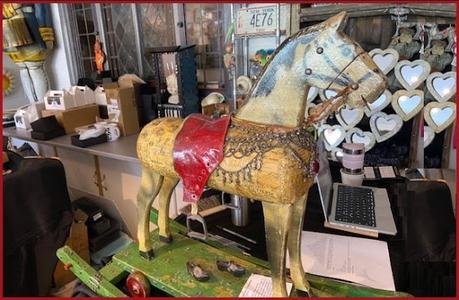
the rocking-horse winner
I've used π (or pi) to determine the form of the poem, in this case the number of lines in each stanza. I didn't stop at fourteen lines, but ran on to nine decimal places (3.141592653) before running out of puff.Horse Pi(e)Triangle on a quadrilateralwith parallel legs and a rocking base,some child's delight, a nursery toy.
Stop!
D.H. Lawrence wrote a ghost storyabout a boy, The Rocking Horse Winner,who rode a frantic dash to deathproclaiming "I've got it - Malabar."
Or some such.
I've not read it in, oh, fifty yearsbut I'm pretty sure he guessedthe winners in advance of big racesby going into a rocking tranceuntil the name came to him.
He told the family's gardener,good working man, who placed his betsand managed the money that came in,sometimes used a tip on his own behalfbut nothing compared to the thousandsthe boy was building up in secret,planning to give the funds to his motherwho always complained of not havingenough for the family to get by.
When she told him he was getting too oldfor rocking horses, he planned one last run.
That's what killed him, number one son,eighty thousand to the good. I wonderwhat happened to the little horseafter the tragedy. His story wasn't told.Did he become horse pie?Put down to firewood perhaps?
Did grief, that constantreminder of the ratio betweenthe circumference of their lossand the diameter of their gain prove endlessly recurring
on haunted nights? The soft rhythmic thrumming of ariderless runner across the nursery floor?
Thanks for reading, S ;-)
Email ThisBlogThis!Share to XShare to Facebook