A fascinating PNAS article by Tiusty and Libchaber offers 'an oversimplified language of life.’ It is a long article, but I found it a very worthwhile read. (Motivated readers can obtain a PDF of the article from me.) Here I pass on the Significance and Abstract paragraphs, and the first figure.
Significance
This
paper follows an idea by Leibniz that life can be seen as an infinite
cascade of machine-making machines, down to atomic machines. It proposes
an oversimplified language of life, highlighting certain scaling
aspects and the key step of self-reproduction, with a singular point at
one micron and a thousand seconds. (click on figure to enlarge)
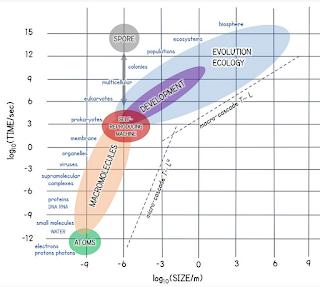
Abstract
Life
is invasive, occupying all physically accessible scales, stretching
between almost nothing (protons, electrons, and photons) and almost
everything (the whole biosphere). Motivated by seventeenth-century
insights into this infinity, this paper proposes a language to discuss
life as an infinite double cascade of machines making machines. Using
this simplified language, we first discuss the micro-cascade proposed by
Leibniz, which describes how the self-reproducing machine of the cell
is built of smaller submachines down to the atomic scale. In the other
direction, we propose that a macro-cascade builds from cells larger,
organizational machines, up to the scale of the biosphere. The two
cascades meet at the critical point of 10
3 s in time and 1
micron in length, the scales of a microbial cell. We speculate on how
this double cascade evolved once a self-replicating machine emerged in
the salty water of prebiotic earth.