


Book review by Alison B: Last and First Men was Olaf Stapledon’s first published work of fiction. It is a hugely ambitious and wide ranging imaginary account of the future of humanity spanning 2 billion years and 18 distinct human species, written from the perspective of a member of the eighteenth species looking back, who has guided the author by his ability to reach back in time through the process of telepathy! There are almost no specific individuals referred to in the course of the book so it is not the usual form for a novel at all, but rather an extended essay. It is certainly not the sort of book that I could read for half an hour before bedtime for relaxation, but, in my view it is written with such precision and clarity that it is extraordinarily readable despite the highly unusual structure. Fortunately, I had a copy of this book over the Christmas holiday when I had time to read it reasonably carefully for periods during the day, and I became both engrossed and excited by it, reading out snatches of it to my husband at regular intervals! There is so much that I could say about it, but have chosen three points that interested me:-
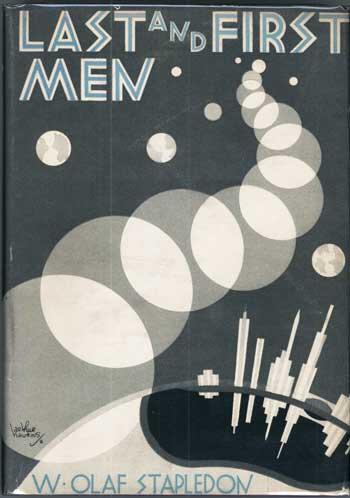 Cover of the first edition
The first is the extent to which the ideas which Stapledon introduced and developed during the course of the book were grounded in factual information known at the time of writing. One key issue which Olaf Stapledon refers to was that genetic engineering (he uses the term ectogenesis) could be a means to
address challenges associated with not only large scale climactic changes (for example breeding plants able to withstand different environmental conditions), but also the alteration or improvement of the genetic quality of a human population, i.e. eugenics. The principle of eugenics was a very controversial topic in the 1930s, but possible practical methods to achieve it other than selective breeding, were in
their very early stages, and almost certainly unknown to the average reader. I read his preface after I had read the book, and there, Olaf Stapledon thanks several other academics for their input to the book, making it clear that he had sought out people knowledgeable in fields other than his own to inform the development of his ideas for this work of fiction. Whilst not mentioned specifically, I have discovered that he was a friend of the author Naomi Mitchison, who, in turn, was the sister of the eminent biologist JBS Haldane. Haldane was the first to suggest the concepts of in vitro fertilisation and cloning in the 1920s, and it would seem quite likely that Stapledon’s ideas in the book could have been partially derived
from direct or indirect communication with Haldane. Interestingly, Haldane also knew Aldous Huxley who may well have discussed some of the ideas expressed in Brave New World with him, which was published two years later.
The second is Stapledon’s discussion about the emergence of key individuals at intervals during human history. As the book progresses, Stapledon introduces the idea that individuals of human species that evolve in the future could communicate back through time with earlier existing individuals via some sort of direct connection between their brains, the method by which the author is empowered to write about events occurring in the future, which I mentioned before. He develops this idea, explaining that many attempts at communicating back in time are unsuccessful because the message becomes somehow garbled in the process, or the recipients of intact messages who attempt to share the information are regarded by others of their species as being so eccentric as to be not worth listening to. However, there are some individuals in history, and he certainly names Jesus and the Buddha, who have received useful information from the future and their acquired wisdom, effectively disseminated to others, has led to their being highly significant and influential. The mechanism which Stapledon describes is wholly absurd to my mind. However, the idea that individuals who do become of substantial and lasting significance might achieve this through an exceptional ability both to think in a markedly different way from, and communicate their novel ideas effectively to others is, I think, compelling.
And finally, on a lighter note…. The form of the human body changes over the course of the eighteen iterations described in the book, partly through ‘natural evolution’ and partly through ‘deliberate design’. One feature which develops is a sixth finger which had been… ‘’induced to divide its tip into two Lilliputian fingers and a corresponding thumb.” As the mother of three children who are pretty close in age, I used to assert that mothers should develop an extra hand as they became pregnant with each child beyond two so that they could hold on to each one and keep them safe in busy places! Hence the notion of being able to both hold onto something and also manipulate it with one hand had a definite appeal!
All in all, I found this a highly entertaining and thought-provoking book, which I would absolutely not have even opened had it not been required for the Popular Fiction group’s meeting. Thank you very much to whoever suggested Olaf Stapledon as a discussion topic for the group!







