


Format: Blu-Ray from Cortland Public Library on gigantic television.
Ray Bradbury said in interviews that he has distinct memories of being not merely an infant, but of being days old despite being told that this is essentially impossible. I say this because it’s going to be relevant to Little Amélie or the Character of Rain ( Amélie et la métaphysique detubes in the original French). This is a story a very young child, essentially in utero until 3, from that child’s perspective. Little kids have been in movies before, and have even been main characters in movies before, but this feels like the first time that a film has been narrated from this perspective.
What this means is that our title character, Amélie, is going to have an adult vocabulary, but a child’s version of the world around her. Specifically, this means that she is going to be a solipsist for the bulk of the film, which takes place between her second and third birthdays. Amélie is difficult to like initially because of this. It’s not inaccurate, but it is frustrating. Amélie is entirely self-absorbed, which makes her a difficult narrator.
We start with Amélie’s discussion of God, and it soon becomes evident that she is talking about herself before she was born. She likens herself to a tube—things go in and come out, but the tube remains unchanged. When she is born, she is essentially in a vegetative state, silently observing the family around her. On her second birthday, an earthquake breaks her free, but she sees herself as being unable to meaningfully interact with her family. Amélie becomes a terror to her family and especially her siblings, Juliette and André.
Everything changes for Amélie with the arrival of two people. The first is her grandmother, who has taken so long to visit because of circumstances. We learn that the family is Belgian but living in Japan—her father is a diplomat. Granny introduces Amélie to white chocolate, and suddenly the world makes sense to her. The second person is Nishio-san, who has come to the family to help take care of the residence, and with whom Amélie forms an immediate bond.
This is where we are going to spend a great deal of the film. Amélie is going to learn about the world, about death, about grudges and racism in the time between her awakening and her third birthday. We’re also going to see some really bad parenting when the family takes a visit to a beach and essentially decides to let a 2-year-old wander around by herself on the shoreline.
Fortunately, the selling point here is only partly the awakening and growing awareness of Amélie, who deals with the death of her grandmother and the open hostility and racism of the family’s landlord who hates the relationship between Amélie and Nishio-san because of what happened in World War II—the loss of her loved ones as well as all of Nishio’s family in bombing raids.
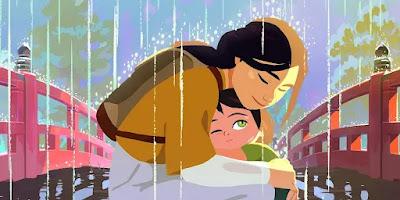
The real sell, at least for me, is the artwork. It’s hard to place what this would actually be called. It’s clearly 2D and hand-drawn. It feels impressionistic in some ways. It’s so unusual in the world of computer animation and attempts to make animated worlds look as real as possible. Little Amélie is a throwback to earlier times. There are moments when it feels like this could be watched with the sound off and simply enjoyed as a visual display.
Ultimately, the film won me over, but it took some time. Amélie is not a fun character for much of the film because of how demanding she is and because of how she views the world not as an extension of herself, but as something clearly the point of creation. Through most of the film, she sees herself as God—not as “a” god, but as “the” god. I think this is probably consistent with young children, who don’t really understand the concept of other people as having actual separate existence from them. Theory of mind doesn’t develop until later years (sometimes never, really), so Amélie’s perspective is natural, but no less frustrating.
For much of the film, I wanted to like this film more than I did. I did like it, but I still think it’s prettier than it is good. I felt the same way about Loving Vincent about a decade ago.
Why to watch Little Amélie or the Character of Rain : A fascinating perspective and lovely artwork.
Why not to watch: Amélie is unpleasantly narcissistic for much of the film.






