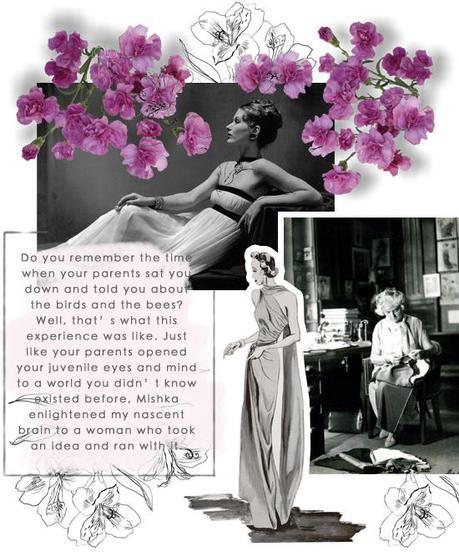
It was only a short time after I met Mishka and a short time before I started my blog that she told me about Madeleine Vionnet. Do you remember the time when your parents sat you down and told you about the birds and the bees? Well, that’s what this experience was like. Just like your parents opened your juvenile eyes and mind to a world you didn’t know existed before, Mishka enlightened my nascent brain to a woman who took an idea that was not new and made something using it.
While I was halfway through a blind hem on one side of the room, Mishka was crouched over her sewing machine on the other side, and mid-sewing, she started a conversation. “Have you ever heard of Madeleine Vionnet?” I piped with a quick no and that’s when “it” happened. Up she went from her chair and straight to her bookshelf, pulling out a very long book, Madeleine Vionnet. My flimsy world of Forever 21 and J. Crew came crashing down and what was left was a designer that has stood the test of time.
Madeleine Vionnet was born in 1876 and from a young age, she showed an affinity for sewing. As a teenager, she worked for London designer Kate Reilly, copying haute couture patterns for individual clients. She later moved to Paris to work for Callot Soeurs, where her job was the same as it was at Kate Reilly’s design house. While there, Vionnet refined her skills in pattern cutting, fitting, and sewing. She briefly opened her own house in 1912 but because of the war, she closed it in 1914. She picked up where she left off once the fighting was over, opening her own house once again to a society that was ready for her creations. Her halter dresses, circle skirts, and wrapped waists replaced not only darts, but the way women dressed. The bias cut gowns she designed could be put on over the head and in one swoop, making dressing a one step process rather than a multi-step effort. Her off-grain garments were also the forerunner of knits (she was way ahead of her time). By the early 20s, Vionnet had a long roster of American and European clients, a home base on the famous Avenue Montaigne, and a work force of 1,200.
Over Labor Day weekend, AKA my sewing holiday, I was watching The Great Gatsby for the umpteenth time when I took particular note to a line Gatsby quipped just after his and Nick’s adventurous drive into the city. At lunch, where the two had a beautiful scenery of dancing women, Gatsby introduces Nick to Meyer Wolfshiem, who, he claims, was responsible for fixing the 1919 World Series.
“Who is he anyhow, an actor?” says Nick.
“No” says Gatsby.
“A dentist?” Nick chimed.
“…No, he’s a gambler.” Gatsby hesitated, then added cooly, “He’s the man who fixed the World Series back in 1919.”
“Fixed the World Series? How did he happen to do that?” Nick repeated.
“He just saw the opportunity,” said Gatsby.
This brought me back to a quote I’ve kept in my repertoire – it was said by Steve Jobs: “Life can be much broader once you discover one simple fact – everything around you that you call life was made up by people that were no smarter than you and you can change it, you can influence it, you can build your own things that other people can use.”
Enough quotes. What do Gatsby and Jobs have to do with Madeleine Vionnet? Vionnet didn’t invent bias cut garments, she simple “stretched” it to its fullest potential. There are records of garments being cut on an angle before her, but it was she that was innovative in its use. In an amazing article by Betty Kirke (a definite read if you want to know more about Vionnet’s construction and patterning techniques), she describes how she duplicated one of Vionnet’s skirts: “To fit a quarter circle to the waist, the apex has to be cut away, not straight across, but in a concave curve. In drafting this pattern, the curve would be drawn equidistant from the apex. The response of the fabric when hung along this curve, however, is not equal. On one side, the fabric will hang from warp yarns, which won’t stretch at all. On the opposite side, it will hang from weft yarns, which will stretch little or much, depending on the weave and yarn structure. The central area will hang on the bias and stretch a lot. The very center, on the true bias, will stretch the most. To control the ripples at the hemline, one must control the amount of fabric stretching into and collapsing under each point of the waistline according to its stretchability at each point. The warp side will be cut deeper than the weft side, and the bias, with the most ability to stretch, must be restrained from doing too much. At the true bias, I stretch the fabric horizontally and force some of the fabric into the area of less stretchability.” Vionnet developed her own method of dealing with the varying degrees of stretch on a bias, creating not only gorgeous gowns but symmetrical ones.
So, what Vionnet did was not invent bias cut garments; what she did was take an opportunity, just like Meyer Wolfsheim, and expanded it. She may or may not have been smarter than you or I, who knows, but if she wasn’t, that’s even more encouraging to us. Encouraging because it means that regardless of our IQ or if we have a masters degree or if we graduated from college, we are all capable of becoming a legend. It’s also encourage because it comforts my own worry of whether it’s okay to copy others and/or take something that was started by someone else and go some place else with it. Here’s a women who made a career doing just that! Now that’s cool and a big reason why I named my blog after her, with a slight variation of the spelling.