As I looked up to the sky the other day, this raptor bird circling high above naturally attracted me - fortunate to capture a few clicks of this Raptor. Generally we know and can identify – Crows, Pigeons, Mynah, Parrots, Eagle (Parunthu !), love birds, Peacock, Egrets, Kingfisher .. .. .. this was different – not as big as vulture, slightly smaller and it color made me think – it could be a Garuda (Brahmini kite)
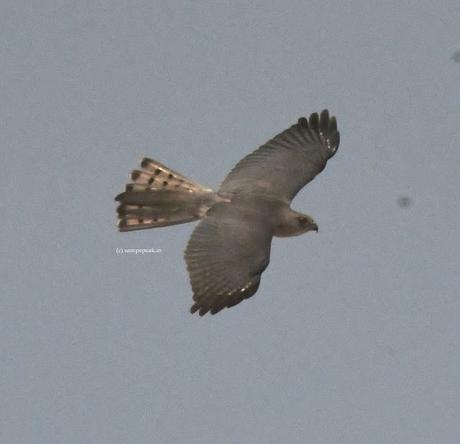
In cities, we see many Parunthu (black kite). The main difference between a Black Kite (Milvus migrans): and a Brahminy Kite (Haliastur indus): lies in their plumage and tail shape. Black Kites have a dark brown body with a forked tail, while Brahminy Kites have a distinctive chestnut plumage with a white head and breast and a rounded tail.
Birds of prey or predatory birds, also known as raptors, are hypercarnivorous bird species that actively hunt and feed on other vertebrates (mainly mammals, reptiles and smaller birds). In addition to speed and strength, these predators have keen eyesight for detecting prey from a distance or during flight, strong feet with sharp talons for grasping or killing prey, and powerful, curved beaks for tearing off flesh. Although predatory birds primarily hunt live prey, many species (such as fish eagles, vultures and condors) also scavenge and eat carrion.

Google lens identifies this bird as “Shikra” - The shikra (Tachyspiza badia) is a small bird of prey in the family Accipitridae, which also includes many other diurnal raptors such as eagles, buzzards and harriers. They are found widely distributed in Asia and Africa where it is also called the little banded goshawk. It nests in trees, building a new nest each year. The shikra was formally described in 1789 by the German naturalist Johann Friedrich Gmelin in his revised and expanded edition of Carl Linnaeus's Systema Naturae. He placed it with the eagles, hawks and their relatives in the genus Falco and coined the binomial name Falco badius. Gmelin's description was based on the "brown hawk" from Ceylon that had been described and illustrated in 1776 by the English naturalist Peter Brown. The word Tachyspiza combines the Ancient Greek ταχυς (takhus) meaning "fast" with σπιζιας (spizias) meaning "hawk". The specific epithet badia is Latin meaning "chestnut-coloured" or "brown".
The shikra was a favourite among falconers in India and Pakistan due to the ease with which it could be trained and was frequently used to procure food for the more prized falcons. They were noted for their pluck and ability to take much larger birds including partridges, crows and even young peafowl. The word shikra or shikara means hunter in the Hindi language (the male was called chipak or chipka based on call).
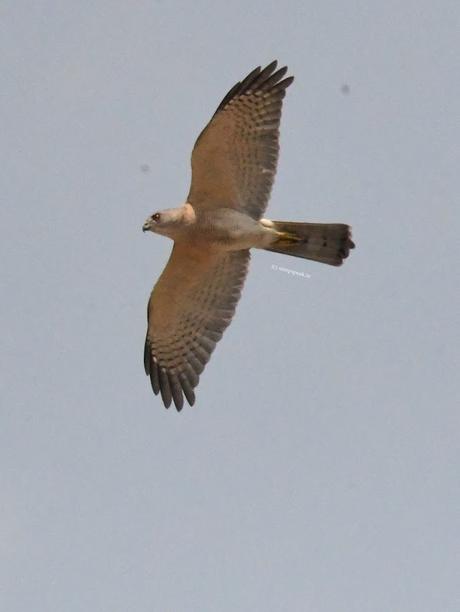
Another photo taken of the same bird was identified by Google lens as ‘Levant sparrowhawk’ (Tachyspiza brevipes), a small bird of prey. It breeds in forests from Greece and the Balkans east to southern Russia. It is migratory, wintering from Egypt across to southwestern Iran. It will migrate in large flocks, unlike the more widespread Eurasian sparrowhawk. It is sometimes considered to be a subspecies of the shikra (Tachyspiza badia), though it differs in measurements, proportions and plumage, and breeds contiguously. The Levant sparrowhawk and the Shikra are closely related raptors, but they can be distinguished by several features. Shikra typically have a paler head and a finely barred, rufous upper section with a white underside, while Levant sparrowhawks have grayish upperparts and orange-barred underparts !
Interesting ! (pictures taken from my terrace at Triplicane around 9.30am)
Regards – S Sampathkumar
19.5.2025