The culture in many Offices is – people don’t talk to each other – instead – send e-mails…… not many of them have a salutation and signature – and not the appropriate caption …. People reply and chain mails, though the subject matter is different – go with the same caption – worser still, people reply to all and that too with all its annexures, thereby adding weight to other inboxes as well… Most offices have common printers …..the other day – two persons waiting near the printer were conversing – one said to other – your desktop is faraway from the printer and hence yours would be delayed – mine would get printed faster due to proximity .!! ~ a couple of decades ago, the famous story was that an improperly configured email server had too strict timeout settings which effectively limited its communication radius to 500 miles. The story going around suggested that a particular Company could send e-mails only to some destinations – whilst some bounced back, which were all later analysed to be places physically 500 miles and more. 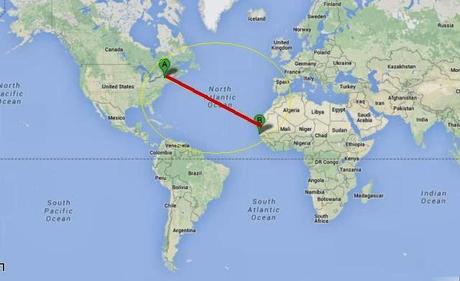
When an email is sent, the location of the server sending the message is tagged into the code of the mail. Email Miles scans an email for this so-called Geolocation tag. Every time an email is received by a new server, the new location tag is added to the email. Brucker-Cohen's plug-in tracks the different server locations of the emails and calculates the distance, in miles, between the two using GPS co-ordinates. The distance is direct, from one point to another, and may not account for the length and shape of the cables it passes through. The nature of email and web traffic means that for emails to travel long distances, it sometimes has to be passed through different servers as it enters and leaves different countries. This is because different companies manage different network cables. 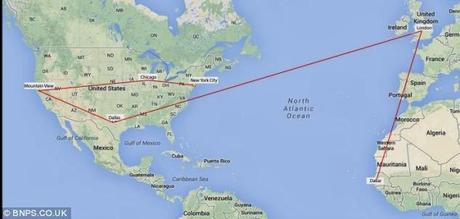 Email Miles calculates the total distance between the two and displays it on a monitor. Inventor Jonah Brucker-Cohen hopes the program will ensure users do not take for granted how quickly we can communicate with one another in the modern world.'Information is ubiquitous, but the speed and transmission of this information is typically invisible to people who have no conception of the infrastructure involved,' he added. In the given example, an email sent from New York to Dakarin Senegal traveled a total of 12,115 miles – because the email first traveled 790 miles west to Chicago, then another 2,163 miles west to Mountain View in California. After that it finally started making its way back east - first 1,699 miles to Dallas, then 4,745 miles to London, before eventually heading 2,718 miles south into the West African city. Email Miles is beneficial because it adds a physical component to a phenomenon like email that is perceived as purely virtual,' he said.Interesting ….please don’t ask, what one would do knowing the actual distance traveled !?!?
20th Feb 2014.