


Carriers bill a parcel by its size instead of its weight when the box is large for what it weighs. They multiply length x width x height, divide by a divisor (139 for USPS, UPS Daily Rates and FedEx in inches and pounds), and charge whichever is greater: that dimensional weight or the actual weight. USPS only does this once a parcel is over one cubic foot, so a single inch can move a 2.4 lb item from a 3 lb price to a 14 lb price. UPS and FedEx can apply it to any box, so even small cartons with empty space cost you.
This guide explains the rules for USPS, UPS, FedEx and Canada Post, then runs one hypothetical product through eight box sizes with real USPS prices. Carrier rules and prices were checked on October 25, 2026.
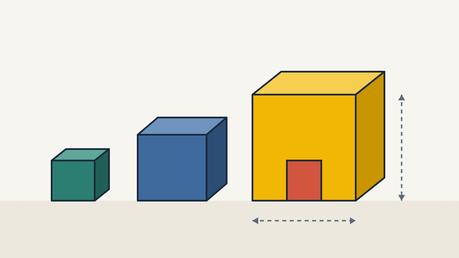
How dimensional weight is calculated
Every major carrier uses the same three steps, with small differences in the details:
- Measure the outside of the box and round each side up to the next whole inch (or centimetre).
- Multiply length x width x height to get the cubic size.
- Divide by the carrier’s divisor and round up to the next whole pound (or kilogram).
The carrier then compares that number with the actual weight, also rounded up, and bills the higher one. UPS calls this the billable weight. Canada Post’s own example shows the logic: a 100 x 60 x 20 cm box weighing 8 kg sent by Xpresspost has a volumetric equivalent of 24, so it is charged as 24 kg.
The divisor is the lever. A smaller divisor produces a higher dimensional weight for the same box. That is why the UPS Retail Rates divisor of 166 is kinder than its 139 Daily Rates divisor, and why the USPS rule revision that set 139 from July 12, 2026 matters most for light, bulky parcels.
Dimensional weight rules by carrier
USPS (Priority Mail Express, Priority Mail, Ground Advantage retail and commercial, Parcel Select Destination Entry) 139 cubic inches per lb, since July 12, 2026 Only parcels over 1 cubic foot (1,728 cubic inches), zones 1 to 9 Each side up to the next inch; result up to the next pound
UPS (US) 139 for Daily Rates; 166 for Retail Rates “May apply to all UPS domestic and international package services” Result up to the next pound (see the note below on sides)
UPS (Canada) 139 in / 5,000 cm; 115 in / 4,100 cm for domestic Air All domestic and international package services Each side up; result up to the next pound or kilogram
FedEx 139 in per lb; 5,000 cm per kg Per package, all shipments in customer packaging; FedEx packaging can also be affected Each side up; result up to the next pound or kilogram
Canada Post 5,000 cm (139 in) for most services; 6,000 cm (166 in) for Regular Parcel Priority, Xpresspost, Expedited Parcel, and US and international services except Tracked Packet and Small Packet Not stated on the help page
Sources: USPS Postal Bulletin 22705 and DMM 283 section 1.4; ups.com US and Canada size and weight pages; FedEx dimensional weight pages (Canada and international versions; the US page did not load for us); Canada Post support article. All checked October 25, 2026.Three details in that table matter more than they look.
USPS has a one cubic foot threshold. Up to 1,728 cubic inches, USPS charges actual weight no matter how much air is in the box. Above it, the minimum dimensional weight is 13 lb, because 1,729 divided by 139 rounds up to 13. There is no gentle slope; there is a cliff.
UPS and FedEx do not have that threshold on their pages. A 10 x 8 x 6 inch box is 480 cubic inches. At 139, that is 3.45, billed as 4 lb, even if the item inside weighs one pound. Shopify’s help page says dimensional weight applies when a package is over one cubic foot, which matches USPS but not what UPS and FedEx publish, so do not rely on it for those carriers.
UPS’s own US page is inconsistent on rounding sides. One section says to round each measurement “to the nearest whole number,” another says to “round up.” The UPS Canada page and FedEx both say round up. Assume rounding up, which is the more expensive reading, until your invoices show otherwise.
A worked example: one product, eight boxes
Here is a hypothetical product that weighs 2.4 lb packed, so its actual billable weight is 3 lb at every carrier. We put it in eight box sizes and worked out the billable weight at USPS and both UPS divisors, plus the USPS Ground Advantage Retail price to Zone 5 from the price list in effect since October 4, 2026.
10 x 8 x 6 480 3.45 3 $15.70 4 3
12 x 10 x 8 960 6.91 3 $15.70 7 6
12 x 12 x 12 1,728 12.43 3 $15.70 13 11
13 x 12 x 12 1,872 13.47 14 $30.55 14 12
14 x 14 x 12 2,352 16.92 17 $34.20 17 15
16 x 14 x 12 2,688 19.34 20 $37.90 20 17
18 x 16 x 12 3,456 24.86 25 $60.65 25 21
20 x 16 x 12 3,840 27.63 28 $93.40 ($72.40 + $21.00 fee) 28 24
Hypothetical 2.4 lb item. USPS prices from Notice 123, USPS Ground Advantage Retail parcels, effective October 4, 2026, checked October 25, 2026. UPS prices are not shown because UPS rates depend on account and service; only billable weight is modelled. Calculated in Python by formula and re-checked with an integer search and exact fractions; both methods agree. Below one cubic foot, USPS ignores box size. UPS Daily Rates do not. Hypothetical item.
What the model shows
The one cubic foot cliff is expensive. Moving from a 12 x 12 x 12 box to a 13 x 12 x 12 box adds one inch and nearly doubles the USPS Retail Zone 5 price, from $15.70 to $30.55. To Zone 8, the same step goes from $23.15 to $57.65. If a store shipped 100 of these orders a month to Zone 5 in the larger box, that one inch would cost $17,820 a year at retail prices. That is a modelled figure, not a typical one, but the cliff is real for every USPS shipper.
At UPS, small boxes are not safe. The three boxes USPS bills at 3 lb cost 4, 7 and 13 billable pounds at UPS Daily Rates. A 12 x 12 x 12 box with a 2.4 lb item is billed at more than four times its weight.
Size fees stack on top. The largest box crosses 2 cubic feet (3,456 cubic inches), which triggers a separate USPS nonstandard fee. On the retail price list that is $21.00, on top of the 28 lb price.
 Same item, same zone, eight label prices. USPS Ground Advantage Retail, Zone 5, prices effective October 4, 2026.
Two notes on these prices. They are retail prices, the ones you pay at a Post Office counter. Commercial prices are listed separately in Notice 123, but the billable weight is worked out the same way under the commercial rules in DMM 283, so the cliff is still there. And USPS holiday prices run from October 4, 2026 to January 17, 2027, so recheck the dollar amounts after that.
USPS size fees that come with big boxes
Dimensional weight is not the only size charge at USPS. Ground Advantage parcels also pay nonstandard fees based on length and volume. On the retail price list in effect now:
Longer than 22 inches, up to 30 inches $4.50
Longer than 30 inches $10.00
Over 2 cubic feet (3,456 cubic inches) $21.00
USPS Notice 123, USPS Ground Advantage Retail parcels footnotes, effective October 4, 2026. Commercial fee amounts are listed separately in Notice 123. DMM 283 section 1.7 says a piece can pay a length fee and the cube fee together.Long, thin items show why shape matters. USPS treats nonrectangular parcels, such as tubes, differently: you multiply the cubic size by 0.785 before testing the one cubic foot threshold. A 36 x 6 x 6 inch tube is 1,296 cubic inches, or about 1,017 after the adjustment, so no dimensional weight applies. But at 36 inches long, it still pays the over 30 inch length fee. Shortening the product’s packaging may save more than changing its width.
Also note the ceiling: if a USPS dimensional weight works out above 70 lb, you pay the 70 lb price.
Canada Post: a different divisor for Regular Parcel
Canadian sellers face two divisors with the same carrier. Canada Post uses 5,000 cubic centimetres per kilogram for most services, including Priority, Xpresspost, Expedited Parcel, and US and international parcels (other than Tracked Packet and Small Packet). Regular Parcel uses 6,000, which is more lenient.
For a hypothetical 40 x 30 x 20 cm box (24,000 cubic centimetres):
- Expedited Parcel: 24,000 / 5,000 = 4.8 volumetric kilograms
- Regular Parcel: 24,000 / 6,000 = 4.0 volumetric kilograms
If the product weighs 2 kg, both are billed above actual weight, but Regular Parcel less so. Canada Post’s help page does not say how it rounds, so read your rate quote rather than assuming.
How to find the biggest box that keeps your price
Turn the formula around. At any carrier that applies dimensional weight to every box, a box stays at or under a given billable weight as long as its cubic inches are no more than the divisor times that weight.
2 lb 278 332
3 lb 417 498
4 lb 556 664
5 lb 695 830
8 lb 1,112 1,328
10 lb 1,390 1,660
Divisor multiplied by billable pounds. Applies to rounded-up outside dimensions. At USPS, anything up to 1,728 cubic inches is billed on actual weight.For the 2.4 lb product above, a 10 x 8 x 5 box (400 cubic inches) stays at 3 lb at UPS Daily Rates. The 10 x 8 x 6 box (480) tips into 4 lb. One inch of height is a full billable pound.
Set package dimensions correctly in Shopify
If you use carrier-calculated rates at checkout or buy labels in Shopify, your saved packages decide what the carrier sees. Shopify says your default package dimensions are sent to the carrier along with the order’s weight. Checked in the Shopify Help Center on October 25, 2026:
- Go to Settings > Shipping and delivery in your Shopify admin.
- In the Packages section, add a package.
- Name it, choose the package type, and enter its dimensions and weight. Shopify says outside dimensions are used, so measure the outside of the box, not the size printed by the box seller, which may be the inside.
- Optionally make it the default package.
One limit is worth knowing. A package assigned to a variant overrides the default only on single-item orders; multi-item orders use the default package. So if your default box crosses one cubic foot, USPS checkout quotes on every multi-item order jump with it.
Shipping cost feeds straight into your margins. If you set a free shipping offer, run it on dimensional prices, not scale weight; our guide to setting a free shipping threshold shows how the label cost changes the maths. And if you price ads off profit per order, recheck your break-even ROAS after any change in label cost.
Ways to pay for less air
- Stay under 1,728 cubic inches for USPS where you can. If a box sits just over one cubic foot, trimming a single inch can halve the label price, as the model showed.
- Use the volume caps above for UPS and FedEx. Pick boxes that land just under a billable pound, not just over it.
- Check which UPS rate type you pay. Daily Rates use 139 and Retail Rates use 166, so the same box can bill differently depending on how you buy the label.
- Measure the outside, and round up. A box sold as 12 x 12 x 12 may be that size inside and cross one cubic foot outside. A side of 12.2 inches counts as 13.
- Price shipping on billable weight, not product weight. Our explainer on gross margin vs contribution margin shows where shipping belongs in your margins.
Dimensional weight also drives fulfillment fees elsewhere. If you sell on Amazon, our comparison of Amazon FBA vs FBM costs covers how size tiers change which option is cheaper. And our look at the July 2026 cost changes covers the same USPS divisor change from a news angle.
What you should check next
- Measure the outside of every box you use and work out its cubic inches.
- Flag any box just over 1,728 cubic inches if you ship USPS, or just over a billable pound boundary at UPS or FedEx.
- Check the default package and any variant packages in Shopify’s shipping settings.
- Compare one month of label costs against what the scale weight alone would have cost; the gap is what air costs you.
- Recheck USPS prices after January 17, 2027, when the holiday prices end.
Frequently asked questions
Does dimensional weight apply to poly mailers?
None of the carrier pages we checked makes an exception for mailers. FedEx says dimensional weight applies per package to all shipments in customer packaging, and Canada Post measures an item where its dimensions are greatest. Measure a filled mailer at its widest points and run the same formula.
Is the USPS divisor different for commercial and retail customers?
No. Since July 12, 2026, USPS uses 139 and the one cubic foot threshold for Priority Mail Express, Priority Mail and Ground Advantage, both retail and commercial. Prices differ, but the billable weight works the same way.
Is USPS cubic pricing the same as dimensional weight?
No. Cubic pricing is a separate commercial Ground Advantage option for small parcels. DMM 283 limits it to parcels of 1 cubic foot or less, 20 lb or less, with no side longer than 22 inches. Dimensional weight only starts above 1 cubic foot, so the two do not overlap.
The takeaway
Dimensional weight is size divided by a divisor, billed when it beats actual weight. At USPS, the line to watch is one cubic foot. At UPS and FedEx, every box counts. Measure the outside of your boxes, find the cheapest size that still protects the product, and set it as your Shopify package so checkout quotes match what you pay.
Sources
- USPS, Postal Bulletin 22705, “Policies, Procedures, and Forms Updates” (dimensional weight revisions effective July 12, 2026). about.usps.com
- USPS, Domestic Mail Manual 283, “USPS Ground Advantage, Commercial” (sections 1.4 dimensional weight and 1.7 nonstandard fees). pe.usps.com
- USPS, Notice 123 Price List (effective October 4, 2026), USPS Ground Advantage Retail parcels. pe.usps.com
- USPS Newsroom, “USPS Announces Temporary Price Change for 2026 Holiday Shipping Season” (August 25, 2026). about.usps.com
- UPS, “Package Dimensions, Size Limits and Weight Guide” (US). ups.com
- UPS, “Package Dimensions, Size Limits and Weight Guide” (Canada). ups.com
- FedEx, “Dimensional weight” (Canada). fedex.com
- FedEx, “How do I calculate dimensional weight of a package?” fedex.com
- Canada Post, “How to cube an item and calculate the volumetric equivalent of its actual weight”. canadapost-postescanada.ca
- Canada Post, “Examples of how to cube an item and calculate the volumetric equivalent of its actual weight”. canadapost-postescanada.ca
- Shopify Help Center, “Understanding shipment packaging and weights”. help.shopify.com
- Shopify Help Center, “Setting up packages”. help.shopify.com
Last reviewed: October 25, 2026. Carrier rules and USPS prices are as published on that date; USPS holiday prices apply until January 17, 2027.
How this article was made: researched and drafted with AI assistance, with every factual claim checked against the sources above. The 2.4 lb product, its eight boxes, the 100 orders a month and the 40 x 30 x 20 cm and 36 inch tube examples are hypothetical; label prices are USPS published retail prices, not negotiated or commercial rates.
Related guides
- Free shipping threshold: how to set it without losing margin
- What happens if a customer says their package never arrived?
- Amazon FBA vs FBM: which costs less for your product?




Magazines
COMMUNITY MARKETING & ADVERTISING

-
 Ana Hoffman
873564 pt -
 Pro WebGuru
836301 pt -
trendmarketers
737838 pt -
 hpmurah2u
645001 pt