PALMDALE – Occurring mostly at night and in remote areas, illegal dumping is difficult to prevent – and to prosecute. To prosecute illegal dumpers they must be caught in the act.
The City of Palmdale recently announced its plan to work with local businesses to stop illegal dumping through video sharing.
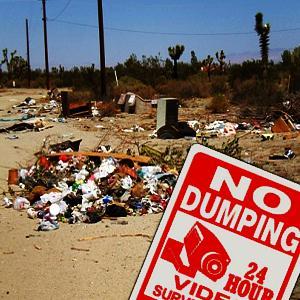
“We are reaching out to local businesses to work together so that they can utilize their security cameras to provide us with evidence that we can use for criminal prosecution of illegal dumping,” Code Enforcement Officer Aaron Price stated in a news release. “We believe that this will have a hugely powerful effect on reducing and stopping the plague of illegal dumping in our city.”
Price said that Palmdale’s Code Enforcement Division has been able to go after illegal dumpers more aggressively only because they have had “great cooperation” from the public recently.
“We want to capitalize on this interest to create a positive change and correct a problem that affects everybody,” Price said, asking the public to contact him at 661-267-5234 for more information.
* * *
The County of San Bernardino also believes surveillance video is a solution to illegal dumping.
A brochure discouraging illegal dumping from 5th District Supervisor Josie Gonzales states the county has purchased “over 90 surveillance cameras to be used to catch illegal dumpers. Some are visible to the public and some are not.”
According to CalRecycle, calrecycle.ca.gov, the state’s Department of Resources Recycling and Recovery (which shares responsibility with local enforcement agencies for the cleanup and enforcement of illegal disposal sites), surveillance can play a major part in the strategy to prevent illegal dumping.
However, CalRecycle notes that “standards for evidence and prosecution need to be identified prior to usage if they are to be used in enforcement.”
On its Illegal Dumping Resources Toolbox page, calrecycle.ca.gov/illegaldump, CalRecycle provides examples of cameras used by different counties, whether motion-detector cameras or solar-powered units mounted in vandalism-resistant boxes that can capture crisp images from up to 100 feet away.
“Available options for the systems include continuous filming of a site, motion- or sound-activated digital or video filming, sound recording systems, systems that provide a light flash when activated, and systems that download directly … to laptop computers,” the site reports.
CalRecycle explains that license plate numbers and violators’ faces are easy to see with high-resolution surveillance, and the photos are combined with other evidence to form a criminal case.
But the state is careful to point out that the 24-hour surveillance cameras are trained on selected dumping areas and do not photograph passing cars or pedestrians. Also, letters are sent to residents living within a quarter-mile of the camera locations, advising them of the program, according to CalRecycle.
* * *
THE COST OF DUMPING
The 5th District brochure also states that San Bernardino County “spends approximately $300,000 a year to clean up illegal dumping. The total cost to local taxpayers, including the depreciation to property values, can easily reach into millions of dollars annually.”
According to CalRecycle, “California local government spends tens of millions of dollars annually to remove illegally dumped materials.”
The total has amounted to an “annual local government abatement and enforcement cost of $44 million,” according to a 2007 California State Association of Counties Illegal Dumping Survey, calrecycle.ca.gov/…Survey (the most recently available statewide survey on illegal dumping), which received input from 35 out of the state’s 58 counties.
CalRecycle also reports that private property owners incur very significant costs to clean up illegal dumping.
According to Los Angeles County’s 2004 ordinance against illegal dumping, taxpayers are charged “hundreds of thousands of dollars every year in cleanup, public education, and enforcement costs.”
* * *
PITCHING IN
A different approach to preventing illegal dumping – if all else fails – is community awareness.
Town councils and other smaller communities of the High Desert are arranging local Dump Day events to encourage the legal disposal of unwanted, but nonhazardous, trash so it does not wind up in the desert.
Littlerock Town Council Secretary Annamarie Dyemartin told the Bee that the council is planning its next Dump Day in February 2014. Coordinating with Waste Management’s schedule, Dyemartin will announce the event at the upcoming council meeting on Thursday, Jan. 9.
The Town Council recently sponsored a free Dump Day on Oct. 26, where they arranged a free disposal bin with Waste Management.
“It was to benefit the whole community,” Dyemartin reported at the Nov. 14 Town Council meeting. “You can come and throw everything away – even couches and stoves and refridgerators, except for tires or hazardous waste. But it was a good day, and I couldn’t believe how quickly it filled up.”
Information on the upcoming Dump Day will be announced on the Littlerock Town Crier’s Facebook page at facebook.com/littlerockca.
* * *
On a larger scale of community awareness, the Antelope Valley Illegal Dumping Task Force is dedicated to keeping the High Desert landscape beautiful by attacking illegal dumping head-on with education and specialized programs.
One such program is the Waste Management-sponsored Desert Cleanup Program, where the Task Force selects 2-4 site clean-up projects annually across the Antelope Valley.
According to the LA County Public Works website, dpw.lacounty.gov/epd/illdump, the Antelope Valley Illegal Dumping Task Force is accepting applications for site nominations – as well as applications from volunteer groups seeking to participate in a desert clean up event. Contact Sandra Pursley at 661-223-3422 or by email at [email protected] for more information.
Formed by the Los Angeles County Board of Supervisors in 1996, the Task Force meets on a monthly basis to discuss and coordinate illegal dumping prevention programs in the Antelope Valley.
For information on Task Force meeting dates and agendas, visit ladpw.org/epd/illdump.
* * *
PENALTIES & REWARDS
So which is bigger? The fine for getting caught illegally dumping or the reward for catching an illegal dumper?
A Los Angeles County brochure on illegal dumping says that state and county laws provide strict penalties for those convicted of illegal dumping – which may include fines up to $10,000, seizure of their vehicle, and/ or incarceration of six months in jail.
However, reward programs, such as San Bernardino County’s program, offer monetary rewards up to $1,000 for catching someone in the act.
These reward programs, which use information that results in an arrest and conviction, have the added bonus of increasing the use of hotlines and acknowledging the “important role citizens play in the legal process,” according to CalRecycle, calrecycle.ca.gov/illegaldump.
* * *
REPORT ILLEGAL DUMPING
Victor Valley residents can report illegal dumping anonymously by calling the WeTip hotline at 1-800-782-7463. If illegal dumping is in progress, call the County of San Bernardino Sheriff’s Department at 760-256-4841.
More information on reporting illegal dumping in San Bernardino County is at sbcounty.gov/dpw/solidwaste.
Antelope Valley residents may report illegal dumping when observed in the process by calling the Lancaster Sheriff’s Station at 661-948-8466 or the Palmdale Sheriff’s Station at 661-272-2400. Illegal dumping locations also can be reported at 888-8-DUMPING or by visiting cleanla.com.
More information on reporting illegal dumping in the Antelope Valley can be found at cityoflancasterca.org.
High Desert residents also are encouraged to use the WeTip website and hotline at wetip.com. Residents may remain completely anonymous when reporting illegal dumping – or any other crime in your area.