


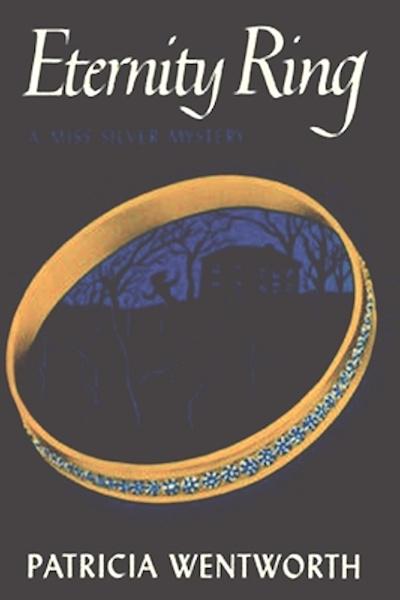
Book review by George Simmers: Eternity Ring is the fourteenth of Patricia Wentworth’s thirty two ‘Miss Silver novels’. I’ve seen Miss Silver is sometimes referred to as an imitation of Miss Marple, but she first appeared in Grey Mask in1929. Jane Marple had made one appearance in a short story before then, but the first Marple novel (Murder at the Vicarage) did not appear uintil 1930.
Eternity Ring is a satisfactory whodunnit. A hysterical girl claims to have seen a young woman being murdered, but there is no trace of a dead body. Meanwhile a woman with the same distinctive earrings as the supposed victim has disappeared from a town miles away. The solution won’t surprise many readers, but it’s a good enough read.
Our reading group this month is interested in spinsters, and Miss Silver is the archetype of a spinster. I think Wentworth is enjoying herself when she makes her heroine as old-fashioned as possible, and the stereotype of a survival from earlier times:
From her Edwardian fringe, rigidly controlled by a hair-net, to her black woolen stockings and beaded glacé shoes she was the perfect survival of a type now almost extinct. She might have stepped out of any family album to be immediately recognized as a spinster relative of slender means but indomitable character.
There is reflection on the social position of the spinster:
she presented a perfect picture of the elderly English spinster whose means, like her ideas, are strictly limited, and her position in the social scale such that she may quite safely be ignored or taken for granted.
But the whole point, of course, is that Miss Silver should never be ignored or underestimated:
Easy enough to dismiss […] as dowdy and governessy. Easy, that is, in the first five minutes or so. After that you could only go on doing it if you were very stupid or quite unable to rid yourself of a preconceived idea
Like Miss Marple, Miss Silver knits, and notices things while she does so:
Her thoughts went to and fro as methodically as her needles, noting a loophole here, a small discrepancy there, a definite possibility somewhere else.
Miss Silver is unlike Miss Marple ain that she is a professional detective. She has an office, and distributes cards with the discreet message ‘Private enquiries’. Wentworth enjoys herself making the office a caricature of Victoriana, with heavy furniture and pictures like ‘Hope’ by G.F. Watts on the wall – paintings very much in tune with Miss Silver’s fondness for the poetry of Tennyson.
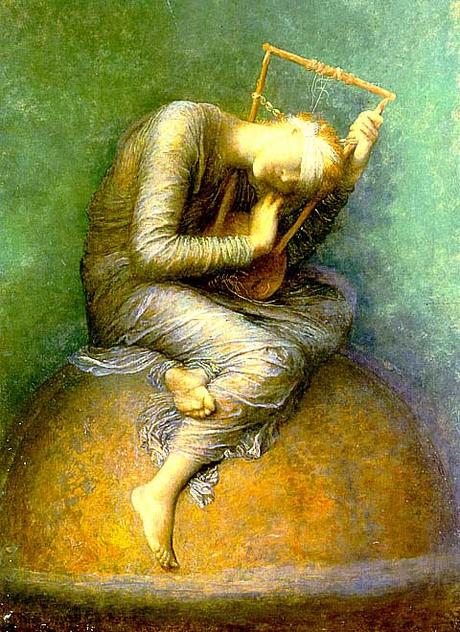 ‘Hope’ by G.F. Watts
Whereas Miss Marple solves mysteries by her shrewd judgment of human nature, and her ability to remember analogous situations having happened in her own village, Miss Silver triumphs through having a precisely logical mind. She contributes to the solution of the mystery partly by doing ‘old lady’ things – listening patiently to local gossip and reading the dull volume of local history that contains a clue as to where the body might have been hidden. But she is also the only one to recognize the tiny discrepancy in a suspect’s story that proves his guilt.
Miss Silver is the spinster as heroine, but the novel contains other spinsters whose roles are les heroic.
In this book, unmarried young women fall into two classes: there are the nice girls whom circumstances can lead into danger and misunderstandings, and there are the ones with peroxide hair – an apparently infallible sign that a young woman is no better than she should be. Older unmarried women are also a mixture. Miss Silver is a paragon, but others are less admirable. There is a mature unmarried servant who forms an erotic obsession with the employer – and who when he shuns her, betrays him to the police. There is a very twee and gossipy old lady whose character is displayed by the fact that almost all of her clothes and character are bright pink (She even paints the exposed beams of her cottage pink.). And there is another unmarried lady, an invalid, whose great interest in life is listening to other people’s telephone conversations. These last two share Miss Silver’s interest in the affairs of others, but have none of her power of intelligent analysis.
Mind you – the men don’t come out of it much better. Apart from a couple of heroes, they too tend to be rackety types. Patricia Wentworth was generally a realist about human nature.







