


When you’re cooking Japanese (and many other) East Asian foods, the basis of many dishes is that classic umami flavor, that usually comes from a dashi stock or a savory fish sauce.
If you’ve had miso soup, you’ve probably tried dashi already, and if you’ve had authentic pad thai, you’ve likely tasted fish sauce too!
Dashi and fish sauce are both popular umami condiments, but they are different in terms of flavor and texture and should not be used as substitutes for each other.
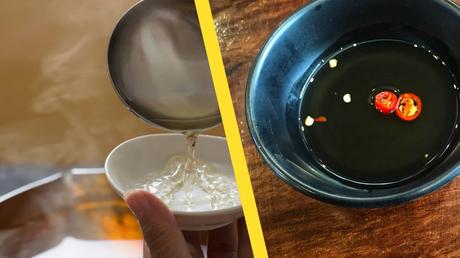
There is fish in some types of Dashi (dried tuna bonito flakes with kombu seaweed), but it’s not the same as fish sauce, which is thick and black made from anchovies and salt used in small amounts. Dashi is a clear and thin umami broth used in larger quantities.
I’ll explain how they’re made and how to use them down below.
What’s the difference between dashi and fish sauce?
Dashi and fish sauce are both popular umami condiments, but they are different in terms of flavor and texture and should not be used as substitutes for each other.
Dashi is a popular Japanese stock, and there are two common types: simple, which is a vegan stock made of Kombu (kelp), and a rich seafood flavored dashi made with Kombu and Katsuobushi (bonito flakes), which are made out of skipjack tuna.
On the other hand, fish sauce is made by fermenting anchovies with salt for an extended period.
Both are used in familiar savory dishes like stir-fries, pad-thai, and soups because they add umami flavor, but in different ways.
When do you use dashi and when fish sauce?
Both dashi and fish sauce are popular staples in East Asian kitchens, so they’re versatile and go with many dishes.
Dashi, as you may know, is one of the base condiments in miso soup (besides miso, of course), and it is very popular in ramen, tare dipping sauce, marinades, chawanmushi (egg custard), and nimono (food simmered in Shiro stock).
You can generally use it for all kinds of Asian and Western dishes that benefit from umami flavor and savory saltiness.
Fish sauce can be used as a substitute for salt. It is commonly found in dishes that require a strong seafood/fish flavor.
It’s widely used in pad thai, salad dressings, marinades, stir-fries, sauteeing greens, broths, chicken dishes, and even pasta and noodles. It gives a savory and unmistakable flavor.
One heads up though, fish sauce is very flavorful, and a little goes a long way. You probably only need to use a teaspoon or two to infuse any dish with a fishy taste.
What is dashi?
It’s a flavorful broth used as a base for many popular dishes. It tastes just as flavorful as meaty broths that have simmered for hours, except it has that salty kelp taste.
Dashi is best known for that umami taste, which is a combination of salty, savory, and delicious flavor that lingers on the tongue.
If the dashi contains bonito flakes or other seafood, it can take on a slightly fishy taste, but it’s much lighter than fish sauce.
But, dashi on its own isn’t very salty, so you shouldn’t use it as a salt substitute.
There are different dashi types, but the most common two are vegan Kombu dashi and Katsuobushi dashi.
Vegan dashi is a simple, lightly-flavored stock made from only a couple of ingredients like cold-brewed Kombu, a large seaweed type, and cold water. The seaweed is very flavorful and salty, so it imparts an umami flavor when used in dishes.
Katsuobushi is another type of dashi, but it’s made with Kombu and bonito flakes (skipjack tuna). Some people like to add dried sardines, dried shiitake mushrooms, and even adzuki beans or toasted soybeans for more complex dashi flavors.
It all comes down to how much flavor you’re after.
Of course, there are many types of dashi you can try, including Maguro (tuna), Saba (mackerel), and Iwashi (sardine), which has the strongest and fishiest flavor.
The texture is like that of a soup broth, and it’s very liquidy, so it’s much thinner than fish sauce.
If you don’t want to make your own dashi at home, you can buy dashi stock from Riken on Amazon.
Another great brand is Hikari, as they make dashi miso, which you can use in miso soup.
Dashi nutrition
In general, dashi has a low glycemic index, but it’s has a lot of sodium, even though it doesn’t have a strong salty flavor.
Since it has a high sodium content of about 44% of an adult’s daily recommended intake, those with cardiovascular disease and diabetics should be careful about how much dashi they consume.
Here are some nutritional facts about dashi:
- Calories per serving: 430 calories
- Fat: 14 g
- Sodium: 1000 mg
- Protein: 17 g
Dashi is low in cholesterol and sugar, and it doesn’t contain trans fats.
The Kombu kelp is a nutritious food because it’s rich in antioxidants. It contains iodine, which contributes to a healthy thyroid. As well, it is a good source of iron, calcium, and vitamins A, C.
Check out these 3 easy recipes using Dashi Stock + steps to make at it home
What is fish sauce?
Exactly what it sounds like: it’s a sauce made out of fish, this is a popular condiment in many Asian dishes.
It brings immediate saltiness and adds a ton of fish flavor to many soups, stir-fries, noodles, and even other meats.
It’s made by fermenting small fish like anchovies with salt for anywhere from a few months to a few years even!
Fermented fish has been popular in Asia for centuries because this method preserves the fish but also makes for some flavorful dishes.
The anchovies are stored in large barrels and covered in salt. Naturally occurring bacteria begin to break down the fish, and the result is a briny and savory liquid, which is essentially the sauce.
The flavor is a rather interesting mixture of funky brininess, pungent fishiness, saltiness, and a slight sweetness. While it’s also a bit earthy, fish sauce is considered to be another classic umami flavored condiment.
Fish sauce texture is similar to soy sauce, and it even has the same brown color. However, it’s a bit more viscous and obviously much different than dashi stock.
Also read: Is Anchovy Sauce the Same as Fish Sauce?
Fish sauce nutrition
Fish sauce contains sodium, but it’s a bit of a better low-sodium alternative for salt. Again, as with dashi, people who are sensitive to salt should consume low quantities of fish sauce.
When it comes to health benefits, fish sauce is not a very nutritious food, but it does have small amounts of beneficial properties. It is a good source of protein and contains a small amount of calcium.
1 tbsp of fish sauce contains about 6 calories, so it’s definitely a low-calorie condiment.
1 tbsp of fish sauce also has:
- Sodium: 1400 mg
- Potassium: 51 g
- Protein: 0.9 g
- Carbs: 0.7 g
The top brand of Vietnamese-style fish sauce is Red Boat because it’s made with only two ingredients: anchovies and salt and has a pure fishy flavor.
If you’re looking for a premium fish sauce, then the Megachef Thai Fish Sauce is a great option because it’s also pure without added ingredients that deter from the fishy taste.
Bottom line
Both dashi and fish sauce are versatile foods used to enhance and infuse Asian and Western dishes with umami flavor.
They are both savory and add a strong flavor to soups, stir-fries, and sauces.
While fish sauce undoubtedly has a strong fish taste, in many cases, dashi also contains seafood ingredients such as bonito flakes.
But for a vegan dashi version, stick to kelp alone.
More on this topic: Can You Substitute Fish Sauce for Dashi? These are better





