


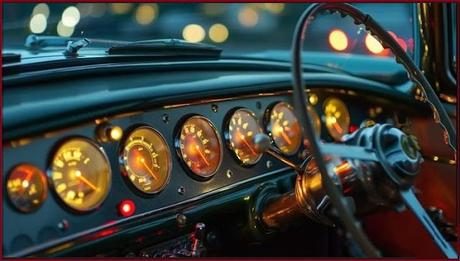
a vintage car dashboard circa 1930s
I could regale you with thrilling tales of my time in the world of computer systems, designing applications using Lotus Symphony, Visual Basic and C++ that mined and aggregated data into high-level information dashboards for busy decision makers tracking performance in Key Result Areas - let's label that B, the Bill Gates scenario.If you prefer, I could just make up some crazy fictive shit that's wacky and off the top of my head, but way more entertaining. That, logically, is option C - and let's dub it (appropriately) the Arthur C. Clarke variant.
Or I could write at length about why people should trust the graphical statistics published online by e.g. the CBI, GCOS, the ONS, UN and WHO about everything from climate change to coronavirus levels to immigration and industrial growth (or lack of it), rather than falling for the unsubstantiated conspiracy nonsense washing about on TikTok, X and YouTube. That's option D, the Chris Morris 'reality check' alternative.Very well, there you have them, A, B, C or D, and the decision is yours, so fingers on your special keypads and all make your selections now in the time-honoured 'ask the audience' fashion. [Here follows a short computational pause...]

the readership dashboard
Blimey! The votes are in and that is not what I was expecting. However, your wish is my command this Saturday night, ladies and gentlemen on the modern equivalent of the Clapham omnibus. Herewith, some crazy fictive shit for your delectation.DashboardsOnce the science of anti-gravity had been properly understood and its principles embodied into a practical and cost-effective equivalent of the skateboard - only one without wheels or friction, one that moved through the air just inches off the ground using electro-magnetism - people took to these dashboards as they were called in a big way, to travel short distances of a few miles, e.g. to work, to school, to the shops, to the pub. They were so much more convenient than bicycles, scooters and cars for a person on his/her own getting from A to B and were fully GPS-compliant and programmable if so desired.
They were voice-activated, so only workable by the registered users (of which there could be more than one). They were self-balancing which rendered them safe to ride and they featured anti-collision software and an illuminated-strip which was activated automatically when ambient light conditions were poor. They could be charged overnight, functioned in all weathers and had a top speed of fifteen miles an hour (approximately three times normal walking speed).
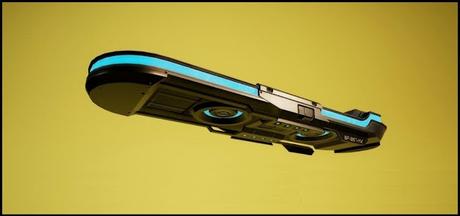
an anti-gravity Dashboard '99'
Naturally they came in different sizes, but even the largest could be carried comfortably under the arm, stowed on a luggage rack on public transport, or in the boot of a car. Very soon designated dashways were laid out along most urban thoroughfares, and in short order, offices, schools, cafes, pubs and shops installed dashslots, vertical racks to hold those ubiquitous dashboards.Of course there were limitations. All models had weight restrictions, for obvious reasons, and dashboards would not work over rough/uneven terrain. They simply shut down, on principles of safety. They were somewhat unreliable over water too, though they were fine across ice providing the surface was flat, and dashing on ice was quite a popular past-time. In fact, recreational and sporting use of dashboards became quite a thing, and eventually an Olympic sport.
Now if all of this sounds too good to be true, then it probably is - just like the light-bulb, the car, radio and tv, contact lenses, microwave ovens, pacemakers, computers, mobile phones and drones once did.
No new poem from me this week, I must be running low on poetic fuel. Instead, here is something rather splendid by Stephen Dunn, a Pulitzer Poetry Prize winning American writer (1939-2021):
The Sacred
After the teacher asked if anyone had
a sacred place
and the students fidgeted and shrank
in their chairs, the most serious of them all
said it was his car,
being in it alone, his tape deck playing
things he’d chosen, and others knew the truth
had been spoken
and began speaking about their rooms,
their hiding places, but the car kept coming up,
the car in motion,
music filling it, and sometimes one other person
who understood the bright altar of the dashboard
and how far away
a car could take him from the need
to speak, or to answer, the key
in having a key
and putting it in, and going. Stephen Dunn, 2012








