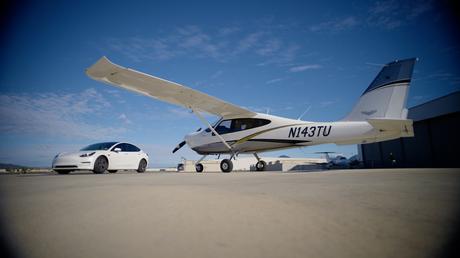
The idea of Tesla building an aircraft sounds, at first, like the kind of speculation that follows any company with a reputation for ambitious engineering. Tesla transformed electric cars from a niche concept into a mainstream product category, expanded into energy storage, and built a global charging network. It is therefore natural to ask whether the same company could apply its battery, motor, software, and manufacturing expertise to aviation. The serious answer is: possibly, but not easily, and probably not soon.
TLDR: Tesla could theoretically build an aircraft, especially a small electric or hybrid-electric aircraft, because it already has relevant experience in batteries, motors, power electronics, software, and manufacturing. However, aviation is far more regulated, safety-critical, and technically demanding than the car industry. The biggest obstacle is battery energy density, which remains well below what is needed for most commercial aircraft. If Tesla ever entered aviation, it would likely begin with a specialized aircraft rather than a full-size passenger jet.
Why the Question Is Plausible
Tesla is not just a car company in the traditional sense. Its core strengths include electric propulsion, thermal management, battery integration, power electronics, and software-controlled systems. These capabilities are directly relevant to electric aviation. An aircraft, like an electric vehicle, needs an efficient drivetrain, a lightweight energy source, reliable control systems, and sophisticated monitoring of temperature, performance, and safety.
There is also a strategic logic behind the question. Aviation is one of the harder sectors to decarbonize. While cars and buses can transition to battery-electric platforms relatively quickly, aircraft face much tougher weight and range constraints. A company that could make electric flight commercially viable would enter one of the most important transportation markets in the world.
Elon Musk has also publicly discussed the idea of electric aircraft for many years. He has suggested that the key requirement is substantially better battery energy density. That does not mean Tesla has an aircraft program ready for production, but it does show that the concept is not completely outside the company’s technical imagination.
The Central Technical Challenge: Batteries
The most important issue is energy density. Jet fuel stores a very large amount of energy per kilogram. Batteries are far cleaner at the point of use and electric motors are highly efficient, but current batteries are still much heavier for the same usable energy. In a car, added battery weight is manageable. In an aircraft, extra weight affects everything: takeoff distance, climb rate, range, payload, structural design, and safety margins.
Modern lithium-ion batteries are impressive, but they do not yet match aviation fuel for long-distance flight. Electric motors may convert energy into motion more efficiently than combustion engines, but the battery still has to be carried into the air. For small aircraft flying short routes, this can work. For large passenger jets flying across continents or oceans, it remains extremely difficult.
A commonly discussed threshold for broader electric aviation is around 400 watt-hours per kilogram at the pack level, though the exact number depends on aircraft design and mission. Some advanced cells may approach or exceed promising figures in laboratory or limited applications, but aviation needs certified, durable, safe, mass-produced battery packs. The difference between a laboratory breakthrough and an FAA-certified aviation system is enormous.
What Kind of Aircraft Could Tesla Build First?
If Tesla ever decided to pursue aviation, the most realistic first product would not be a full commercial airliner. A more plausible path would involve one of the following:
- A small electric training aircraft for flight schools and short-duration flights.
- A short-range regional aircraft designed for routes under a few hundred miles.
- An electric vertical takeoff and landing aircraft, often called an eVTOL, for urban or regional mobility.
- A high-performance personal aircraft for a limited market of private owners.
- A hybrid-electric aircraft that uses batteries together with a fuel-based generator or turbine.
Among these, a small fixed-wing aircraft is probably the most technically realistic. It avoids some of the complexity of vertical lift while still benefiting from electric propulsion. An eVTOL may sound more futuristic and marketable, but hovering consumes enormous energy, and the certification challenges are severe. Tesla’s brand could generate attention in that space, but attention is not the same as a viable aircraft program.
Where Tesla Has Real Advantages
Tesla would not be starting from zero. The company has developed important capabilities that could matter in aircraft development.
Battery systems are the most obvious advantage. Tesla has spent years improving battery pack architecture, thermal management, high-voltage safety, and production at scale. Aircraft batteries would require different standards, but the underlying experience is relevant.
Electric motors are another strength. Aviation values reliability, efficiency, and power-to-weight ratio. Tesla has built compact, powerful electric drive units in very large quantities. An aircraft motor would need different design priorities, but Tesla understands electric propulsion better than most industrial companies.
Software integration could also be valuable. Modern aircraft are software-heavy machines. Tesla’s experience with vehicle control systems, sensors, diagnostics, and fleet data could support aircraft monitoring and maintenance. However, aviation software certification is much more conservative than automotive software deployment. An aircraft cannot be updated casually if the software affects flight-critical functions.
Manufacturing scale is another potential advantage. Many aviation startups struggle not only to design aircraft, but to build them reliably and profitably. Tesla has experience scaling complex electric machines, although its production history has also shown how difficult such scaling can be.

Where Tesla Would Face Serious Obstacles
The aviation industry is unforgiving. A car can pull over if a fault occurs. An aircraft may not have that option. This changes the entire engineering philosophy. Systems must be redundant, extensively tested, documented, and certified. Every material, component, control system, and maintenance procedure can be subject to regulatory scrutiny.
The certification process would be one of Tesla’s biggest challenges. In the United States, the Federal Aviation Administration has strict requirements for aircraft design and operation. Similar agencies exist worldwide, including the European Union Aviation Safety Agency. Certification can take years and cost billions of dollars, especially for a novel aircraft design using new propulsion systems.
Tesla’s fast-moving culture could be both an asset and a liability. The company is known for rapid iteration, bold timelines, and willingness to rethink established practices. Aviation regulators generally prefer caution, documentation, and proven reliability over speed. A Tesla aircraft program would need to adapt to a much more conservative environment.
There is also the issue of liability and public trust. Aircraft accidents receive intense global attention. Even a small number of incidents could damage a company’s reputation and threaten an entire program. Tesla already faces scrutiny over driver-assistance systems in cars; an aircraft would raise the stakes substantially.
Could SpaceX Help?
Any discussion of Tesla and aircraft inevitably leads to SpaceX, another company led by Elon Musk. SpaceX has deep expertise in aerospace engineering, propulsion, structures, avionics, and mission-critical systems. In theory, knowledge from SpaceX could inform an aircraft project, even if Tesla and SpaceX are separate companies.
However, rockets and aircraft are not the same. SpaceX builds vehicles that operate under very different conditions and business models. A reusable rocket booster is not certified like a passenger aircraft that may fly multiple times per day with civilian passengers. Still, SpaceX’s engineering culture and aerospace talent could be relevant if Musk ever chose to assemble a serious electric aircraft effort.
A more likely scenario might involve Tesla contributing batteries and electric systems while another aviation-focused company designs and certifies the aircraft. This would allow Tesla to participate in electric aviation without taking on the full burden of becoming an aircraft manufacturer.
The Market Opportunity
There is a real market for cleaner aircraft, especially on short routes. Many regional flights cover distances that are theoretically suitable for electric or hybrid-electric aircraft. Electric propulsion could reduce operating costs through lower energy costs and fewer moving parts. It could also reduce noise, which matters for airports located near urban areas.
Flight schools are another promising market. Training aircraft often fly short, repeated missions and return to the same airport, making charging infrastructure easier to manage. Electric aircraft could lower fuel and maintenance costs for schools, although battery replacement costs would need to be carefully considered.
Urban air mobility is the most speculative market. Many companies are developing eVTOL aircraft for air taxi services, but the business case remains uncertain. These vehicles must be safe, quiet, affordable, easy to maintain, and acceptable to regulators and city governments. Tesla could bring brand recognition and engineering depth, but it would still face the same difficult economics as everyone else.
Would It Fit Tesla’s Strategy?
Tesla’s stated mission is to accelerate the world’s transition to sustainable energy. Electric aviation fits that mission in a broad sense. However, strategic fit is not only about mission; it is also about opportunity cost. Tesla still has major unfinished work in cars, batteries, charging infrastructure, energy storage, robotics, and autonomous driving. Building aircraft would require a huge diversion of leadership attention and capital.
For Tesla to justify an aircraft program, it would need a convincing path to commercial success. A symbolic prototype would not be enough. The company would need to prove it could certify, manufacture, support, and insure aircraft over decades. That is a very different commitment from building a concept vehicle.

The Most Realistic Answer
Could Tesla ever build an aircraft? Yes, in principle. The company has several of the technologies that electric aircraft require, and its history shows a willingness to enter difficult industries. But the more practical question is whether Tesla should build one, and when the technology would support a compelling product.
In the near term, a Tesla-branded passenger jet is highly unlikely. Battery limitations, certification demands, and strategic priorities make that scenario remote. A small electric aircraft, a technology demonstrator, or a partnership with an aviation company would be much more plausible.
The most important factor will be battery progress. If batteries become significantly lighter, safer, and cheaper, electric aviation will become more attractive. Tesla could then have a stronger reason to enter the field, either as a supplier or as a manufacturer. Until then, aircraft will remain an intriguing but difficult frontier.
Conclusion
Tesla could one day play a role in aviation, but expectations should be realistic. Building an aircraft is not simply a matter of putting Tesla batteries and motors into wings. Aviation demands a level of certification, redundancy, documentation, and safety assurance that exceeds even the toughest parts of the automotive industry.
The most credible future is not an immediate Tesla airliner, but a gradual entry into electric aviation through components, partnerships, or small aircraft. If battery technology reaches the necessary level, Tesla’s expertise could become highly relevant. Until then, the company’s aircraft ambitions, if they exist at all, are likely to remain secondary to its larger work on cars, energy systems, and manufacturing. In short, Tesla could build an aircraft someday, but the sky is not yet as ready as the idea is exciting.