


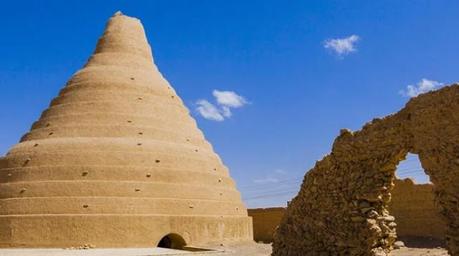
a yakhchal
Records suggest that yakhchals were first constructed as early as 400 BCE. They have a conical shape. This allows hot air to escape upwards out of the structure. Cool air is allowed in thanks to small entryways at the bottom. The cold air stays firmly trapped within, while hot air escapes. Apparently many people in Iran still use “yakhchal” to refer to modern refrigerators.To cut a longish story short modern fridges really started in 1851 when James Harrison created a patent for the first practical application of artificial cooling. He started in 1851 by creating an ice-making machine, which he showed off in Geelong, Australia. After tweaking the design slightly, he released the first commercial ice-makers in 1854 and then refrigerators.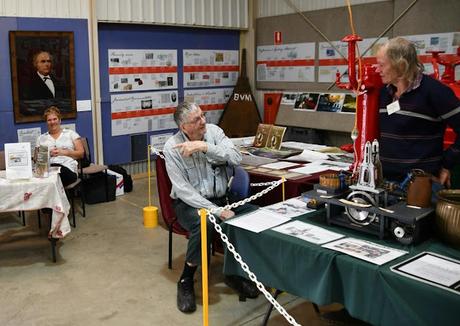
Geelong museum with Harrison's portrait
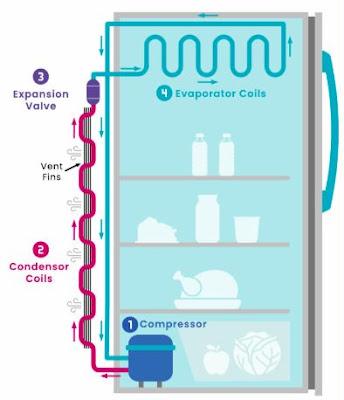
So how does it and subsequent machines work?Step 1 – The CompressorThe compressor pumps in cold and low pressured refrigerant in a gaseous state. Then, the refrigerant is compressed. This compression heats and pressurises it.
Step 2 – The Condenser
The hot and high pressured refrigerant is then channelled into the condenser. The condenser removes the heat and condenses the gas into a liquid.
Ventilation Fins: The heat that is removed from the refrigerant is then released through cooling fins at the back of the fridge. This is why the back of your fridge can get quite warm, or even hot.
Step 3 – The Expansion Valve
Then, liquid refrigerant is pushed through the expansion valve. Within this chamber, the pressure is suddenly dropped. This sudden drop in pressure causes the liquid to expand, with some of it rapidly turning into vapour. This change of state from liquid to gas has a cooling effect on the surrounding area.
Step 4 – The Evaporator
Afterwards, cold refrigerant in a liquid state leaves the expansion valve and enters the evaporation coils. As it travels through, it absorbs any warm air inside of the fridge. Because refrigerants have low evaporation points, this absorption turns it back into a gas, therefore evaporating. This process has a cooling effect that keeps your fridge cool.
Finally, the cold and low pressure gas from the evaporator travels back into the compressor to begin the cycle again.
Lips too chilled
for prattle –
autumn wind

Matsuo Bashō
Thanks for reading, Terry Q. Email ThisBlogThis!Share to XShare to Facebook






