


Of the estimated thirty-three billion chickens in the world, there are hundreds of different breeds.In the US, the most popular chickens for meat are a cross breed between Cornish hens and Plymouth Rocks. Hybrid White Leghorns are the most popular breed for egg laying, producing the bright white eggs that I was so familiar with in my early life.In the UK, chickens raised for meat in factory farm sheds are typically Cobb 500, Ross 308 and the Hubbard Flex – sadly dubbed the ‘Frankenchickens’ because of so many abnormalities like being so fat their legs can’t support their bodies.Popular UK breeds producing brown eggs include Bovans Brown, ISA Brown, Lohmann Brown and the Novogen.Until the 1970s, white eggs were popular in the UK, then fell out of fashion. Preferences are attributed to numerous factors including cultural perceptions, marketing and branding, consumer preferences and production practices to name a few.As the brown egg has been the norm for decades, consumers were again reintroduced to the whites during the pandemic due to stock shortages. Since then, they have been on the rise with many major British retailers supplying them due to changes in poultry management requirements (i.e. beak treatment) and consideration to sustainability (carbon footprint impact). Some of the white egg producing breeds are now more suitable to raise under new legislation. As in the States, the Leghorn is a popular breed.Production methods are different between the two countries affecting storage requirements. In the States, eggs are washed stripping them of their natural protective coating, the ‘bloom’ or ‘cuticle’. The eggs become porous and thus, it is important to refrigerate them so bacteria can’t grow and penetrate the vulnerable shell.Also, the current federal rules do not require vaccination of hens against Salmonella (they do require testing). Major retailers have implemented their own mandates on their suppliers in regards to vaccination, however they do vary.In the UK and most other countries, the washing of eggs is prohibited. Therefore, the coating remains on the shells and eggs are seen as protected from bacteria.
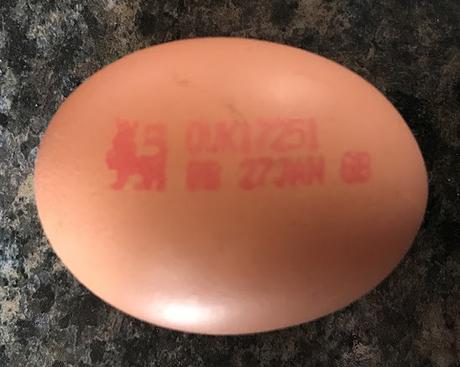
In addition, since 1998 the British Lion Quality mark (shown above) guarantees that eggs have been laid by British hens vaccinated against Salmonella Enteritidis and Salmonella Typhimurium.Over 90% of eggs sold in the UK carry this mark. Although refrigerating eggs in this part of the world is not critical, storing in a cool place is recommended.And now to throw in something completely different and a bit of fun regarding chickens. Several years ago I visited the Rubber Chicken Museum in Seattle. Fun fact: It has the world’s largest and smallest rubber chicken.

The Rubber Chicken Museumat Archee McPhee
will put a smile on your face
a must see and it’s free
rubber chickens galore
in all shapes and sizes
some smartly dressed
in familiar disguises
like Santa Claus suits
although most of them be
naked as jaybirds
with no modesty
some of them squeak
some are printed on towels
they all tell the tale
of this funny old fowl
yes the Rubber Chicken Museum
at Archee McPhee
will put a smile on your face
a must see and it’s free
Thanks for reading.
Kate JSourcesArchie McPhee, 2025. Rubber Chicken Museum. https://archiemcpheeseattle.com/rubber-chicken-museum/Accessed 16 January.
Egg Info, 2025. British Lion Eggs. https://www.egginfo.co.uk/british-lion-eggs Accessed 12 January.
Humane League, 2025. How many chickens are in the world and the us.https://thehumaneleague.org/article/how-many-chickens-are-in-the-world Accessed 12 January
Poultry News, 2025. White turn. https://www.poultrynews.co.uk/production/white-turn.html Accessed 12 January 2025
Quora, 2025. Poultry: How did brown eggs become a standard market choice over white ones in the UK? https://www.quora.com/Poultry-How-did-brown-eggs-become-a-standard-market-choice-over-white-ones-in-the-UKAccessed 12 January 2025.
Statista, 2025. Number of chickens worldwide. https://www.statista.com/statistics/263962/number-of-chickens-worldwide-since-1990/#:~:text=How%20many%20chickens%20are%20in,13.9%20billion%20chickens%20in%202000Accessed 12 January.
Email ThisBlogThis!Share to XShare to Facebook







