


Geological evidence suggests the bramble originated in North America some time in the Eocene age, approximately 34 million years ago, before spreading - as brambles do - to the rest of the world. (Note to self: to read up on the fascinating origins of plant species when I have time).
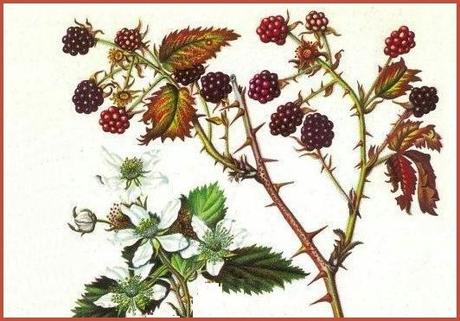
brambles (or blackberries)
The bramble is fast-growing and tenacious. One can almost see its spiny tendrils reaching out to find new rooting sites, to bind onto whatever else it happens to encounter on the way. I have some brambles in my back garden. The flowers are pretty and bees seem to love them. I manage to collect about a saucepan full of juicy blackberries each year before the birds help themselves,When I was a child living in Peterborough in the early 1960s, my parents used to take us brambling on Saturday afternoons in late summer in the local countryside. It was very rural, country lanes, wide grass verges, with huge stretches of tall brambly thickets around the edges of arable fields. We would go armed with step-ladders, walking sticks and buckets plus a picnic tea and would pick loads of fruit in an afternoon. One time my mother fell off the step-ladder into the brambles. We were shocked, but she'd never laughed so much. Our father untangled her with no harm done, save a few scratches. We all looked forward to bramble jelly and blackberry and apple pies.
As a curious aside, there is a bird called a brambling, but we never saw one when we were out foraging for blackberries . And its name has nothing to do with brambles, being derived from the old English 'bram' and 'lyng' meaning loud lungs, for it is a mellifluous finch, and very pretty too.
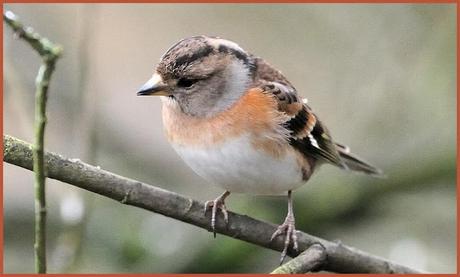
brambling
You're getting two poems, you lucky people. How could I not share Seamus Heaney's fabulous piece on theme?Blackberry-Picking
Late August, given heavy rain and sun
For a full week, the blackberries would ripen.
At first, just one, a glossy purple clot
Among others, red, green, hard as a knot.
You ate that first one and its flesh was sweet
Like thickened wine: summer's blood was in it
Leaving stains upon the tongue and lust for
Picking. Then red ones inked up and that hunger
Sent us out with milk cans, pea tins, jam-pots
Where briars scratched and wet grass bleached our boots.
Round hayfields, cornfields and potato-drills
We trekked and picked until the cans were full
Until the tinkling bottom had been covered
With green ones, and on top big dark blobs burned
Like a plate of eyes. Our hands were peppered
With thorn pricks, our palms sticky as Bluebeard's.
We hoarded the fresh berries in the byre.
But when the bath was filled we found a fur,
A rat-grey fungus, glutting on our cache.
The juice was stinking too. Once off the bush
The fruit fermented, the sweet flesh would turn sour.
I always felt like crying. It wasn't fair
That all the lovely canfuls smelt of rot.
Each year I hoped they'd keep, knew they would not.
Seamus Heaney
My own latest by contrast has nothing to do with brambles, but is written in reaction to what has been going on in the Middle East in recent weeks, with Trump's 'war of choice' against Iranians who've lived their whole lives under a kind of religious tyranny. I've shaped it as a concrete poem. (I hope it retains its shape in your browser.)
Revenge Pawn
I am
merely a
piece on this
shell shocked, pock marked
board. My every move is
constrained by convention.
Trapped between oil and
ideology, my lamp
no longer burns,
my heart no
longer yearns.
I have never
truly found
life. The light was
elsewhere. So wrap me
round in a suicide vest and
point me towards your pearly
king. I’ll willingly do the rest.
Thanks for reading, S ;-) Email ThisBlogThis!Share to XShare to Facebook







