Wow. It “only” took me about two months, but I’ve finally completed the epic known as The Lord of the Rings.
As I’ve said before, I had only read about half the novel before inexplicably putting it down many years ago without finishing. What was I thinking?
The Lord of the Rings is, quite possibly, the best novel ever written.
I don’t say that ironically, and I’m not saying that to troll. I really mean it. But, of course, as is everything on this blog, that’s just my opinion—which is reflected in my rankings.
You know the story, right?
There’s a ring that was forged years ago by the evil Sauron in the bowels of Mt. Doom. Bilbo Baggins came upon the ring, as told in The Hobbit. He’s much older now.
After being defeated, Sauron has slowly returned to power—and is doing everything within his power to regain control of the ring, which is now in the hands of Frodo, who is Bilbo’s cousin.
Whoever wears the ring can eventually become powerful—but at the risk of “losing their soul” in a sense, because the ring is full of darkness and evil. A bunch of wise folks, like Gandalf and Elrond, decide the only way to make sure Sauron doesn’t gain full power, and the only way to really destroy him, is to destroy the ring.
The ring has to be destroyed in the fires of Mt. Doom, where it was first created, and that responsibility falls upon Frodo, the ring bearer.
The Lord of the Rings is the tale of Frodo and his companions–like Gandalf the mighty wizard, the future King Aragorn, Legolas the elf, and Gimli the dwarf, as well as his hobbit friends, Merry, Pippin, and Samwise–as they seek to destroy the ring.
One of the many reasons The Lord of the Rings is so unique is its detail.
Tolkien can take two pages to describe a tree. Some readers lose their minds over that amount of detail—and I fully admit I feel the same way when an author is overly descriptive.
But that wasn’t the case with Tolkien.
By the time you’ve read The Lord of the Rings, you feel like you were on the journey with Frodo, that you’ve been through it all. And a lot of that has to do with the sense of place that Tolkien builds into the story.
The settings are so unique, and filled with hundreds of years of backstory of their own. He can’t tell you all of that the history (though he tries in The Silmarillion), but he tells enough for you to get the sense of place and context you need to appreciate what’s going on in the story.
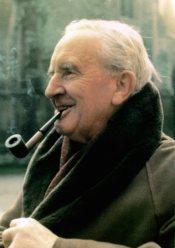
J.R.R. Tolkien
As Brandon mentioned in his guest post a few weeks ago, Tolkien has been incorrectly criticized for his lack of character development. Brandon points out that he wasn’t interested in character development—but moreso in the use of language in telling a story.
But I would say that he was pretty darn good at character development—for an author who is supposedly not very good at it.
When you think about the development of the hobbit characters—Frodo, Pippin, Merry, and Sam—throughout the course of the three books, you can’t help but be impressed.
But, again, I keep coming back to the beauty of Tolkien’s descriptions. His writing is just fantastic, as evidenced in this passage from Fellowship.
The rain, however, did not last long. Slowly the sky above grew lighter, and then suddenly the clouds broke, and their draggled fringes trailed away northward up the River. The fogs and mists were gone. Before the travellers lay a wide ravine, with great rocky sides to which clung, upon shelves and in narrow crevices, a few thrawn trees. The channel grew narrower and the River swifter. Now they were speeding along with little hope of stopping or turning, whatever they might meet ahead. Over them was a lane of pale-blue sky, around them the dark overshadowed River, and before them black, shutting out the sun, the hills of Emyn Muil, in which no opening could be seen.
Frodo peering forward saw in the distance two great rocks approaching: like great pinnacles or pillars of stone they seemed. Tall and sheer and ominous they stood upon either side of the stream. A narrow gap appeared between them, and the River swept the boats towards it.
Isn’t that pretty?
Look, I could go on and on and on about The Lord of the Rings, but we’re not covering any new ground here. Plus, I’ve been talking about this novel for two months and I’m guessing all of you are tired of it.
So let’s move on. But, please, do yourself a favor and give The Lord of the Rings a chance if you’ve never read it. This is truly an epic novel.
Other thoughts
The Opening Line: “When Mr. Bilbo Baggins of Bag End announced that he would shortly be celebrating his eleventy-first birthday with a party of special magnificence, there was much talk and excitement in Hobbiton.”
The Meaning: Tolkien hated allegories, so it’s not that. But the novel touches on death, immortality, the “addictiveness” of the ring, as well as the age old tension between fate and free will.
Highlights: Let’s start with the fact that this novel runs well over 1,000 pages, and I was plugged in the whole time. I already knew how it ends. I understood the basics of the story, though I had never read the second half. But, still, The Lord of the Rings left me mesmerized. I also love how Tolkien plants Merry and Pippin in scenes to give almost a voyeuristic account of what’s going on. They aren’t involved in much combat.
Lowlights: The most difficult aspect of this novel is keeping up with all the names, of both people and geography. There’s Mordor and Gondor and Boromir and Rohan and Aragorn and Arwen and the list goes on and on. It’s difficult, but it’s also amazing how Tolkien created an entire language as a basis of the novel.
Memorable Line: “It’s a dangerous business, Frodo, going out your door. You step onto the road, and if you don’t keep your feet, there’s no knowing where you might be swept off to.”
Final Thoughts: I love this novel. That’s it. You might surprised at where I place it in my rankings, so go take a look if you’re curious. God bless you, Tolkien. You left the world with an amazing piece of art.