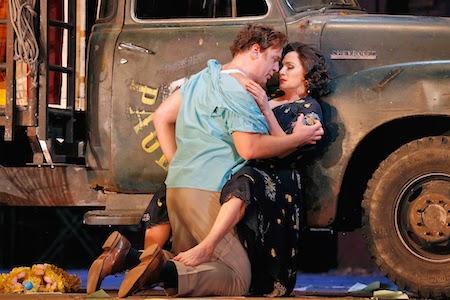
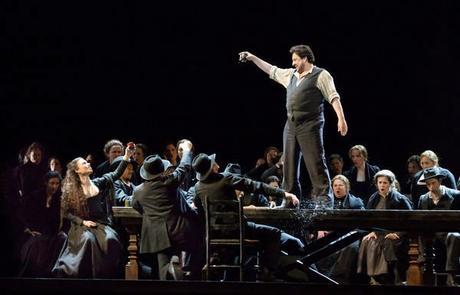
 The concept and choreography of Cavalleria seemed similarly vague, and left me dissatisfied. Ritualizing Cavalleria Rusticana might work, but turning a story driven by very specific psychological and social forces into something allegedly atavistic, an acted-out myth only dimly understood by its participants, flattened the drama. I did like the image of the communal table that was also a stage, dramatizing the fact that to participate in the life of this village is also, inevitably, to invite its judgment (Santuzza, significantly, stands alone here during the prelude.) Although the chorus goes through the not-very-specific motions of community, Santuzza seems to be the only character who actually believes in mutual responsibility, to say nothing of the profound and sublime joy of the Easter chorus. Santuzza has faith in the possible usefulness of apprising Mamma Lucia of her plight; of appealing to Turiddu's better nature; of apprising Alfio of Lola's public infidelities. But none of these actions has any constructive result. Even the men's mutual defiance is a ritual that neither appears to believe in. (This could be made dramatically effective, as in Effi Briest, but I didn't feel that it was.) Musically, matters were more felicitous. Fabio Luisi led the orchestra in an admirably energetic and detailed performance. I appreciated the extent to which Luisi brought out the dark orchestral textures, and dug into the complexity of individual moments, though more could have been done with overall momentum. As Lola, Ginger Costa-Jackson gave an assured performance, and used her physical presence well. George Gagnidze, as Alfio, started out with a slightly rough opening aria, but gained in nuance of dynamics and tone as he warmed up. In the unsympathetic role of Turiddu, Marcelo Alvarez as Turiddu sang with lovely tone and very fine diction throughout. Still, I wished that I had felt any sense of conviction, or desperation; instead, he waved his arms emphatically, an unfortunately durable cliché of operatic gesture. The Santuzza of Eva-Maria Westbroek was a standout, warm-hearted and warm of tone. Her intonation was occasionally wayward at the beginning, but she had beautiful and big sound, and used the phrases well, her performance the only larger-than-life thing in the opera.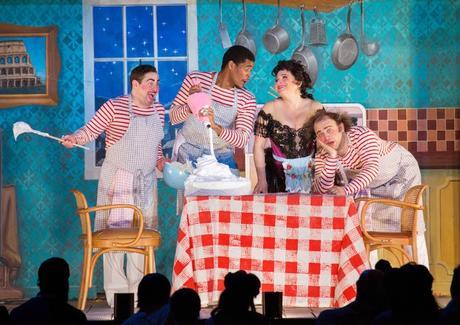
The precarity of performance: Nedda & Co. on stage. Photo (c) Sara Krulwich
After the interval, we returned to find the slightly shabby magic of vaudeville, fronted by a blue velvet curtain, spangled with cheap stars. The entire production was noisy, active, and gloriously vulgar. The demands of the prologue that we dismantle prejudices to see common humanity can be too easily taken for granted, in an opera that has become perhaps too-comfortably absorbed into the canon... but here, I was inveigled into despising Tonio for his double-breasted and sequined suit jacket, his excessively brilliantined hair. I was shocked at myself, delighted with the production. The choreography here was as specific as that of the preceding opera seemed generalized. One of its greatest strengths was the establishment of good chemistry among the members of the troupe, as well as good individual characterization. I felt that vaudeville antics were out of place in the prologue, when Tonio is attempting to establish precisely that we are not to identify the characters with this... but breaking down porous boundaries between high and low art, was one of the things that the production accomplished most effectively. This may be partly due to McVicar's wickedly, brilliantly accurate assessment of the Met audience. This is an audience that will applaud scenery. This is an audience that will laugh at cheap sight gags. This is an audience that will do those things even when the real drama of Pagliacci is gathering its terrifying momentum. And it did. The effect was, ironically, chilling in the extreme.