


Book review by George Simmers: I hadn’t read Black Mischief since I was a teenager, when I remember enjoying it heartily. Since then it is a book that has attracted a lot of opprobrium, as the most prejudiced of Waugh’s novels, containing attitudes and stereotypes offensive to modern sensitivities. In the twenty-first century, I approached it warily.
This was Evelyn Waugh’s third novel, after the brilliant farce of Decline and Fall, and Vile Bodies, which segues from a satire on the Bright Young Things to a fantasy of future war. This book was inspired byb his experience as a journalist; Waugh had been to the coronation of Haile Selassie in Ethiopia, where he had been impressed by the spectacle and the sometimes ridiculous mismatch between African and European ways.

In Black Mischief he invents Azania, a fictional island off East Africa, where young Oxford-educated Emperor Seth has just inherited the throne. The first chapter is a brilliant depiction of a capital in disarray.Expecting conquest by the rebels, all officials and prominent citizens are deserting Seth in expectation of disaster. Unexpectedly, Seth’s general wins the battle (mostly because he ditched the tank in which progressive Seth had placed great faith, and relied on the blood-thirstiness of his troops.) Seth is thereby in a position to introduce a great programme of modernisation, in which he is helped by an Oxford contemporary, Basil Seal.
Basil Seal is one of the great Waugh characters, who recurs in other novels. He is utterly amoral. At the start of the book he decides that Azania is the country where the future of the world will be decided, and is determined to go there. He steals his mother’s emeralds to finance his passage. Once he gets there he makes it his mission to help Seth in his modernisation mission.
The book has a reputation as expressing prejudice against Africans, and there are phrases that a modern publisher’s sensitivity reader would definitely cut, but the villains of the book are the Europeans, all pursuing their own ends in Azania, with no thought for the natives. The diplomatic community is presented as utterly self-absorbed and self-interested. The French are depicted as especially resentful and scheming, the English as inefficient and trivial. or example. Some of the liveliest satire is directed at two middle-aged English ladies, Dame Mildred Porch and Miss Sarah Tin, who have come to Azania with concern about the treatment of animals, who show no concern for humans: Dame Mildred writes a letter home:
Fed doggies in market-place. Children tried to take food from doggies. Greedy little wretches.
The main butt of the satire, though, is Seth’s modernisation scheme, which allows Waugh to point outwhat he sees as the incompatibility of progrerssive ideas with actual human nature. Whenever he reads about a progressive scheme in Europe, Seth wants to import it. One of his main obsessions is family planning. He gets Basil Seal to organize a publicity campaign, and he produces a poster:
“It portrayed two contrasted scenes. On one side a native hut of hideous squalor, overrun with children of every age, suffering from every physical incapacity—crippled, deformed, blind, spotted and insane; the father prematurely aged with paternity squatted by an empty cook-pot; through the door could be seen his wife, withered and bowed with child-bearing, desperately hoeing at their inadequate crop. On the other side a bright parlour furnished with chairs and table; the mother, young and beautiful, sat at her ease eating a huge slice of raw meat; her husband smoked a long Arab hubble-bubble (still a caste mark of leisure throughout the land), while a single healthy child sat between them reading a newspaper. Inset between the two pictures was a detailed drawing of some up-to-date contraceptive apparatus and the words in Sakuyu: WHICH HOME DO YOU CHOOSE?
The message is read in a quite unintended way by the Africans:
Interest in the pictures was unbounded; all over the island woolly heads were nodding, black hands pointing, tongues clicking against filed teeth in unsyntactical dialects. Nowhere was there any doubt about the meaning of the beautiful new pictures. See: on right hand: there is rich man: smoke pipe like big chief: but his wife she no good: sit eating meat: and rich man no good: he only one son. See: on left hand: poor man: not much to eat: but his wife she very good, work hard in field: man he good too: eleven children: one very mad, very holy. And in the middle: Emperor’s juju. Make you like that good man with eleven children. And as a result, despite admonitions from squire and vicar, the peasantry began pouring into town for the gala, eagerly awaiting initiation to the fine new magic of virility and fecundity.”
The novel ends with war and the capital in chaos, with Basil fleeing for his life. He finds rescue among an African faction of loyalists, who are celebrating an unexpected triumph. His is invited to a feast where Waugh gets his culminating darkest joke from one of the oldest of stereotypes – African cannibalism. This book is maybe not for everybody.
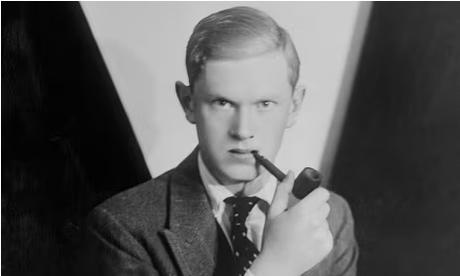 Evelyn Waugh
After greatly enjoying it, though, I decided to re-read Waugh’s 1942 novel Put Out More Flags, which also features Basil Seal – a bit older, no more respectable, just as devious. It is set during the ‘phoney war’ the period between September 1939 and the Battle of Britain in June 1940, when the country was officially at war, but nothing much seemed to be happening.
Much is made of the culture clash between the inhabitants of a country village and evacuees from Birmingham. Basil makes a good living from bribes as he threatens to impose the most awful of the evacuee children on households. The book is even better than Black Mischief.







