


By the way, in a quick digression, scientists have just discovered an enormous 'whale graveyard' in the Diamantina fracture, four miles down at the bottom of the Indian Ocean. The graveyard is about 745 miles long and contains fossilised whale skeletal remains dating as far back as 5 million years ago, including several now-extinct species, as well as recent and currently decomposing bodies. Amazing or what?Back to barnacles. Not very sexy, as I was saying, but tenacious little beggars. They've been around some 300 million years - i.e. way before there were boats or breakwaters to stick onto, so it must have been rocks, turtles and the occasional whale in those far off millennia. They are crustacea and there are are some 2,000 different species of them. They are exclusively marine invertebrates, less fanciful cousins of the crab and the lobster and nothing like limpets, which are molluscs.Barnacles live mainly in shallow and tidal waters and are sessile (my word of the week) meaning they have no natural mobility, excepting during the larval stage, when they are busily floating around looking for a suitable surface to adhere to. Once they've found their spot, they secrete a water-resistant glue from glands in their heads, stick themselves head-first to their chosen substrate, and that's it, cemented in place for life, often upside down. Many species are hermaphroditic, and it only takes one to start a colony!Mariners hate them, because barnacle colonies can form weighty encrustations on the hulls of boats, giving rise to what's called hydrodynamic drag, increased weight and reduced sailing efficiency. The only remedy is to scrape them off in dry dock, a laborious process.
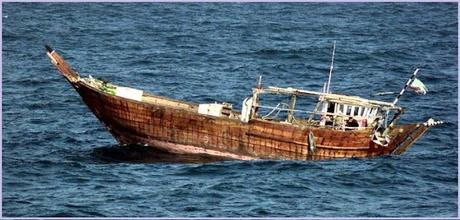
a boat's bottom weighed down by barnacles
By the way, too many of them encrusting the shell of a sea turtle can make life difficult for the turtle as well, the extra weight, the increased drag, so animal conservationists often intervene to de-barnacle badly affected creatures by scraping the blighters off.The most common barnacles have their own hard outer carapace or shell, made up of six calcareous plates which protect the organism inside. They open up to feed, waving their feathery legs around as in the diagram below to entrap floating plankton and pull their prey down into their shells. They are heartless creatures, literally it appears. They have stomachs, guts, an anus but no heart that anyone has been able to find, and no brain to speak of. They are just eating, shitting and reproducing automatons, serving no useful purpose as far as I can see.
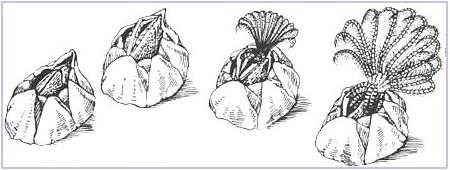
a barnacle opening up to feed
And yes, reproduction. I've said barnacles are not very sexy. However, because they can't move around once glued in place, if they want to mate they have to be able to penetrate the nearest barnacle, which may be quite some distance away. As a result, barnacles have the largest (i.e. longest) penis in relation to body size of any animal. If you take nothing else away from this blog, take that surprising fact. It may come in useful one quiz night.I don't have anything more of interest to say on the subject.
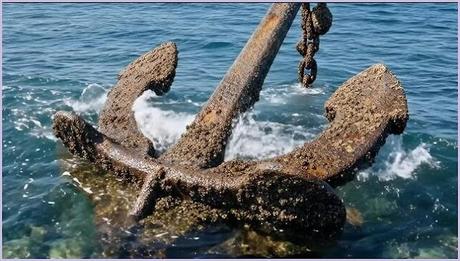
an anchor's flukes encrusted with barnacles
Usually I find myself posting these blogs quite late on a Saturday, sometimes only just before midnight, but I've set myself a deadline of 10:30pm because I plan to watch Morocco in their opening world cup fixture against Brazil and that kicks off at 11:00 pm.I haven't written an acrostic poem in a while, so thought I'd give it a try this evening.
Barnacles
Briny little beggars, sessile too. Moored headfast for life, stuck to their spot,
A seaside breakwater, a rock, or if they're lucky a ship's hull, perhaps a whale,
Rare opportunity to get around, see a bit of the world, except they've no eyes.
No heart either, for that matter, briny little beggars from Carboniferous times,
Aquatic automata made to eat, shit, reproduce without advance for millennia.
Clam up at low tide, though they're not clams but simple, stubborn crustacea
Look a bit volcanic, then opening up like Tracy Island, waving those tentacles
Enticingly to fill their stomachs with passing plankton and tiny marine debris.
Surprising fact: their penis in ratio to body size, largest in the animal kingdom.
Thanks for reading, S ;-) Email ThisBlogThis!Share to XShare to Facebook







