


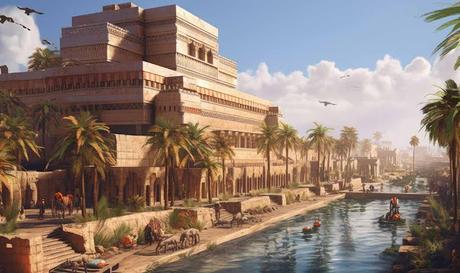
artist's impression of Uruk, circa 4500 BCE
Incidentally, Rome at the height of its power had over one million people in it before it collapsed in around 400 CE. The next city to have over a million in its population was London in the 19th century.So what is ancient? Well, for the purposes of this article, as it relates to cities, I’m taking a time period where we have physical evidence and texts that the places exist.Much of the following is taken from the World History Encyclopaedia by Joshua J. Mark published on 05 April 2014:In the study of the ancient world a City is generally defined as a large populated urban center of commerce and administration with a system of laws and, usually, regulated means of sanitation. This is only one definition, however, and the designation `City' can be based on such factors as the:
population of the settlement
height of buildings
density of buildings/population
presence of some kind of sewer system
level of administrative government
presence of walls and/or fortifications
geographical area of the settlement
or whether a `settlement' was called a `city' in antiquity and fits at least one of the above qualifications.
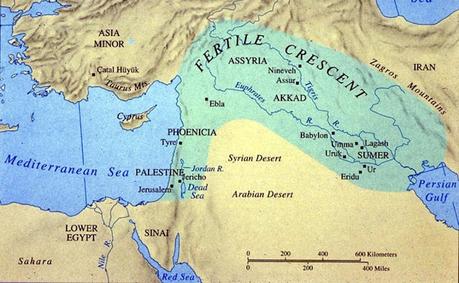
the fertile crescent
Professor George Modelski, of the University of Washington, encourages a definition based on the work of the historian Tertius Chandler (in his book Four Thousand Years of Urban Growth) which defines a city, as distinct from a village, based upon population. Modelski writes:Adopting Chandler's means of definition, then, settlements such as Tell Brak in modern-day Syria (first founded in c. 6000 BCE) cannot be considered cities.The city of Uruk, today considered the oldest in the world, was first settled in c. 4500 BCE and walled cities, for defence, were common by 2900 BCE throughout the region. The city of Eridu, close to Uruk, was considered the first city in the world by the Sumerians while other cities which lay claim to the title of `first city' are Byblos, Jericho, Damascus, Aleppo, Jerusalem, Sidon, Luoyang, Athens, Argos, and Varasani.All of these cities are certainly ancient and are located in regions which have been populated from a very early date. Modelski cites the population of Uruk at 14,000 in the year 3700 BCE but 80,000 by the year 2800 BCE. I was a bit surprised by the figure of 80,000 as when I was checking I found that Carlisle has much the same population now and that seems, to me, a fairly large city.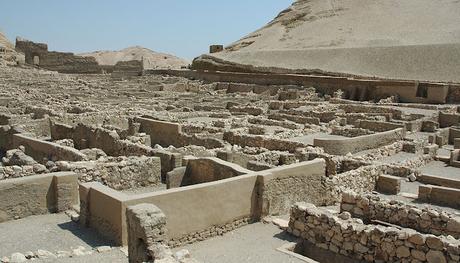
the ruins of Uruk today
I wanted to use a poem that actually praises the city, from the ancient to the present day, as a place to live. There is a reason why people have wanted to live in them but I can’t find one that really suits my purpose so I’m going to make use of this chance which sort of works.Ever since my school days I’ve disliked Robert Browning purely on the basis of one poem. This is a short section with a corrected title:Up the City – Down the Villa
Had I but plenty of money, money enough and to spare,
The house for me, no doubt, were a house in the city-square;Ah, such a life, such a life, as one leads at the window there!
Something to see, by Bacchus, something to hear, at least!
There, the whole day long, one's life is a perfect feast;
While up at a villa one lives, I maintain it, no more than a beast.
Well now, look at our villa! stuck like the horn of a bull
Just on a mountain-edge as bare as the creature's skull,
Save a mere shag of a bush with hardly a leaf to pull!
--I scratch my own, sometimes, to see if the hair's turned wool.
But the city, oh the city--the square with the houses! Why?
They are stone-faced, white as a curd, there's something to take the eye!
Houses in four straight lines, not a single front awry;
You watch who crosses and gossips, who saunters, who hurries by;
Green blinds, as a matter of course, to draw when the sun gets high;
And the shops with fanciful signs which are painted properly.
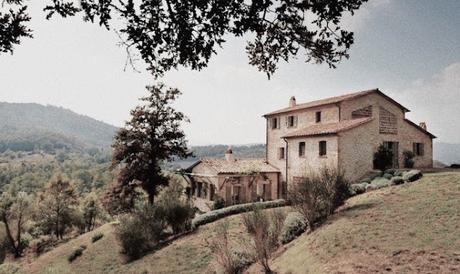
Down the Villa
Thanks for reading, Terry Q. Email ThisBlogThis!Share to XShare to Facebook






