


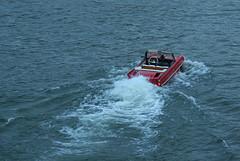
Amphibious car. Admiralty Jurisdiction? (Photo credit: vincen-t)
In theory, admiralty law only applies to things “nautical” . . . at sea or in large bodies of water.
However, there’s a “wing” in the legal reform/patriot/sovereignty movement that contends that our government has brought admiralty law onto the land. Under this contention, automobiles are deemed “vessels“; police cars are deemed “cruisers”; the streets are deemed to be “rivers of asphalt”; and court rooms are structured in such a way that if you pass through the gate at the “bar” and enter into the court “arena”, you’re deemed to have voluntarily entered into admiralty jurisdiction and exposed yourself to a law form that is harsh and, for most people, nearly incomprehensible.
The admiralty-law-on-the-land theory is not new. I was aware of it 20 years ago.
Therefore, back about A.D. 1993, when the Texas Bar conducted a seminar on Admiralty Law, I bought a copy of the resulting 400-page collection of all the speeches presented at that seminar. I read those 400 pages. Much of it was incomprehensible to me. But I was looking for some clue that admiralty law had been brought onto the land of Texas. Surely, if the State Bar would hold a two-day seminar on admiralty law, and if admiralty law lay at the foundation of modern traffic law, there should be some clue to that fact in the 400-pages of speechs. I found no such clue.
That’s not proof, but it is evidence that the admiralty-law-on-the-land theory was at least flawed and possibly false. Therefore, I’ve not paid much attention to that theory for the past 20 years. I still doubt the validity of that that theory, but I can’t prove that it’s wrong.
However, the Supreme Court has just issued an order in the matter of LOZMAN v. CITY OF RIVIERA BEACH, FLORIDA which involves admiralty law. The case involved a man (Lozman) who had a “floating home was a house-like plywood structure with empty bilge space underneath the main floor to keep it afloat.” It had no means of self-propulsion.
Lozman parked his “floating home” in a local marina and offended the City of Riviera Beach. ”After various disputes with Lozman and unsuccessful efforts to evict him from the marina, the City brought a federal admiralty lawsuit in rem against the floating home, seeking a lien for dockage fees and damages for trespass.”
Lozman moved to dismiss the suit for lack of admiralty jurisdiction.
“The District Court found the floating home to be a “vessel” under the Rules of Construction Act, which defines a ‘vessel’ as including ‘every description of watercraft or other artificial contrivance used, or capable of being used, as a means of transportation on water,” 1 U. S. C. §3, concluded that admiralty jurisdiction was proper, and awarded the City dockage fees and nominal damages. The Eleventh Circuit affirmed, agreeing that the home was a ‘vessel’ since it was ‘capable‘ of movement over water despite petitioner’s subjective intent to remain moored indefinitely.”
Judging from the the decisions of the District Court and Eleventh Circuit Court, it’s conceivable that–if a house floating on water can be deemed a “vessel”–so might an automobile since automobiles are truly “capable of movement over water”.
Think not? When I was a kid, my dad used to take us up to Lake Geneva, Wisconsin and drive us out on the ice on that huge lake. While driving and spinning on that huge lake of ice we were clearly “moving over water”. Thus, insofar as ice is deemed to be “water,” the patriot theory of bringing admiralty onto the land, may have been true.
Even so, Lozman appealed to the Supreme Court which declared in part:
2. Lozman’s floating home is not a §3 “vessel.” Pp. 3-15.
(a) The Eleventh Circuit found the home “capable of being used . . . as a means of transportation on water” because it could float and proceed under tow and its shore connections did not render it incapable of transportation. This interpretation is too broad. The definition of “transportation,” the conveyance of persons or things from one place to another, must be applied in a practical way. Stewart v. Dutra Constr. Co., 543 U. S. 481, 496. Consequently, a structure does not fall within the scope of the statutory phrase unless a reasonable observer, looking to the home’s physical characteristics and activities, would consider it designed to a practical degree for carrying people or things over water. Pp. 3-5.
(b) But for the fact that it floats, nothing about Lozman’s home suggests that it was designed to any practical degree to transport persons or things over water. It had no steering mechanism, had an unraked hull and rectangular bottom 10 inches below the water, and had no capacity to generate or store electricity. It also lacked self-propulsion, differing significantly from an ordinary houseboat. Pp. 5-6.
Hmph. Is this evidence that–because “no reasonable observer” would consider an automobile to be designed for carrying people or things over the water”–that an automobile also can’t be a “vessel” and therefore can’t implicate admiralty law on the land?
Or, is that evidence that an automobile–which does have a “steering mechanism” (while on ice), a “capacity to generate and store electricity,” and a capacity for “self-propulsion”–might be construed to be a vessel and therefore subject to admiralty law?
And note that the Supreme Court starts point #2 of this order with “Lozman’s floating home is not a §3 ‘vessel’.” By specifying that this ruling applies only to [section] §3 vessels, the Supreme Court leaves open the issue of whether another class of “vessels” (perhaps found at §2 or §22, or even some completely different law) might exist that could “reasonably” include automobiles.
I can’t yet answer those questions. At first glance, I thought the Supreme Court had trashed the “admiralty-on-the-land” theory. But on reconsideration, I’m not so sure. If there’s a class of vessel other than §3, automobiles might still be deemed “vessels”. If so, by operating one of those “vessels” you might be subjecting yourself to admiralty law.
So, what do you think?
Do any of you still embrace the “admiralty-on-the-land” theory (especially in relation to traffic law)? Or, do you suppose that theory to be just another patriot “rabbit trail”?
The Lozman court order is fairly brief and offers more insight into whether an automobile might arguably be–or not be–a “vessel”. Take a look. See what you think. Let me know.







