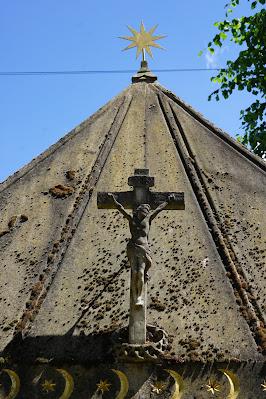
Between a terrace of houses and a traditional English church in Mortlake, West London is a surprising mausoleum. Not only is it much larger than might be expected in such a churchyard; it is shaped like a Bedouin tent. This is the last resting place of Sir Richard and Lady Isabel Burton, Victorian explorers and authors.
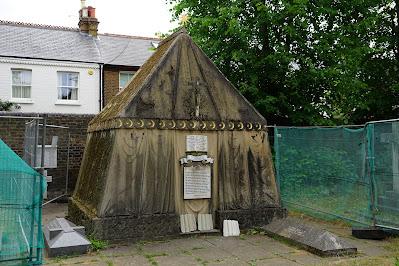
Richard died first, in 1890, and Isabel commissioned the strange structure. Her late husband had told her he would like them to be side by side in a tent after death, hence the design of the sandstone mausoleum. The central panel at the front was originally a stone door; opening it would activate an electric system to shake camel bells in the ceiling, adding to the tent-like atmosphere. At the rear is a window, added because Richard didn't like the dark. It currently serves as the entrance for restorers as the door has been replaced by an immobile panel. The current restoration project hopes to reinstate the door, although they do not yet know how it was constructed - a solid stone door would be impractically heavy.
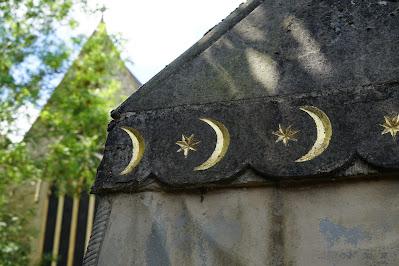
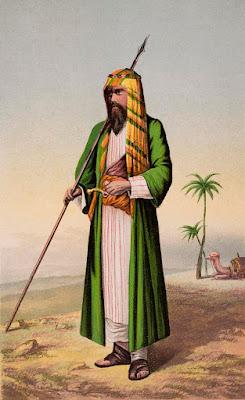
The mausoleum is in the churchyard of St Mary Magdalene Roman Catholic Church: Isabel was from an old Catholic family. Richard's approach to religion was rather more idiosyncratic, as acknowledged in the mixture of Islamic and Christian decoration on the mausoleum. Indeed, his first bestselling book was an account of how in 1853 he adopted various disguises in order to join the Hajj (pilgrimage to Mecca) - something which is forbidden to non-Muslims. This glimpse of the forbidden fascinated Victorian Britain, although as Heba Al-Haj Yonis persuasively explained at a recent event, Richard's account was very much that of an outsider, missing the intense emotional and spiritual meanings of Hajj.
Richard also lived and traveled in India and Somalia, as a member of the East India Company's army; to East Africa in Royal Geographic Society expeditions; and as a British consul to Fernando Po, off the West African coast, Brazil, Damascus, and finally Trieste where he died. He was a talented linguist and produced translations of the Kama Sutra and Arabian Nights along with his travel books. (The more sexually explicit translations were published privately for subscribers only, to avoid obscenity proceedings.) His interest in the Kama Sutra was part of a wider fascination with sexuality which attracted criticism from his contemporaries, and can be problematic in different ways for modern readers, not least for his racial theories. He was also rumoured to have killed another man during the Hajj in order to avoid discovery, but he always denied this.
Isabel accompanied Richard on many of his travels - although officials told her that she could not go with him to Fernando Po since the climate was apparently too dangerous for white women. She was also an accomplished author in her own right. Nonetheless, as Mara Willson discussed, she successfully positioned herself as companion and assistant to Richard - the devoted wife rather than the adventurer - in order to avoid scandalising respectable society. (In fact, she had been determined to find adventure long before she married him.) Her care for reputation extended to destroying a number of Richard's manuscripts after his death, a decision which made sense given the social attitudes of the day - and the fact that she was already being made extravagant offers by publishers who apparently intended to publish some of the work as pornographic texts - but for which she has been vilified.
The event I attended, part of the London Festival of Architecture, was hosted by Habitats and Heritage. who care for this and other monuments in the area.