


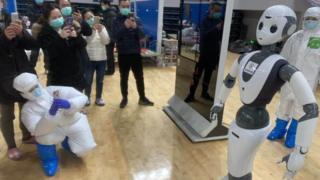
Since February, the California-based manufacturer CloudMinds has shipped over 100 robots to China.
Many of these went to hospitals, where XR-1 provides information to patients and helps guide visitors to the right ward.
Artificial intelligence (AI) built into machines means they can operate alone. They are also connected to the latest 5G mobile networks, which means they can react very quickly.
"The high speeds and wide reach of 5G networks make them ideal for XR-1, which interacts by talking, gesticulating, dancing and physically guiding people," says Karl Zhao, president of CloudMind.
According to Dean Wan Jun of Wuhan Wuchang Field Hospital, they would have been helpful. "The contactless operation and reliability of the CloudMinds robots supported the field hospital in a difficult time," he says.
A few dozen robots won't seriously affect the coronavirus epidemic, but it could be a sign of what's coming.
Artificial intelligence has made great strides in activities such as speech processing, which makes digital helpers increasingly useful.
Dr. Anita Montes, a North Carolina-based obstetrician-gynecologist, says that Suki saves her "hours and hours a day" by writing down notes.
"Proper mapping is vital for good patient care," he says.
Do you think the service could be useful for doctors who are dealing with Covid-19 patients, as a result: "It could take 12 hours to see the patients, then other hours to track them, so any tool that can reduce the time needed it's really useful. "
Until now, most people's experience with digital assistants has been limited to leisure-focused services like Amazon's Alexa and Apple's Siri.
"Business usage is growing, but the digital assistant market is currently predominantly residential," says Blake Kozak, an analyst with global technology researcher Omdia.
But quarantined helpers are turning to AI tools for help.
"We are currently organizing more meetings than we have ever had," says Dennis Mortensen, CEO and co-founder of x.ai, an AI meeting planning tool that sends attendees potential moments.
"The situation is pushing people to turn to software solutions and I doubt they will return when things return to normal."
This is good news for Microsoft, which recently started removing consumer-oriented features like controlling music from its assistant Cortana's skill set and concentrating on personal productivity apps like reading emails aloud. and scheduling meetings.
"You need an assistant who can go beyond answering questions or setting alarms," Microsoft said in a note.
"Our ultimate goal for Cortana is to create an assistant that can help you go back in time so you can focus on the things that matter most."
However, for anyone who wants to use a digital assistant to lighten their load, Mortensen recommends choosing a range of tools that each does one thing well.
"I don't expect any digital assistant to be able to do everything, but I think we will see start seeing artificial intelligence agents employed to perform well-defined tasks within the next five years," he says.
"You may need 10 or 11 to do all the small jobs you need to do, but if we can get them all talking together, they could really do great things."
More business technologyAI's IPsoft staff, based in New York, hopes this is the case.
Develop software packages designed to fulfill roles traditionally played by people, such as an IT service desk engineer.
Through its new online market, potential employers can interview the Amelia company assistant to decide whether to hire a digital employee rather than a person.
At a cost of $ 1,800 (£ 1,460) per month, their IT troubleshooter can reset passwords, unlock accounts and handle up to 1,000 requests per month.
So should humans be concerned about these emerging digital rivals?
Not according to Chloe Jessamy of the administrative support and digital marketing company Supportal Business Services in London.
His company provides services, including PA and web design, performed by humans, not computers.
"I'm not worried about digital assistants at all," he says.
"My clients want practical support and communication, which needs a human touch. There is only so much automation that you can use."
Dr Will Venters, assistant professor of information systems at the London School of Economics, supports this view.
"Robots need careful management," he says
"They won't question their work, they don't have an ethical compass, they can't easily explain how they came to a decision, and they can't understand the prejudices they could apply.
"Plus, they work so quickly that the problems they cause can quickly get out of control."
So having a digital assistant might make you more productive, but it's worth remembering that they're not perfect.






