 Ms Chan expects to
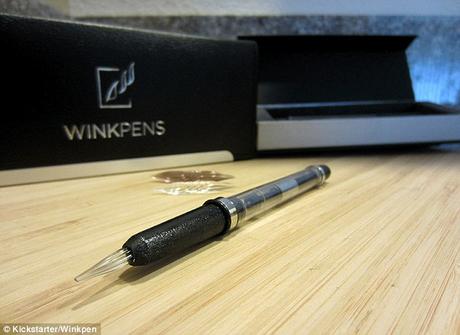
begin shipping the device in July this year. There are some smart pens too. The main components of the pen are a glass
nib, a corkscrew-shaped container to draw liquid up into the pen and a twisting
cap at the top. By dipping the pen into, for example, a glass of wine, the top
of the pen can be twisted to suck any liquid into it. As long as the liquid has
a staining property, the user can then write on a piece of paper. This means
that wine, beer, tea, juice and more - and of course regular ink - can all be
used to write on paper. And the whole pen can be disassembled, so it can be
cleaned fairly easily. The double-sided glass nib is angled and can be used for
calligraphy. Alternatively, turning it
around reveals the regular conical nib for finer writing.
Using glass
supposedly removes the risk of corrosion, and also makes it easy to clean, and
'ink' is fed to the nib through spiral grooves in the glass. The
Winkpen is billed as a sustainable way to write, without needing to throw pens
away when they run out of ink, and it can be used over and over again. When the pen runs out of 'ink', the top of it
can be twisted to spin the corkscrew within and draw liquid up through the nib.
The cap can also be twisted in the opposite direction to unload liquid from the
pen.
Inside the pen, the
glass is is held in place with a elastomer lining, which also contains a thin
tube that transports liquid from the pen’s central storage tube to the nib. ‘Traditional pens are, more often than not,
disposable products; once the pre-loaded ink stem is exhausted, they
essentially just become empty plastic cases that inevitably wind up in a
land-fill somewhere. ‘In essence, the Winkpen was born from the desire to
create a sustainable alternative to something that many of us use in our daily
lives,’ explained Ms Chan. ....and for
the winkpen, an ink reload can be found right there in your kitchen.
With regards – S.
Sampathkumar
Ms Chan expects to
begin shipping the device in July this year. There are some smart pens too. The main components of the pen are a glass
nib, a corkscrew-shaped container to draw liquid up into the pen and a twisting
cap at the top. By dipping the pen into, for example, a glass of wine, the top
of the pen can be twisted to suck any liquid into it. As long as the liquid has
a staining property, the user can then write on a piece of paper. This means
that wine, beer, tea, juice and more - and of course regular ink - can all be
used to write on paper. And the whole pen can be disassembled, so it can be
cleaned fairly easily. The double-sided glass nib is angled and can be used for
calligraphy. Alternatively, turning it
around reveals the regular conical nib for finer writing.
Using glass
supposedly removes the risk of corrosion, and also makes it easy to clean, and
'ink' is fed to the nib through spiral grooves in the glass. The
Winkpen is billed as a sustainable way to write, without needing to throw pens
away when they run out of ink, and it can be used over and over again. When the pen runs out of 'ink', the top of it
can be twisted to spin the corkscrew within and draw liquid up through the nib.
The cap can also be twisted in the opposite direction to unload liquid from the
pen.
Inside the pen, the
glass is is held in place with a elastomer lining, which also contains a thin
tube that transports liquid from the pen’s central storage tube to the nib. ‘Traditional pens are, more often than not,
disposable products; once the pre-loaded ink stem is exhausted, they
essentially just become empty plastic cases that inevitably wind up in a
land-fill somewhere. ‘In essence, the Winkpen was born from the desire to
create a sustainable alternative to something that many of us use in our daily
lives,’ explained Ms Chan. ....and for
the winkpen, an ink reload can be found right there in your kitchen.
With regards – S.
Sampathkumar
29th May 2015.