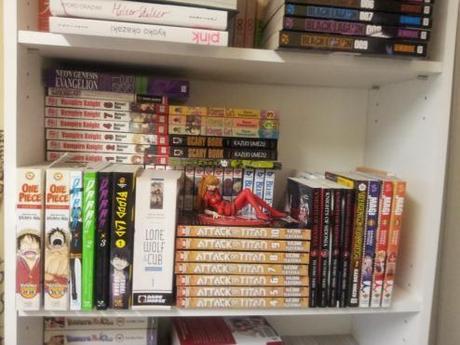
My personal bookshelf is a testament to just how varied manga sizes are. Also, Asuka.
Nowadays manga is rarely a one-size fits all affair. Single volumes, omnibuses, and even deluxe hardcovers are the name of the game. One only has to take a look at recent releases such as Viz’s all color Dragonball Z re-release, Vertical’s deluxe hardcovers of the Gundam Origin series, or Kodansha’s hardcover releases of fan-favorite Vinland Saga to get an idea of the different shapes and sizes available for your manga bookshelf.
With that in mind, what exactly dictates whether a manga will land in the “hardcover”, “omnibus”, or “oversized” section of your bookshelf? First, I take a look at some of the ways manga is released and potential reasons, then I take to social media to ping a manga publisher on their thoughts.
Viz has a pretty representative spread of trims and sizes. The Shojo Beat and Shonen Jump/Shonen Sunday imprints are the “standard” manga size (7.5 x 5.1), while the Sig Ikki/Signature imprints use a larger trim size (8.5 x 5.5). Then you have the omnibus releases, such as the 3-in-1 releases of popular series such as Skip Beat and One Piece and the higher quality VIZBigs for Vagabond and Hot Gimmick. Moving away from Viz, you also have some releases with smaller trim sizes — Vertical’s releases of Knights of Sidonia and Limit as examples. Finally, we have the recent hardcover releases such as for Yen Press’s A Bride’s Story and Fantagraphics’s Heart of Thomas.
Why all the different sizes and releases? Two main things look to be at play here: publisher/artist request and/or original Japanese release format as well as demographic and expected sales. Viz’s regular 3-in-1’s re-releases of megahits like One Piece and Bleach help to lower the barrier of entry to massively long series while potentially creating new fans and sales. I, for one, was entirely too intimidated to broach One Piece’s massive volume count until the arrival of the 3-in-1s. Likewise, hardcover releases may appeal to collectors of fans of more niche content who are willing to pay more for higher production values. A hardcover omnibus of a classic manga such as Heart of Thomas would arguably serve a different audience within manga fandom than a re-release omnibus of one of the Big 3.
Release format can also be dictated by the publisher or the original Japanese release: Vertical’s Limit releases had an obviously smaller trim as a request from the Japanese publisher, while Seven Seas’ forthcoming Citrus has a larger trim size similar to the Japanese release.
Ultimately, I took to social media to find out some of the reasoning behind various release formats. Seven Seas had some pretty interesting info regarding release formats:
In short: it’s a case-by-case basis. We access each license individually, take various factors into account (length, story, demographic(s), marketability, how old/new it is) and then decide to either go for omnibus or singles.
Interestingly, they also note that omnibuses aren’t necessarily the most cost-effective option from a publishing standpoint:
There are plenty of reasons omnibus format is great, namely because this allows for retailers and bookstores to keep a series better in-stock, rather than carrying dozens of individual volumes of a single series. It also provides an attractive price-point for fans looking to pick up a series en masse…
That said, omnibus format series won’t generate the kind of sales a single volume series will…for the most part. Omnibus is perfect for series that had already been partially released (license rescues), or you simply want to get out to the fans as quickly and efficiently as possibly (our upcoming release of LUCIFER AND THE BISCUIT HAMMER, for example). As a publisher, you’re discounting the release to your consumers. In order to turn more of a profit, you need to sell more omnibus volumes.
Seven Seas goes on to mention that omnibuses are essentially sold at a loss; not only is the consumer being charged less for content originally released as singles at higher pricing, there’s still the production related costs (translation, lettering etc) that need to be paid with a lower MSRP. This is interesting in that while omnibuses are economical for the consumer, this isn’t always the case for the publisher. Perhaps this would explain how, at least initially, Viz’s 3-in-1 re-releases of popular series would stop after the third omnibus volume — presumably to drive people to purchase the remaining singles.
Safe to say manga release formats are dictated by a lot more than just the length of series! What format do you prefer your manga in? Are there any currently released series that you’d like to see re-released in a different format?