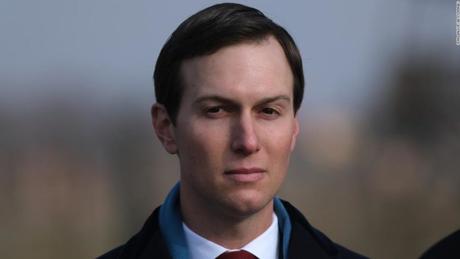
Kushner's comments reflect Trump's burning desire to restore the economy that was shut down to stop the march of a pandemic, he said, would not be a problem in the United States.
The President is increasingly concerned that what the President of the Federal Reserve, Jerome Powell predicts, is the worst economic data in American history will stifle his hopes of winning a second term. CNN's Jeremy Diamond reported that Trump broke out on Friday night against his campaign manager, Brad Parscale, according to three sources familiar with the explosion.


"The goal here is to get people back to work," Kushner, who, like his stepfather, a wealthy real estate investor, said on Wednesday morning.
But Kushner's hairless predictions also ignore complications that cloud the medical battle against the coronavirus - in the absence of proven treatments and a vaccine. They also oversimplify the enormous economic uncertainties inherent in the unprecedented task of reigniting an economy - which will depend to a large extent on the confidence of a wary public. And while millions of Americans are desperate to return to work, Kushner's dismissal - or the risks - seems to reflect disdain for workers who will pay the price if all goes wrong.
In the years to come, public health and policy experts will wonder if the massive closings have been necessary and have saved enough lives to justify the heavy economic toll.
But at the moment, the country is at the dawn of a considerable gamble without the certainty of what will happen next in the fight against a highly infectious virus.
Half of the states are moving forward

In many cases, those most at risk if state openings turn out to be premature are not CEOs, governors or a prominent member of the Trump Empire taken to work by the Secret Service in armored SUVs .
These are lower-paid workers, minorities and manual workers, who cannot connect to a laptop eight hours a day in their living rooms and are therefore exposed when they return to work.
Many states appear to have concluded that they could bear the costs, in terms of increased deaths and infections, that could result from their determination to bring life back to normal. It will take two to three weeks to see that the bet will go wrong given the incubation period of the coronavirus.
If medical experts prove too cautious and the virus can be kept at bay without a heavy human toll, leaders who advocate early opening plans will be eligible for credit.
Their case could in the long term be helped by the discovery of therapy for Covid-19. There was a silver lining on Wednesday when administration health expert Dr. Anthony Fauci said a trial had suggested that a drug, remdesivir, could shorten the course of the disease in patients with Covid-19 and reduce mortality.
Effective treatment without mass-produced side effects could significantly reduce the risk of openings and decrease the severity of any new peak of infection.
But for now, the evidence from other countries - like Singapore and Germany, who controlled the virus more than the United States - is that even careful openings can cause an increase in infections.
An administration which, in tax reform and the assault on the regulatory state, has long sided with companies, seems to have made its choice that economic collapse - which is cataclysmic - means that it is time to liberate the 'economy.
On Tuesday, for example, Trump forced the country's meat factories to remain open, declaring them an essential part of the country's infrastructure. He acted despite warnings from industry workers, who are disproportionately Hispanic and African American, that they are in grave danger of life-threatening illness.
"The eternal locking crowd can make jokes on TV, but the reality is that the data is on our side and President Trump has created a pathway to safely reopen our country," Kushner told Fox.
In fact, the data suggests just the opposite.
It does not seem that a State respects the vague and advisory directives of the White House calling for a "descending trajectory of documented cases within 14 days" before any opening.
But several states either relax the lock requirements or allow them to expire. Many governors in the south seem to want to politically please Trump and appease the conservative media machine - despite their ever-increasing or high infection rates.
Opening picks up speed

Texas plans to return online Friday at a slower pace, with restaurants operating at 25% capacity, for example. Florida Governor Ron DeSantis, a Republican, said his state would take "safe and smart" steps to open starting May 4. The largest counties in the state, Miami Dade, Broward and Palm Beach will not be included at this time.
Home orders to smooth the infection curve in hard-hit areas like New York, Washington, DC, the metropolitan area and California will remain largely in place.
The fear of public health experts is that some of the states that are opening up have not yet reached the peak of infections. They are concerned that the lack of a full tracing operation, despite the administration's exaggerated demands for its testing program, will make it difficult to detect new infections until it is too late to stop localized epidemics.
In Georgia, which angered even Trump with his aggressive opening, deaths could almost double by August due to the relaxation of restrictions, according to a model shared by the United States Centers for Disease Control and Prevention.
A coalition of public health and medical associations on Wednesday called on the administration to put in place strict precautions before states soften local shelter orders.
They called for << des capacités de dépistage à grande échelle, de recherche des contacts, de gestion des patients et des personnels de santé et de santé publique et des fournitures médicales nécessaires à ces activités essentielles >>, as well as new protections for health workers and the capacities of the hospital system.
But there is no evidence that Trump, who has made weeks of misleading claims about the feats of the federal government's test plan, takes all of this particularly seriously.
"I don't know if all this is even necessary," said the president in the middle of a week in which the White House made its senior public health officials much less visible.
"You have governors who like tests, you have others who like to do it in a different way, the old way with tests," said the president.
Vice President Mike Pence got the impression that the White House is not fully at ease with continued social distancing when he did not wear a mask when he visited the hospital on Tuesday.
And Trump showed disdain for long-term precautions when he said he didn't like the idea of Major League Baseball playing its season at kidnapped Arizona venues without fans.
"I would love to see the Yankees play at the Yankee Stadium," said Trump. "I think they would be able to play at Yankee Stadium with obviously smaller crowds, then the crowds would start to build up as things got a little better."
A suspicious public

There are many signs that most Americans are much less sure than some of their political leaders that it is safe to resume a normal life.
A recent NPR / PBS NewsHour / Marist College survey found that the majority of Americans believe that it is a bad idea to return to daily life without having further coronavirus tests.
85% say it is a bad idea for students to return to school without further tests, including 94% of Democrats, 89% of independents and 71% of Republicans.
And 80% of respondents say it's a bad idea to open restaurants for people to eat there, including 63% of Republicans, 82% of independents and 92% of Democrats.
In Georgia, which started to open at the end of last week, business has been scarce in many restaurants and businesses trying to revive their customers. It is also unclear whether the restaurant industry - often characterized by fairly thin profit margins can make ends meet with reduced capacity.
Even in the meat packing factories that Trump helped keep open by relieving owners of responsibility for workers' illnesses, the disruption of staff seems certain.
"It's terrible," said a worker at a processing plant in Omar Jimenez, CNN, Wisconsin, said on Wednesday. "We all have families we have to think about. Of course, I'm afraid to come back, we see positive things every day."