


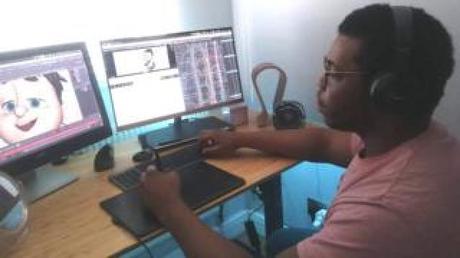
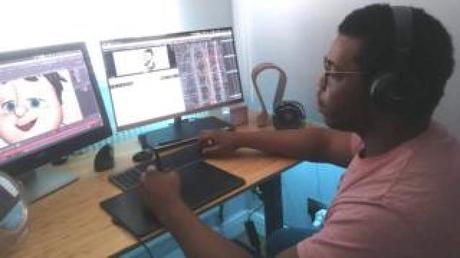
Ere Santos recalls that once he had to animate a fight between his character, the partner and the hero of the film.
The companion lands on the hero's head and the scene stops. Fortunately, the hero's animator was seated next to Mr Santos.
Just like their creations, the two colleagues went to fight over how the interaction should work.
Instead of drawing, these feature film animators create physics-based computer simulations.
Santos compares it to creating a puppet that the computer will bring to life.
Problems result if the build is even inaccurate, because the puppets will travel through their world like a ghost rather than a real being.
"You can have a hand that goes across a table or through another hand if they clap," says Santos.
Eventually, he and his neighbor smoothed out their characters' skirmish.
Huge data files were shared with each other three or four times a day, but it was essential to be able to look behind the colleague and check his computer screen.
Now Mr Santos is working on another film, but this time alone, from his London apartment.
The comic was divided by scene rather than character and distributed to around 100 illustrators working together on the Jellyfish Pictures animated film.
So the animated characters drawn during the block will touch each other less?
Mr. Santos jokes: "I hope so. I mean, every time characters that don't touch each other in the animation are fantastic. The characters that interact with each other - yes. It's just a world like 'Oh no.'"
However, the team still maintained the connection despite the physical separation.
Always in touch, they take notes from their Jellyfish directors and their Los Angeles-based film studio DreamWorks.
"It's an interesting challenge that no one has ever had to make a movie out of the office. So it's really cool and exciting, but also terrifying because you don't want to mess around," says Santos.
The interaction between Santos, his colleagues and the film studio is made possible by cloud computing. That's where a company decides not to process and store all its data in its offices. Instead, he hires another company to store the data, which he can access on the Internet.
Technology has existed for almost 10 years.
But since Covid-19 blocked the world, a wave of new companies have hurried to adopt cloud computing.
And within cloud computing, a micro-industry has flourished, known as corporate infrastructure.
More business technology
The corporate infrastructure is the link between home and cloud: a secure connection that the company can design, manage and in some cases monitor.
Sometimes this is done through software that signs a user on their work network.
In other cases, there is a real hardware box to be connected to the home router. A laptop, tablet or work phone can pick up the Wi-Fi signal and authenticate the user.
These boxes can also prioritize the speed of Wi-Fi when parents are on business calls and children play on the game console or watch streaming movies.
The products, which have been used as part of the disaster recovery protocols over the past 10 years, have seen sales explode since the crashes began.
A recent research note from Goldman Sachs estimates that this sector, which is now worth just under a billion dollars (£ 790 million), could reach a value of $ 9 billion (£ 7.1 billion) in the next five years.
Most also offer IT support.
From his apartment in Ealing, London, Santos begins his normal working day by logging into software, called Teradici, a cloud-based virtual workstation.
As if it were in the office, the Jellyfish Pictures file network opens and can start animating immediately.
But unlike most remote workers who get by on Google Docs, Mr Santos will open a file consisting of layers and animation layers.
These files are ultimately stored on Microsoft Azure, a cloud storage provider, and backed up in a physical Hayes data center.
As if they were characters, the movement of light, props and sets have a life of their own, which occupies hundreds of gigabytes. Normally they would require enormous computing power to charge remotely.
The software with which Mr. Santos works does not actually send him all the pixels of the image he sees on his computer screen.
Over 500 megapixels per second are "remoted" on his monitor with perfect color accuracy. (A megapixel is a million pixels.) However, they are provided as smaller and simpler versions of themselves, somewhat like a streaming movie on Netflix.
This allows multiple people to work simultaneously in each scene, upload and update it while they animate. Each pixel is compressed and encrypted, to keep the film secret and safe while the animators create their work.
Ziad Lammam, of the Canadian company Teradici, says that his company, like other cloud software providers, has seen a boom in business since the blockade began.
"Finding us at home - it was a real turning point," he says.
Lammam says it was a "journey" to see some film studio executives use cloud computing and trust it to work.
Outsourcing any business and allowing third-party companies to manage security and data management carries the risk that some manufacturers were initially slow to adopt.
But experts say that on-site IT is even more vulnerable than data managed in the cloud.
Lammam says that since the beginning of the pandemic, many companies have changed their attitude towards cloud computing.
"A lot of people said, 'Wow, yes, you really saved my bacon," he says.
His customers think differently now, says Lammam.
"It really pushed everyone to jump into that pool, use technology and decide that this isn't just something we can do during a pandemic, but it's something we can do in the long run."
Aran, director of intelligent spaces in Aruba, based in the United States, says: "We had our watershed moment in the workplace and I think there will be some really significant changes that will come to the pike with your work from home."
Aruba, present in various iterations since 2008, is now a Wi-Fi enabled box that connects to a router and opens the office network.
Most of its customers had purchased Aruba as an emergency measure, Ni says, but since the blockade began, business has grown.
Due to its high levels of encryption, Ni claims it is a favorite of finance and insurance companies.
Chris Stori, senior vice president of the American company Meraki, another corporate infrastructure box that connects to the home router, says, "When Covid hit, we saw an unprecedented demand for our products beyond what we had ever planned." .
During the night Meraki set up remote connections for 1,000 call center representatives, with all the apps they needed along with the security credentials required by the bank.
As for the jellyfish animator Ere Santos, he also loves his cloud set-up, especially now that he can work from his newly purchased standing desk at home.
He even installed voice-activated colored lights to decorate his workplace.
Keeping his job on the cloud makes Mr. Santos more comfortable than if his computer crashes, his job won't be lost.
"I can get any computer at any time. And then all I have to do is click on the server again and all my stuff is still there," he says.






