


In this article, we outline why stalled IT projects happen and what leaders can do to recover momentum without starting over. We focus on practical IT project recovery steps — including resetting intent, decision ownership, scope sequencing, capacity planning, and stakeholder alignment — so delivery teams can move forward with clarity and confidence.
Most IT leaders have experienced it at some point. A project that started with clear goals and strong momentum begins to slow down. Timelines slip. Decisions take longer. Teams become frustrated. Progress happens in small bursts, followed by long stretches of uncertainty.
What makes stalled projects particularly challenging is that they rarely fail outright. Instead, they linger — consuming time, energy, and attention without delivering the outcomes originally envisioned.
In our experience, stalled IT initiatives are not usually the result of poor technology choices. More often, they reflect misalignment, unclear ownership, or competing priorities that were never fully resolved. The good news is that many stalled projects can be recovered without starting over — if leaders are willing to pause, reassess, and make a few deliberate changes.
Recognizing the Early Signs of a Stall
Projects rarely stall overnight. There are usually early indicators that momentum is fading, even if progress still appears to be happening on paper.
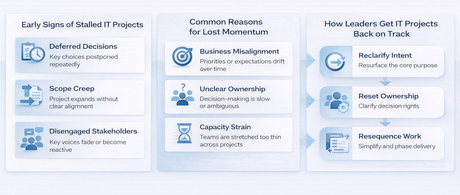
We often see warning signs such as decisions being deferred repeatedly, meetings becoming status updates rather than problem-solving forums, or teams quietly working around unresolved issues. In some cases, scope expands while accountability becomes less clear. In others, key stakeholders disengage, assuming the project is “under control.”
These signals don’t always mean a project is failing — but they do suggest it may be drifting. Recognizing this early creates an opportunity to intervene before frustration sets in or trust erodes.
Why Projects Lose Momentum
When IT initiatives stall, it’s tempting to look for a single root cause. In reality, stalls usually result from a combination of factors that reinforce one another.
One of the most common is misalignment between business expectations and delivery realities. Projects may be approved with ambitious timelines or broad objectives, but without sufficient clarity on priorities, tradeoffs, or constraints. As new demands emerge, teams are asked to absorb additional scope without adjusting timelines or resources.
Another frequent contributor is unclear ownership. When accountability is shared too broadly — or assumed rather than defined — decisions slow down. Teams hesitate to move forward without direction, while stakeholders assume someone else is responsible for resolving issues.
Capacity constraints also play a role. Many projects stall not because teams lack capability, but because the same individuals are supporting operations, responding to incidents, and driving multiple initiatives simultaneously. Over time, progress becomes fragmented and reactive.
Finally, governance can unintentionally become a bottleneck. Well-intentioned oversight structures sometimes add layers of approval that delay decisions, particularly when roles and escalation paths aren’t clearly defined.
<img loading="lazy" decoding="async" data-skip-lazy="" src="https://www.litcom.ca/wp-content/uploads/2026/01/IT-project-momentum-and-recovery-strategies.png" alt="When IT Projects Stall: How to Get Back on Track" width="1536" height="1024" class="alignnone size-full wp-image-21170" srcset="https://www.litcom.ca/wp-content/uploads/2026/01/IT-project-momentum-and-recovery-strategies.png 1536w, https://www.litcom.ca/wp-content/uploads/2026/01/IT-project-momentum-and-recovery-strategies-300x200.png 300w, https://www.litcom.ca/wp-content/uploads/2026/01/IT-project-momentum-and-recovery-strategies-1024x683.png 1024w, https://www.litcom.ca/wp-content/uploads/2026/01/IT-project-momentum-and-recovery-strategies-768x512.png 768w, https://www.litcom.ca/wp-content/uploads/2026/01/IT-project-momentum-and-recovery-strategies-500x333.png 500w, https://www.litcom.ca/wp-content/uploads/2026/01/IT-project-momentum-and-recovery-strategies-800x533.png 800w, https://www.litcom.ca/wp-content/uploads/2026/01/IT-project-momentum-and-recovery-strategies-1280x853.png 1280w" sizes="auto, (max-width: 1536px) 100vw, 1536px" />
Pausing Without Losing Credibility
One of the hardest steps for leaders is acknowledging that a project has stalled. There’s often concern that pausing will be seen as failure or loss of control.
In practice, a short, intentional pause can strengthen credibility rather than weaken it. Leaders who are willing to say, “We need to reassess before moving forward,” signal accountability and realism.
The key is to frame the pause around clarity and outcomes, not blame. This means focusing on what has changed since the project began, what assumptions may no longer hold, and what needs to be realigned to move forward effectively.
<noscript data-mce-fragment="1"><img loading="lazy" decoding="async" data-skip-lazy="" src="https://www.litcom.ca/wp-content/uploads/2026/01/How-IT-projects-get-back-on-track-1.png" alt="How IT projects get back on track" width="1536" height="471" class="alignnone size-full wp-image-21175" srcset="https://www.litcom.ca/wp-content/uploads/2026/01/How-IT-projects-get-back-on-track-1.png 1536w, https://www.litcom.ca/wp-content/uploads/2026/01/How-IT-projects-get-back-on-track-1-300x92.png 300w, https://www.litcom.ca/wp-content/uploads/2026/01/How-IT-projects-get-back-on-track-1-1024x314.png 1024w, https://www.litcom.ca/wp-content/uploads/2026/01/How-IT-projects-get-back-on-track-1-768x236.png 768w, https://www.litcom.ca/wp-content/uploads/2026/01/How-IT-projects-get-back-on-track-1-500x153.png 500w, https://www.litcom.ca/wp-content/uploads/2026/01/How-IT-projects-get-back-on-track-1-800x245.png 800w, https://www.litcom.ca/wp-content/uploads/2026/01/How-IT-projects-get-back-on-track-1-1280x393.png 1280w" sizes="auto, (max-width: 1536px) 100vw, 1536px" />
Reclarifying the Original Intent
When projects stall, returning to the original intent is often more valuable than revisiting detailed plans.
We encourage leaders to ask simple but powerful questions:
- What problem was this initiative meant to solve?
- What outcome actually matters most to the business?
- Has that outcome changed?
Over time, projects can accumulate additional objectives that dilute focus. By restating the core purpose, teams can distinguish between what is essential and what can be deferred or removed altogether.
This step alone often creates immediate momentum, as it gives teams permission to simplify and refocus.
Resetting Ownership and Decision Rights
Stalled projects frequently suffer from ambiguity around who owns key decisions. Clarifying ownership doesn’t require restructuring the entire governance model — but it does require being explicit.
We often see progress resume once:
- a single accountable owner is named
- decision-making authority is clarified
- escalation paths are agreed upon
- stakeholders understand when their input is required versus optional
This clarity reduces hesitation and helps teams move forward without waiting for perfect consensus.
Reassessing Scope and Sequencing
When momentum slows, it’s worth reassessing not just what the project includes, but how work is sequenced.
Many stalled initiatives attempt to deliver too much at once. Breaking work into smaller, meaningful phases allows teams to regain traction and demonstrate progress. It also reduces risk, as assumptions can be tested earlier rather than later.
We’re seeing more leaders succeed by explicitly deciding what won’t be addressed in the current phase — a choice that often feels uncomfortable, but creates space for delivery.
Addressing Capacity Constraints Honestly
Capacity challenges are often acknowledged informally but rarely addressed directly. When teams are stretched thin, projects slow down — not because of lack of effort, but because attention is constantly divided.
Leaders who take time to assess where effort is actually going can make more informed decisions about resourcing. This might involve:
- reprioritizing operational work
- pausing lower-impact initiatives
- supplementing teams with targeted external support
- adjusting timelines to reflect reality
Honest conversations about capacity build trust and reduce burnout, which in turn supports better delivery.
Reengaging Stakeholders with Purpose
As projects stall, stakeholder engagement often becomes inconsistent. Some disengage entirely, while others become more reactive, surfacing concerns only when issues escalate.
Reengagement works best when it’s purposeful rather than performative. This means focusing discussions on decisions that need to be made, risks that need to be addressed, and outcomes that matter — rather than providing exhaustive status updates.
We’ve seen stalled projects regain momentum simply by shifting the tone and structure of stakeholder conversations.
Creating Momentum Through Small Wins
Large initiatives can feel overwhelming once momentum is lost. Identifying achievable short-term wins can help rebuild confidence and demonstrate progress.
These wins don’t need to be transformational. They need to be visible, meaningful, and aligned with the project’s core purpose. Small successes often restore energy and trust — both within teams and with stakeholders.
Knowing When to Redefine Success
In some cases, getting a project “back on track” means redefining what success looks like. Circumstances change. Business priorities evolve. Technology landscapes shift.
Leaders who are willing to adjust success criteria — rather than rigidly pursuing outdated goals — are better positioned to deliver value, even if the end result looks different than originally planned.
This flexibility is not a failure of planning; it’s a reflection of adaptive leadership.
Litcom’s Perspective
Across our work with organizations, we see stalled IT projects as moments of opportunity rather than indicators of failure. Most initiatives don’t need to be restarted — they need to be realigned.
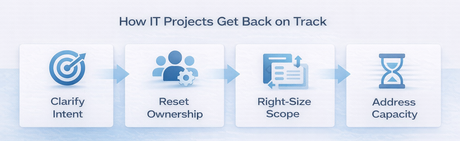
The projects that recover most successfully are those where leaders are willing to pause, clarify intent, reset ownership, and address capacity honestly. Small, deliberate changes often restore momentum more effectively than sweeping restructures or new technology choices.
Getting back on track isn’t about moving faster — it’s about moving forward with clarity.
If you’re navigating a project that’s lost momentum, taking a step back to reassess can be the most productive step forward.





